The most famous carpet in the Yildiz Palace in Istanbul covers 406 square meters.[1] It is said to weigh about four tons.[1] It was too large to carry through a door, and accounts say part of an outer wall was taken down to bring it in.[1] It was woven at Hereke, a small town on the Gulf of Izmit, in the palace factory that made the town’s name famous.
This guide covers how the Hereke factory began, what makes a Hereke carpet, the named designs, where the carpets went, and what the name means when you meet it today.

A palace factory on the Gulf of Izmit
The factory, known as the Fabrika-i Humayun, was set up at Hereke in 1843, on the north shore of the Gulf of Izmit.[2] It began under Sultan Abdulmecid with 50 cotton looms and 25 looms for a silk cloth called canfes.[1] Its purpose was to supply the palaces with upholstery cloth and carpets.[3] It started as a private venture and was presented to the sultan, then registered in his name as an official palace factory.[3] Silk upholstery cloth is still woven there on traditional jacquard looms.[3]
Carpets came later. About fifty years after the factory opened, carpet weaving began there on a hundred new looms.[2] The factory opened its own shop in Istanbul’s Grand Bazaar to sell what it made beyond the palace’s needs, and it also wove to order.[1] A branch, the Hereke Weaving House, was opened in the garden of the Dolmabahce Palace, and carpets were woven there until the last years of the empire.[1]
The factory passed through many hands in the Republic. It joined the state textile company Sumerbank in 1933.[1] In 1995 it moved to the department of National Palaces of the Turkish parliament.[1] During the First World War its staff fell to 40, but work picked up again after the war.[1] By 1939 it employed 200 workers.[1] Today it works as a museum and factory, weaving carpets to special order.[1]
What makes a Hereke carpet
It starts with the knot count. A Hereke silk carpet carries about 1,000,000 knots per square meter, and a wool one about 360,000.[1] The factory’s own figures give the silk carpet 100 by 100 knots per decimeter and the wool carpet 60 by 60.[1] Both are tied with the Turkish knot, also called the Gordes knot.[1]

That density is what lets a Hereke carpet draw like a painting. Demirarslan explains that more knots per square decimeter let weavers render curving motifs easily, so flowers could be carried onto the carpet like a picture.[1] In recent years, 15 master weavers made a 52 square meter carpet in the Yayla Flower design, the largest single carpet woven at the factory in the Republican era.[1] The finest carpet in the world, with 1,024 knots in a single square centimeter, is a Hereke carpet.[1]
The Turkish Patent and Trademark Office protects the name in three categories: Hereke silk carpet, Hereke wool and silk carpet, and Hereke wool carpet.[3]

Named designs

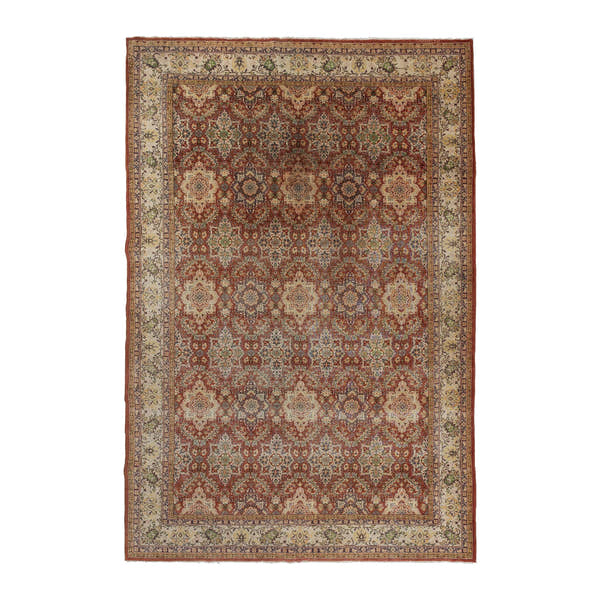
Hereke designs have names. Among them are the Flower of the Seven Hills, the Thousand and One Flowers, the Plum Branch, the Tulip with Vine, the Wildflower, the Sultanahmet, the Polonez and the Caucasus.[1] The Flower of the Seven Hills is the most widely used.[1] It stands for Istanbul, the city built on seven hills.[1] Some carry meanings from Sufi thought: a dragon design stands for the ego, a peacock design for the soul.[1] The tulip stands for love and peace.[1]
Prayer rugs have their own set of designs, among them the Tree of Life, the Pomegranate, the Nightingale’s Eye, the Phoenix and the Tiled Garden.[1] Floor carpets more often use the Flower of the Seven Hills, the Plum Branch, the Tulip Garden and the Caucasus.[1] Half-symmetrical layouts are used for small carpets and prayer rugs.[1]
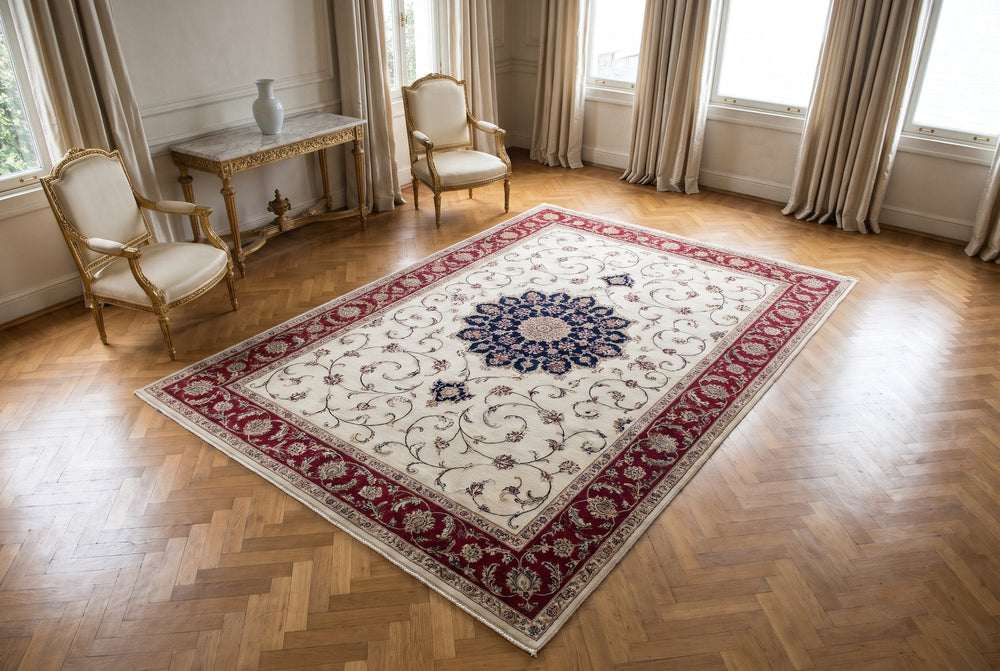
Tile art shaped the designs too. Designers of Ottoman tiles were put to work on palace carpets.[1] They brought the stylized blossoms and split-leaf scrolls of tile work, called hatayi and rumi, into the borders.[1] Layouts fall into seven main groups, from medallion and prayer niche designs to repeating, allover and geometric ones.[1]
Carpets made for a room

Most of the carpets in the Yildiz and Dolmabahce palaces are Hereke carpets.[1] Their most important feature is that they were made to fit the size of the hall they were meant for.[1] Their designs came mostly from the palace painter Emil Meinz, and some from Sultan Abdulhamid II himself.[1] The great Yildiz carpet has three medallions, placed to line up with the chandeliers that hang from the ceiling above.[1]
What the name means today
Hereke is now a name for a standard as much as a place. Demirarslan notes that carpets in the Hereke manner are woven in workshops not only in Hereke but in Canakkale, Karabuk, Diyarbakir, Kars, Erzurum, Siirt, Bingol and Malatya.[1] So a carpet sold as Hereke may describe its quality and style rather than the town where it was knotted. If the place matters to you, ask where a piece was woven and look for the knot count, the material of the pile, and whether it is silk, wool or both.
The registered figures give a useful yardstick: a silk carpet near 100 by 100 knots per decimeter and a wool one near 60 by 60. A piece far below those counts may be in the Hereke style without being of registered Hereke quality.
Where to go next
For the village and workshop rugs of the rest of Turkey, read the ultimate guide to Turkish rugs. The Sivas rugs guide covers another registered workshop carpet, and the Konya rugs guide goes back to the Seljuk carpets where Turkish rug history starts. You can browse all Turkish rugs.
If you like a medallion with fine floral drawing, this Kayseri rug has a navy medallion on a cream field among dusty rose cartouches and flowering vines.
For a village wool rug rather than palace silk, see this Kars rug with a cream and gray medallion on a burgundy field. Neither rug is a Hereke.

Sources
- Ic Mekanda Kullanim ve Teknik Ozellikler Acisindan Hereke Halisi (Technical and Interior Use Properties of Hereke Carpet). Deniz Demirarslan, SDU ART-E, 2020.
- Cumhurbaskanligi Osmanli Arsivi’nde Hereke Ipek Halilariyla Alakali Bazi Belgeler (Ottoman Archive Documents on Hereke Silk Carpets). Ahmet Aytac, Aris, 2022.
- Hereke Hali ve Ipekli Dokuma Fabrikasi (Hereke Carpet and Silk Weaving Factory). KURE Ansiklopedi, 2025.