Siirt Kilims: Dark Flat Weaves from Southeastern Turkey
Siirt is a city in the far southeast of Turkey, in hill country above the Tigris, where the provinces of Batman, Bitlis, Van and Sirnak meet. Its weavers are best known for a single, unusual cloth: the Siirt blanket, a shaggy flat weave made from the hair of goats. The two flat weaves we carry come from the same quiet, dark palette.
This guide covers the weaving of Siirt, how its famous blankets are made, the dark kilims of the eastern provinces, how to read our two pieces, and how to use and care for a flat weave.

The Siirt blanket
The cloth that carries the city’s name is the Siirt battaniye, or blanket. A study by Mine Besen Yalcin and Gunay Atalayer explains that it is named after the region where it is made and the way it is used, and that it is known to have been produced in and around Siirt since ancient times.[1] It is woven from tiftik, the long, glossy hair of the Angora goat.
Its making is unusual. The authors write that in the Siirt blanket the pattern is made with the weft yarn, as in a kilim.[1] After weaving, one surface is raised into a soft pile by combing it with a wooden comb, and then combed again in different directions to bring out the design.[1] The result is a flat weave with a deep, furry face.
The goat behind the cloth
Goats have been part of life in this corner of Anatolia for a very long time. The same study points to a goat carved on the walls of the tenth century Akdamar church on Lake Van as an early picture of the animal in the region.[1] Its hair is valued for good reasons: the authors describe it as strong, fine, water-resistant and slow to conduct heat.[1] Those are exactly the qualities you want in a blanket for cold mountain winters, and they explain why the craft lasted so long in Siirt.
Colors straight from the animal
The palette of Siirt weaving is mostly undyed. The study notes that the colors called white, black, brown, tan and yellow are the natural color of the fiber itself.[1] A blanket woven in black hair, it adds, takes its color straight from the animal.[1]
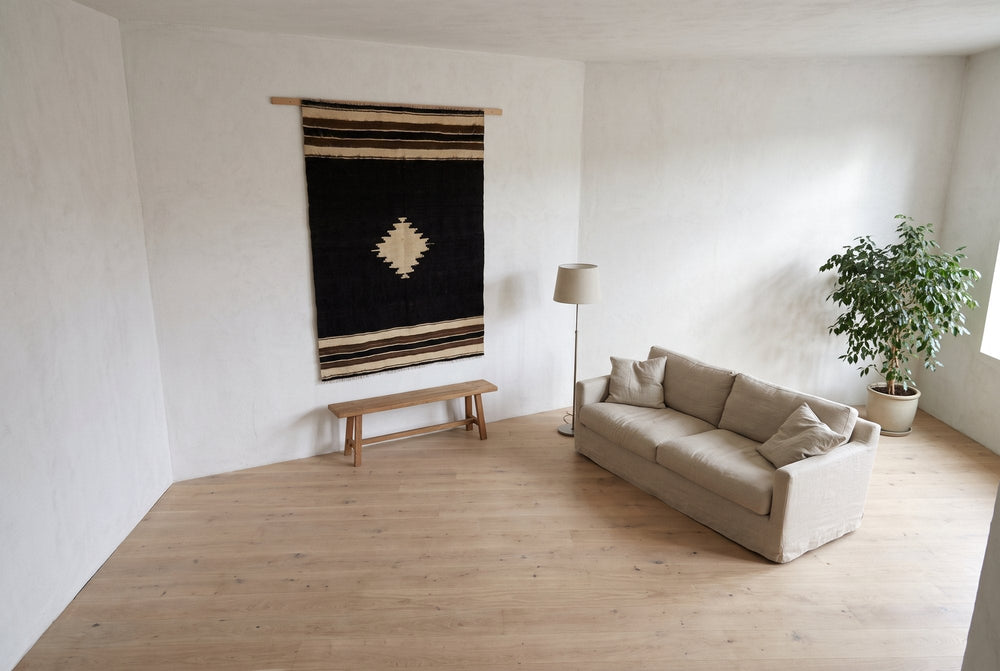
That is the palette of our two pieces: near-black, dark brown, cream, ivory and charcoal, with no bright dye at all. Natural dark fibers rarely match from one batch to the next, so you will see soft brown shading drift across a black field, which is part of the charm.

The dark kilims of the east
Siirt sits among the weaving provinces of eastern Anatolia, where tribal kilims are dark and strong. Mine Taylan, writing about the kilims of neighboring Van and Hakkari, describes them as tribal kilims with dark colors and dense patterns.[2] She adds that they are also woven in neighboring regions, wherever the tribes live.[2]
Our two pieces take the dark ground of that tradition and strip the pattern back to almost nothing. Each has a single light figure in the middle and bands of stripes at the ends, with no border along the sides. The effect is closer to a modern painting than to the busy kilims most people picture.
How a flat weave is made
A kilim has no knotted pile. Walter Hawley described kilims in 1913 as pieces without pile that consist only of warp and weft.[3] The colored weft is packed down over the warp to build the design, which is why the cream diamond on our first piece rises in steps rather than smooth lines. The second piece is flat-woven too, but long fibers give its surface a soft, shaggy look, a little like the brushed face of a Siirt blanket.
Sizes, prices and age
Our two Siirt pieces are about 4⅓ by 6 feet at $710 and about 4¼ by 5¾ feet at $775. Both are flat-woven wool, listed at about 40 to 60 years old, and each listing gives the exact size in feet and centimeters. At this size a flat weave is easy to lift, shake out and move from room to room, and it rolls up small if you want to put it away for a season.
Living with a dark flat weave
A dark kilim with one pale figure suits a light room with white walls and pale wood, where the contrast does the work. Lay one beside a bed, under a small desk or in front of a reading chair, or hang it, where the single panel reads like a picture. On a smooth floor, use a thin pad so it does not slide.
The Canadian Conservation Institute recommends gentle vacuuming with a standard head and low suction, never a power head.[4] For long fibers, it advises always vacuuming in the direction of the pile.[4] Keep it out of strong sun, since light can dry out the fibers and cause colors to fade.[4]
Where to go next
See both pieces in the Siirt collection, or browse all of our Turkish rugs. For the kilims of the neighboring east, read our Van kilims guide, and for flat weaves from across Turkey, see our kilim rugs.


Sources
- Tiftigin Geleneksel Oykusu ve Yaratici Yeni Denemeler Uzerine (The traditional story of mohair and new creative trials). Mine Besen Yalcin and Gunay Atalayer, Aris journal of carpet and weaving arts.
- A New Design in Van-Hakkari Kilims: Tribal Conflict. Mine Taylan, Motif Akademi Halkbilimi Dergisi, vol. 13, no. 30, 2020.
- Oriental Rugs, Antique and Modern. Walter A. Hawley, Project Gutenberg, 1913.
- Basic care: Carpets and rugs. Canadian Conservation Institute.