Taspinar Rugs: Village Carpets from the Hills of Aksaray
Taspinar is a small town in the hills southeast of Aksaray, in central Turkey, and its rugs are the best known of the whole Aksaray district. They are thick, boldly drawn village rugs, usually built around a long stepped medallion, in deep reds, navies and clear secondary colors.
We carry four Taspinar rugs, from a small rug of about 3 by 6 feet to a room-size piece of about 6 by 9 feet. This guide covers the long weaving history of Aksaray, what the records say about Taspinar, how its weavers work, how to read the four rugs we carry, and how to look after one.

Carpets from Aksaray
Aksaray has been a carpet town for a very long time. The geographer Guy Le Strange records that the town was built by the Seljuk sultan Kilij Arslan II in 1171.[1] In the fourteenth century, he writes, its townspeople made excellent carpets from the wool of their sheep, and these carpets were largely exported to Syria, Egypt and Mesopotamia.[1]
That makes Aksaray one of the earliest named carpet towns of Anatolia. The tradition never quite stopped, and the villages in the hills around the town carried it into modern times.
What the records say about Taspinar
A study of Taspinar weaving by Serdar Ceylan, Fatma Emiroglu Aydin and Ihsan Bulut traces the name back to an Ottoman provincial yearbook. The first written source in which the name Taspinar appears, they write, is the second Konya yearbook of 1869 to 1870, which counted the rugs woven at Taspinar among the best.[2] By the early 1900s, the same study notes, Aksaray had 32 carpet looms.[2]
Weaving is still alive there. The study describes a carpet workshop founded by the women of Taspinar, where looms are still at work and weaving is done by middle-aged women as an extra source of income.[2]

How Taspinar weavers work
Taspinar weavers have traditionally worked from memory and from sample rugs. The study explains that the women weave their patterns by heart or by looking at the motifs on sample rugs, and that the workshop holds eight such samples, the newest of them forty years old or more.[2] Those samples, it says, form the color and motif catalog of Taspinar rugs.[2]
Wool and plant dyes are at the heart of the tradition. The researchers note that the mountainous country and its rich plant life made natural dyes possible, above all madder root and buckthorn.[2] They also describe the classic Taspinar rug as all wool, in warp, weft and knots alike.[2] Our four are listed with a cotton foundation under a wool pile, so they belong to the wider production sold under the Taspinar name rather than to that strict all-wool workshop tradition.
Names by size and use
Taspinar weavers name their rugs by what they are for. The study lists the names: the taban for the floor, the cift somya for a divan, the minder and yastik for cushions, the namazlik for prayer, the heybe saddlebag and the saddle cover.[2] Our room-size rugs are floor pieces, and the smallest, about 3 by 6 feet, sits close to the prayer rug size.

Reading our Taspinar rugs
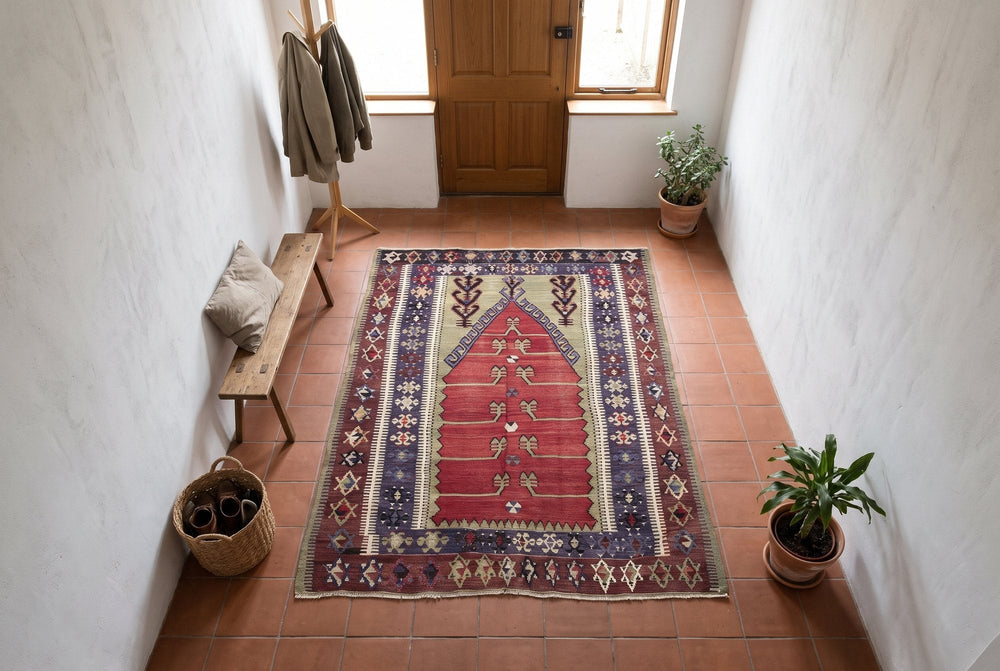
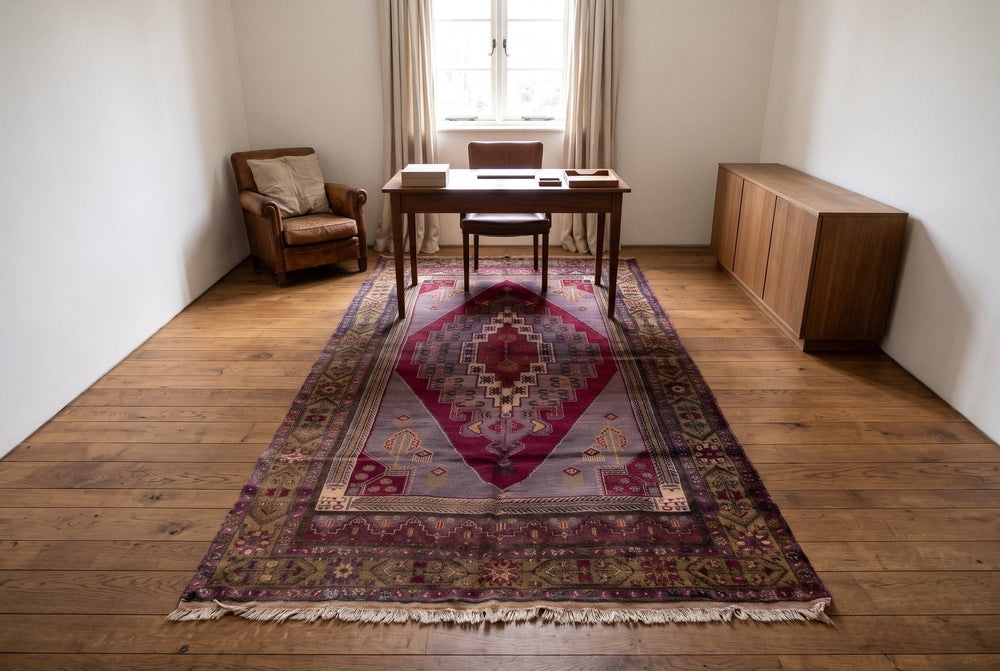
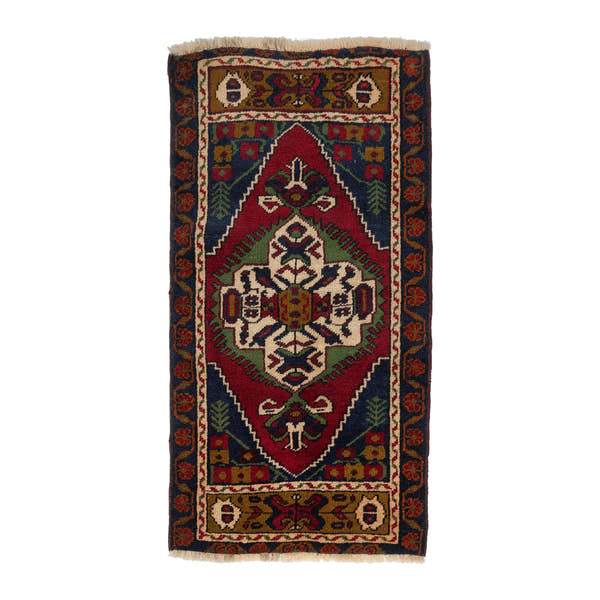
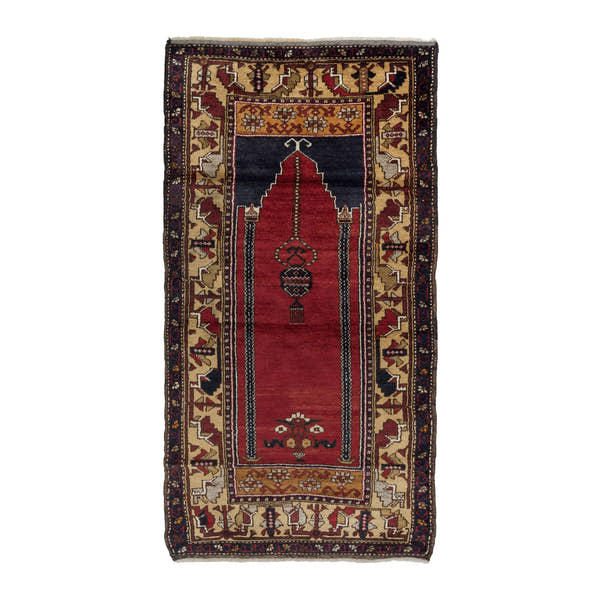
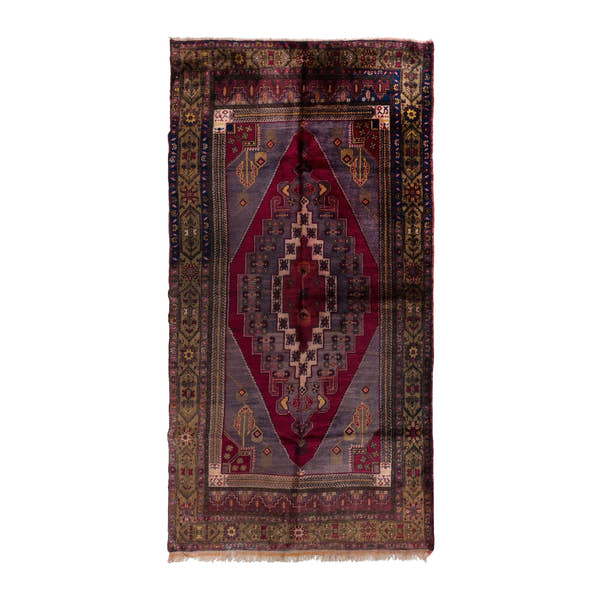
The long stepped medallion is the backbone of all four. On the largest, a red frame steps in and out like a staircase around a cream medallion of small flowers on a cool powder blue field. The long red one sets a cream stepped diamond in a red medallion with navy all around, and the lilac one puts a crimson diamond on a soft lilac ground with gold trees in the corners. The smallest stacks two gold medallions in a long red field with navy corners and a gold border of crosses.
Where they work best
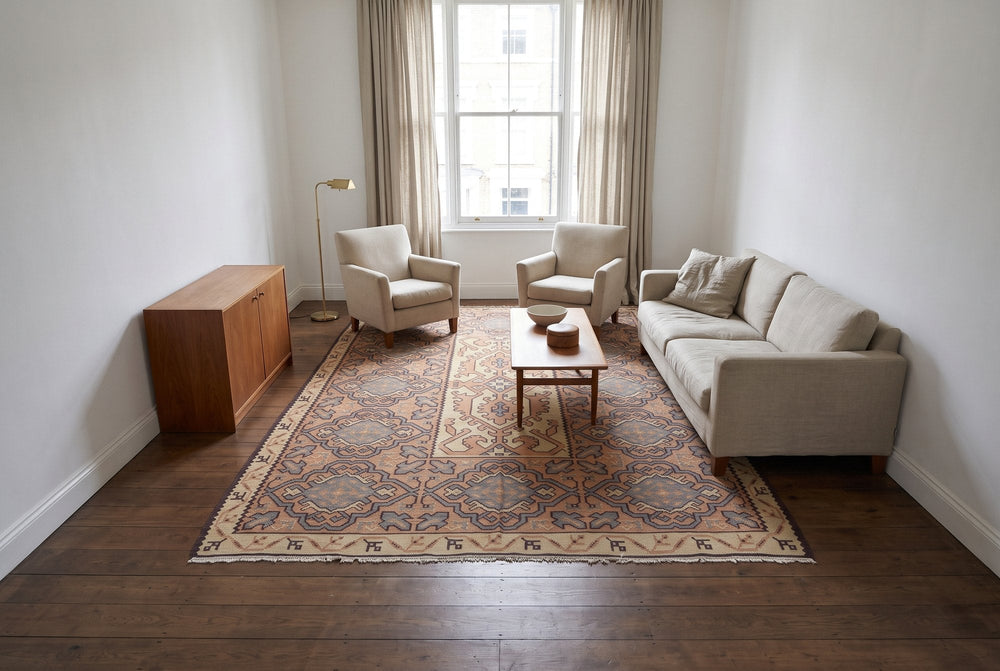
Bold medallions like these want a little space around them. The long rugs suit the side of a bed or a narrow living room, the powder blue one brightens a room with pale wood and white walls, and the small one makes a strong welcome inside a front door. Their clear reds, navies and golds also sit well with plain modern furniture, which lets the drawing do the talking.
Sizes, prices and care
Our Taspinar rugs run from about 3¼ by 6⅓ feet at $720 to about 6 by 9 feet at $1,440, with two long rugs of about 4¾ by 9¼ and 5 by 10 feet in between. All are hand-knotted wool on a cotton foundation and listed at about 50 years old, and each listing gives the exact size in feet and centimeters.
Two of them have a high, soft pile, which feels good underfoot in a bedroom. The Canadian Conservation Institute recommends regular vacuuming with a standard head and low suction, never a power head.[3] Turn the rug every so often so it wears evenly.[3] Blot spills gently instead of rubbing them in.[3]
Where to go next
Browse every piece in the Taspinar collection, the Aksaray rugs from the same area, or all of our Turkish rugs. For the neighboring province, read our Konya rugs guide.
Sources
- The Lands of the Eastern Caliphate. G. Le Strange, Cambridge University Press, via Internet Archive, 1905.
- Kulturel Bir Miras Olan Taspinar (Aksaray) El Dokuma Halilarinin Korunmasi ve Turistik Urun Olarak Surdurulebilirligi (Hand-woven Taspinar carpets as cultural heritage). Serdar Ceylan, Fatma Emiroglu Aydin and Ihsan Bulut, Uludag University Journal of Social Sciences, vol. 24, no. 44.
- Basic care: Carpets and rugs. Canadian Conservation Institute.