Van Kilims: Wool, Color and Meaning from Eastern Turkey
Van sits on the eastern shore of Lake Van, the great lake of eastern Turkey, ringed by high mountains and long winters. It is herding country, and Turkey’s culture ministry says that raising animals is what made wool weaving so widespread there.[1] Van kilims tend to be dark, dense and full of small motifs.
Every Van piece we carry is a flat-woven kilim. This guide covers how they were used, the names of the best-known types, and how to read the motifs.

Kilims for every use in the house
In Van a kilim was not only a floor cover. Families used them as floor spreads, cushions and pillows, storage bags, food sacks and even as cradles.[1] Both warp and weft are entirely wool.[1] Weavers dyed it with natural dyes and spun it themselves on a hand spindle.[1]
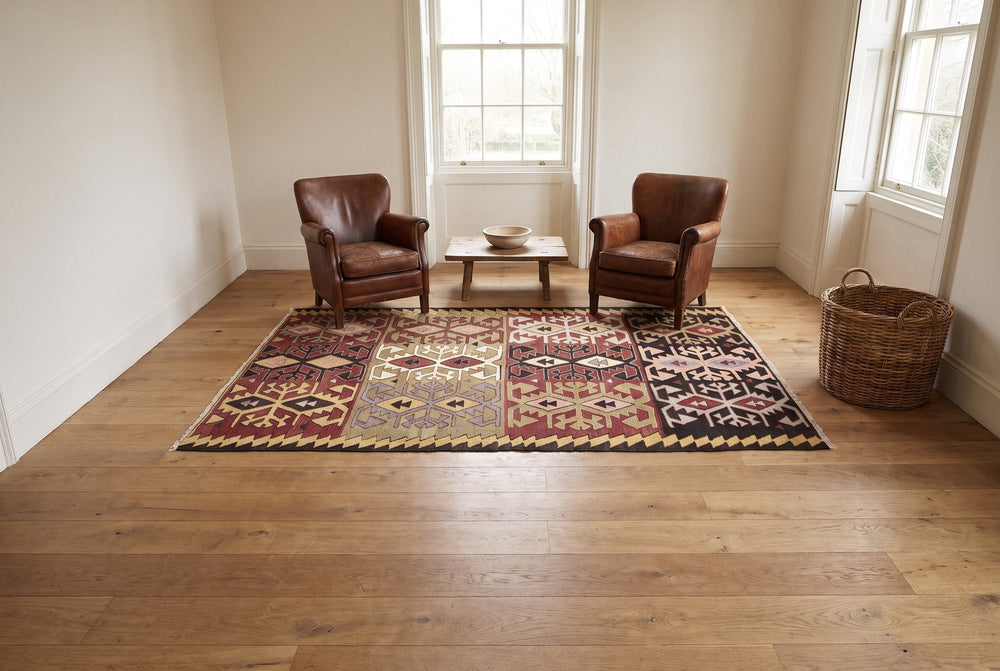
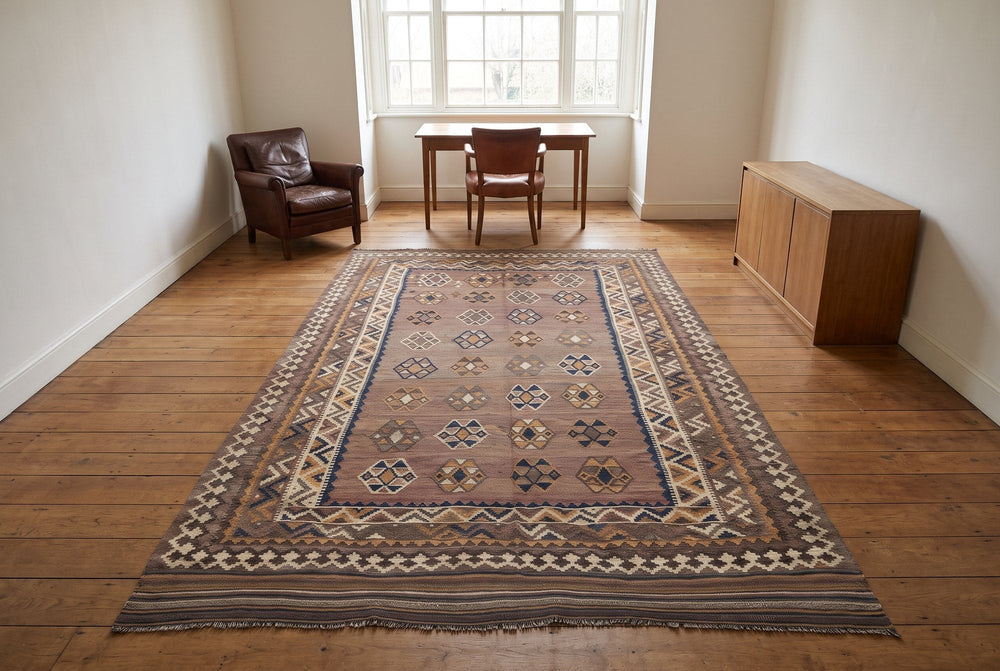
The palette is short and strong: navy, burgundy, the natural brown of undyed wool, and an off-white the region calls Van white.[1] Those colors run through the Van kilims we carry, from a near-black field around a deep red center to a soft chestnut set with cream, navy and gold.
Gulsarya, Nehrek and other named kilims
Van weavers give their kilims names. The ones seen most often, according to the provincial cultural inventory, are Gulsarya, Nehrek, Halit Begi, Sahneri and Luleper.[1] The Gulsarya, or rose of Sarya, is thought to take its name from the kilims of a woman called Sarya.[2] A study of these kilims found the hands-on-waist figure and the Sarya rose in every example.[2] It is the order of the motifs, the study notes, that gives each kilim its identity.[2]
The same study describes Gulsarya kilims woven in wool, mostly with natural dyes.[2] They come in many forms: floor, divan, runner, table and pillow kilims.[2]

Motifs that carry messages
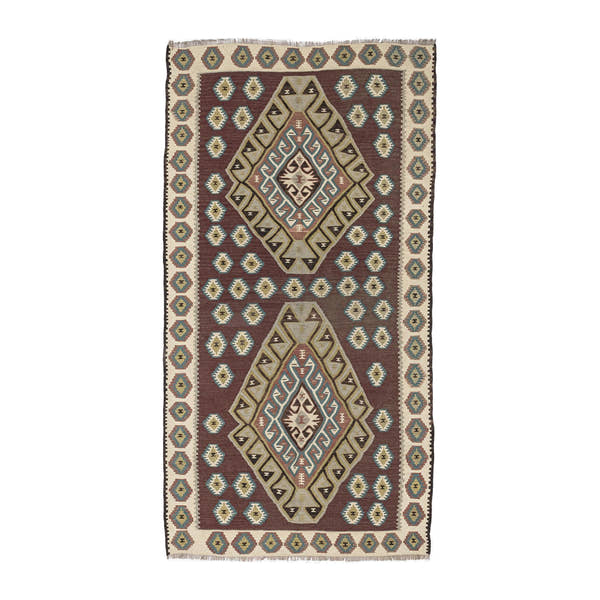
In Van, the provincial inventory says, what a kilim says matters even more than how it looks.[1] Women who could not read or write wove their feelings into the motifs: love they could not say aloud, sorrow and hope.[1] Among the motifs it lists are the wolf’s paw, the scorpion, the flint, the lovebirds, the ram’s horn and the hands-on-waist figure.[1] Patterns are built from repeated motifs, with one or two rows of border around the edges.[1]
Some eastern kilims add a little shine. The Textile Museum’s kilim catalog notes that thread made by wrapping flat strips of metal around a core was used to highlight motifs, and that this was more common in kilims from the Erzurum-Van region.[3] If an old Van kilim shows a few bright metallic glints, that is the reason.

Van pile rugs
Van weavers knot pile rugs too, which they call halice.[4] A study of Van carpets from Yuzuncu Yil University puts the region’s weaving down to its climate, its herding and its long winters.[4] Some of those pile rugs borrow the kilim motifs.[4] The ram’s head, the nehrek, the hook and the angular star are the ones seen most often.[4] The pieces we carry from Van are all kilims, but the shared motifs show how closely the two weaving traditions sit together.
How the weave works
A Van kilim is mostly slit weave. The design is built up of small blocks of solid color, each woven with its own weft yarn.[3] Where two colors meet, a short vertical slit is left between them, which is why the lines step and zigzag instead of curving. Compared with cicim and zili, a slit-woven kilim is thinner and lighter, so it could serve so many uses in a house.[3]
Weaving in Van today
Kilim weaving has not stopped. The Textile Museum’s catalog describes workshops near Van that teach girls weaving along with elementary education.[3] Through the workshops and the sale of their weaving, the girls go to school and bring income home.[3]
The Van kilims we carry
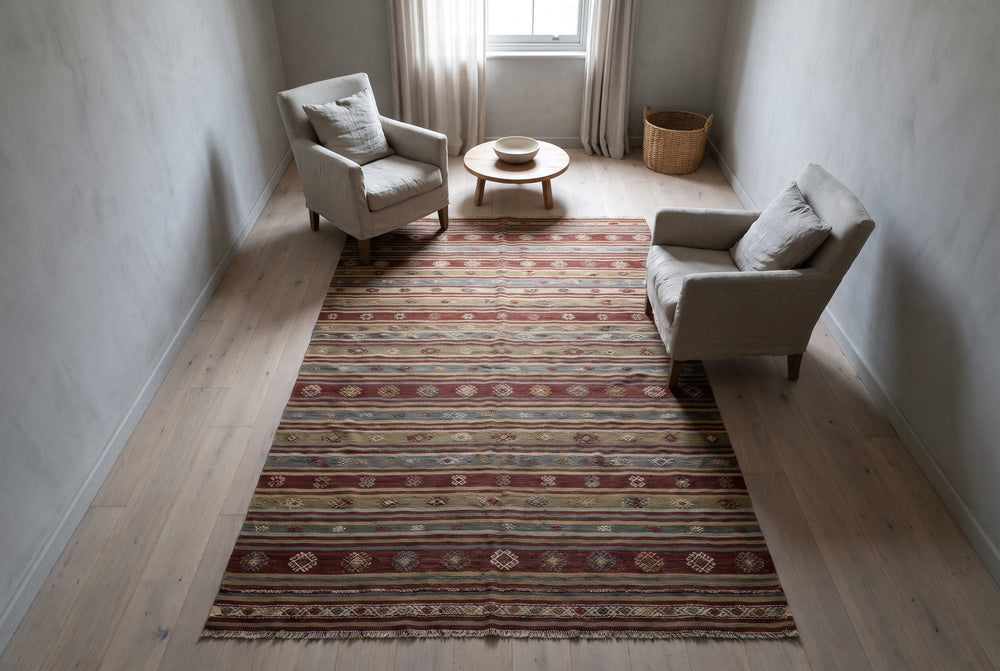
Ours are small and graphic. One is covered in tight rows of tiny diamonds on cream, one has neat rows of small hexagons on chestnut inside layered sawtooth borders, and one has a bold H shape on deep red. Most are small, from about 2 by 3½ feet to about 5½ by 8½ feet, with one long runner of nearly 14 feet, and prices run from about $560 to $2,840. Their ages vary from about 20 years to close to a century, and each listing gives the exact size and age.
Living with a Van kilim
A small Van kilim makes a strong accent at a front door, beside a bed or in front of a fireplace, and the larger one holds its own in front of a sofa. Dark fields hide wear well, and a thin non-slip pad keeps a light kilim in place. The small pieces also make good wall hangings: a kilim is light, and hung from a sleeve sewn along the top edge it shows off a dense Van pattern better than a floor can. Vacuum without the beater bar, and see our guide to kilim rugs for the rest.
Where to go next
The kilims themselves are in the Van collection, and every flat weave we carry is in the kilim collection. North of Van, Kars has a guide of its own, and the ultimate guide to Turkish rugs covers the whole country. More rugs are in the Turkish rug collection.



Sources
- Van Kilimi (Van Kilim). Kultur Portali, Republic of Turkiye Ministry of Culture and Tourism.
- Sarya’nin Gulleri / Roses of Gulsarya (R. Karahan). Journal of the Institute of Fine Arts, Ataturk University, 2010.
- A Nomad’s Art: Kilims of Anatolia. The George Washington University Museum and The Textile Museum, 2018.
- Yoresel El Sanatlarinda Van Halisi / The Carpet of Van in Local Handicrafts (M. Unsal Mercan). Vankulu Journal of Social Research, Yuzuncu Yil University, 2018.