Balikesir Rugs: Yoruk Kilims of Northwest Turkey
Balikesir lies in northwest Turkey, between the Sea of Marmara and the Aegean, in hill country where Yoruk herding families settled over the centuries. Turkey’s culture ministry describes how the Yoruks who migrated into the region lived as nomads and then, over time, settled into villages.[1] Those villages became known for their weaving, above all for flat weaves beaten in with the comb.[1]
Nearly every Balikesir piece we carry is a flat-woven kilim. This guide covers where they come from, how they differ from the region’s famous pile carpets, and how to choose one.

A name with two meanings
Balikesir is a name collectors use in two ways. The Textile Museum’s catalog of Anatolian kilims explains that many weaving names began as the names of carpet markets or of mosques where old pieces were found, such as Bergama and Balikesir.[2] So a Balikesir kilim may come from the villages of the province, or from weavers who sold through its markets. Either way, it belongs to the weaving of northwest Anatolia. Collectors also use tribal names, such as Yuncu and Karakecili, for some weavings of this region, which is why the same piece can turn up under more than one label.[2]
The province’s best-known weavers are the Yagcibedir Yoruks, who appear in the Balikesir area from the seventeenth century.[1] Their villages lie around Sindirgi, Bigadic and Kepsut.[1] They are famous for knotted pile carpets in deep red, dark blue and navy, with a little white.[1] Those are pile rugs, a different object from the kilims in this guide, and the same palette of deep reds and dark blues runs through both.
Kilim, zili and cicim
Kilims are not the only flat weave here. In western Anatolia, from Canakkale and Balikesir down to Fethiye and Antalya, the name zili is used for weavings patterned with an extra, supplementary weft.[2] Zili is common in the mountain villages of Balikesir.[1] Weavers there size it by the number of motifs, making pieces of seven or nine tabak.[1] Brown, white, red and blue are the usual colors, and the village of Dedekasi in Kepsut is known for its zili.[1]
A slit-woven kilim is lighter than either. Compared with cicim and zili, it is thinner and lighter, which is why it served so many purposes in the household.[2] In a slit weave, the design is built up of small blocks of solid color, each woven with its own weft yarn.[2] Where two colors meet, a short vertical slit is left between them, and you can often see these against the light.

Natural dyes and a short palette
The weavers of Balikesir worked with a short list of colors, and they made a great deal of it. In Sindirgi, the district governorship says, the yarn for Yagcibedir carpets is colored with root dyes that do not fade.[3] It names four main colors: dark blue, red, deep red and white.[3] Our kilims share that restraint, with mahogany, faded red and seal brown fields lit by small accents of cream, orange, pink and teal.

Woven for home and for sale
Kilims were woven first as useful things for daily life.[2] But Yoruk weavers also sold their work, and they did so very early. The thirteenth-century geographer Ibn Sa’id described a people he called the Yoruks who wove both for their own use and to sell.[2] Kilims never fetched the prices of knotted carpets, but they were traded for goods and services and sometimes woven to order.[2] That is part of why so many reached town markets like Balikesir, and from there the wider world.
The motifs carry meaning too. In Sindirgi, the district governorship writes that each motif in the local carpets has a meaning, and that weavers put their joys and sorrows into them.[3] Its list includes the star, the dog’s tooth along the border, and the elibelinde, a woman with her hands on her hips.[3]
The Balikesir kilims we carry
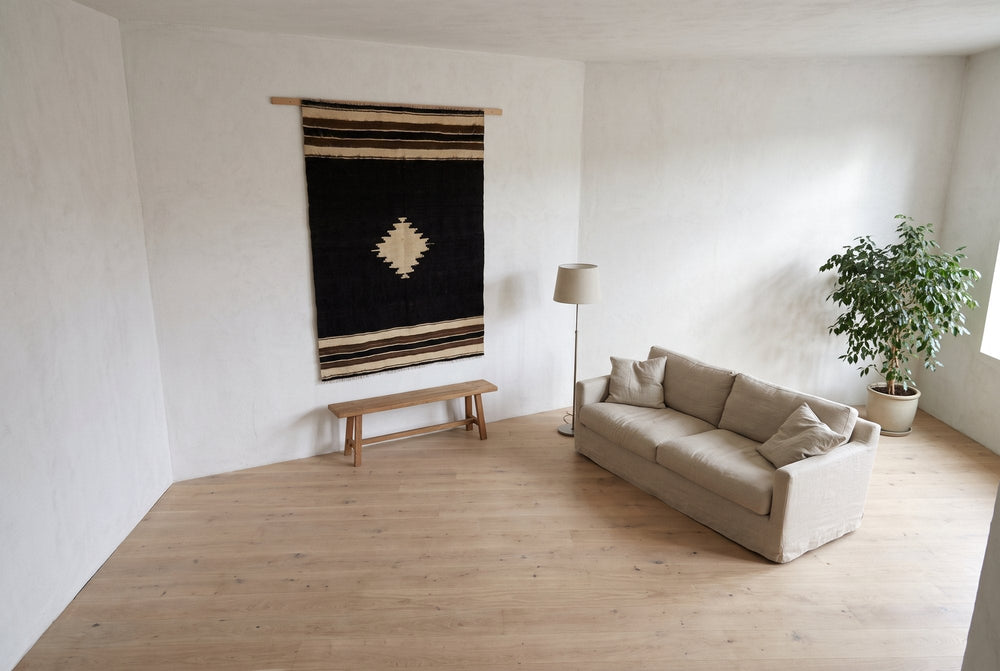
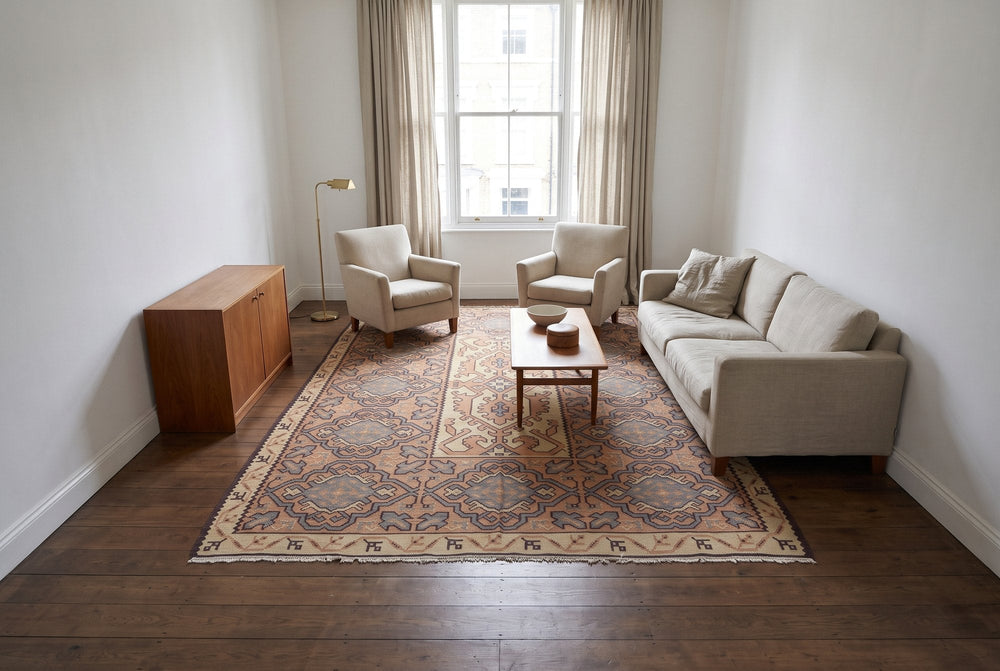
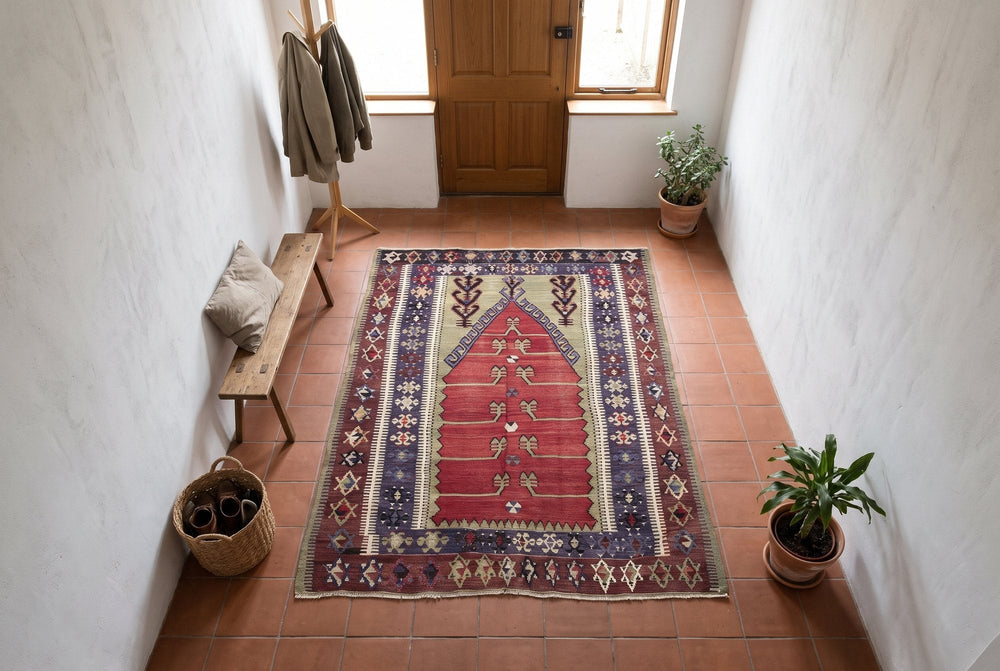
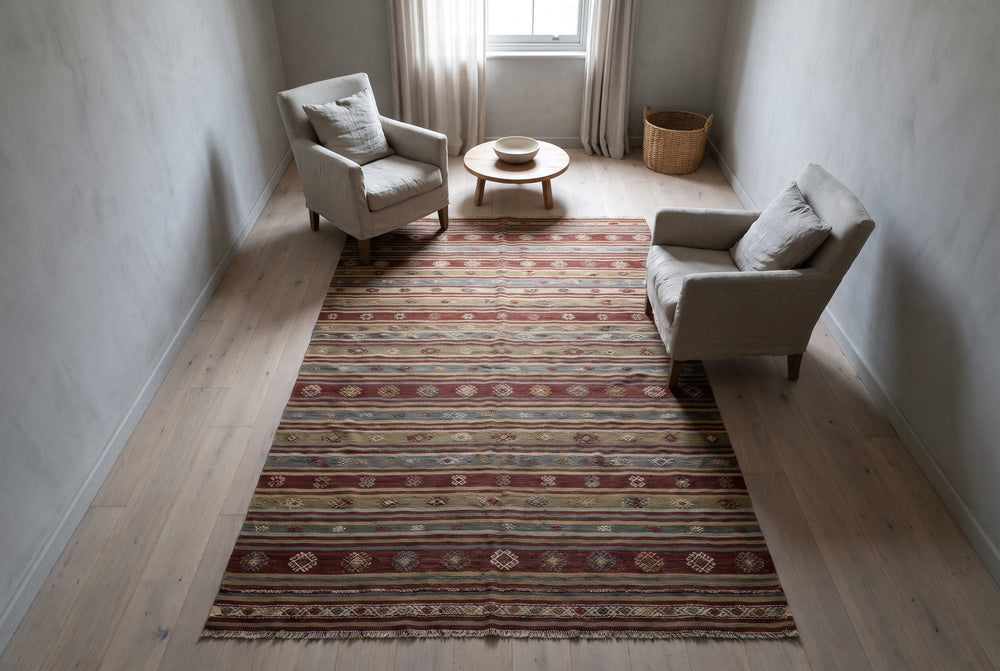
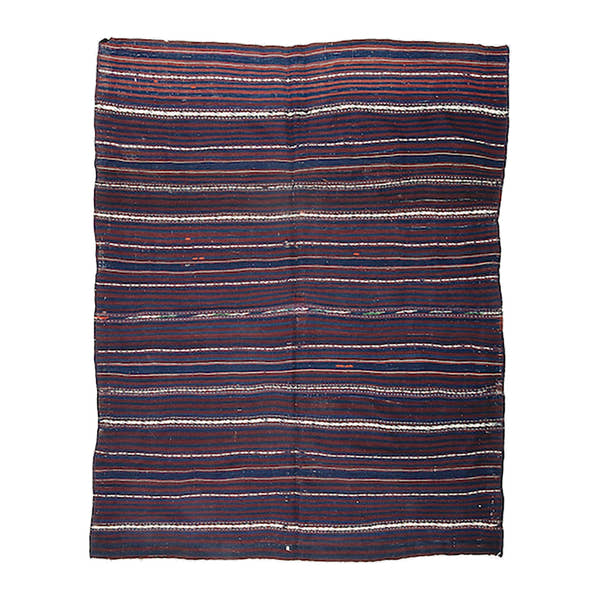
Our Balikesir kilims fall into two groups. Some have one large stepped diamond, or rows of small ones, floating on a plain dark field. Others are banded from end to end, with fine stripes and narrow rows of tiny diamonds, crosses and hooks. They are flat-woven wool, most about 40 to 60 years old, and a couple are younger. Sizes run from small pieces of about 3½ by 4 feet to about 5½ by 9 feet, and prices from about $775 to $1,445.

Where a Balikesir kilim fits
The small pieces suit an entry, a bedside or the space in front of a fireplace. The larger ones can sit in front of a sofa or under a small dining table, where a thin kilim lets chairs slide easily. A plain dark field with one bright diamond reads clearly from across a room, while the banded pieces look calmer and suit busier rooms. Put a thin non-slip pad underneath, vacuum without the beater bar, and see our guide to kilim rugs for the rest.
Where to go next
The kilims themselves are in the Balikesir collection, and every flat weave we carry is in the kilim collection. To the south, Manisa has its own guide, and the wider story is in the ultimate guide to Turkish rugs. Browse more in the Turkish rug collection.


Sources
- Geleneksel Halk Sanatlari: Balikesir (Traditional Folk Arts). Kultur Portali, Republic of Turkiye Ministry of Culture and Tourism.
- A Nomad’s Art: Kilims of Anatolia. The George Washington University Museum and The Textile Museum, 2018.
- Kultur (Culture). District Governorship of Sindirgi.