Manisa Rugs: The Most Consistent Rug We Sell

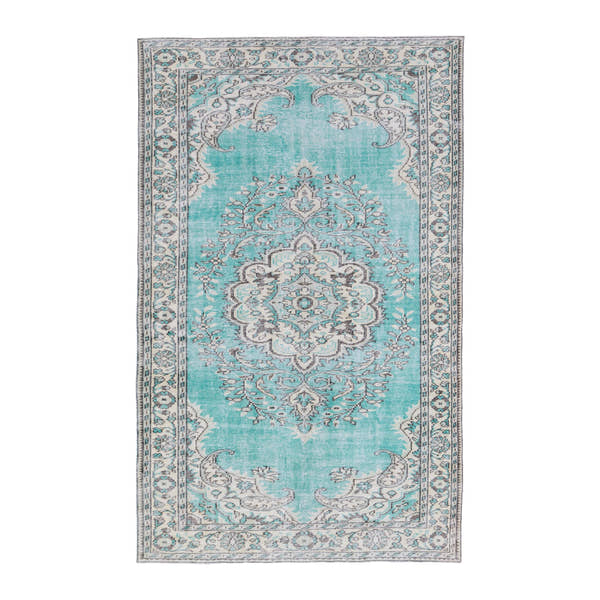
Manisa rugs are vintage Turkish rugs from western Turkey, inland from Izmir.[1] They are pale, low-piled and remarkably alike. Picture a cream or soft rose field, a medallion in the middle and a blue or sage border. Almost every one measures between 5 by 8 and 6 by 10 feet. If you have a normal living room and want to stop deliberating, a Manisa is the simplest choice.

Where Manisa rugs come from
Manisa sits inland from Izmir. The region has woven rugs and shipped them through the Aegean ports for a very long time. Like Isparta, it worked to a plan rather than improvising at the loom. By the 1970s that meant a steady output of room-size rugs in a settled style.
A rug woven to a drawing looks different from one woven from memory. The shapes repeat cleanly and the borders stay straight. Our guide to tribal, village and city rugs explains why, if you want the background.
The result is a rug with very little variation. That is either the point or the problem, depending on what you want. Nothing in a Manisa will surprise you. That is why it works so well in a room where the rug should sit quietly under everything else.
What a Manisa looks like
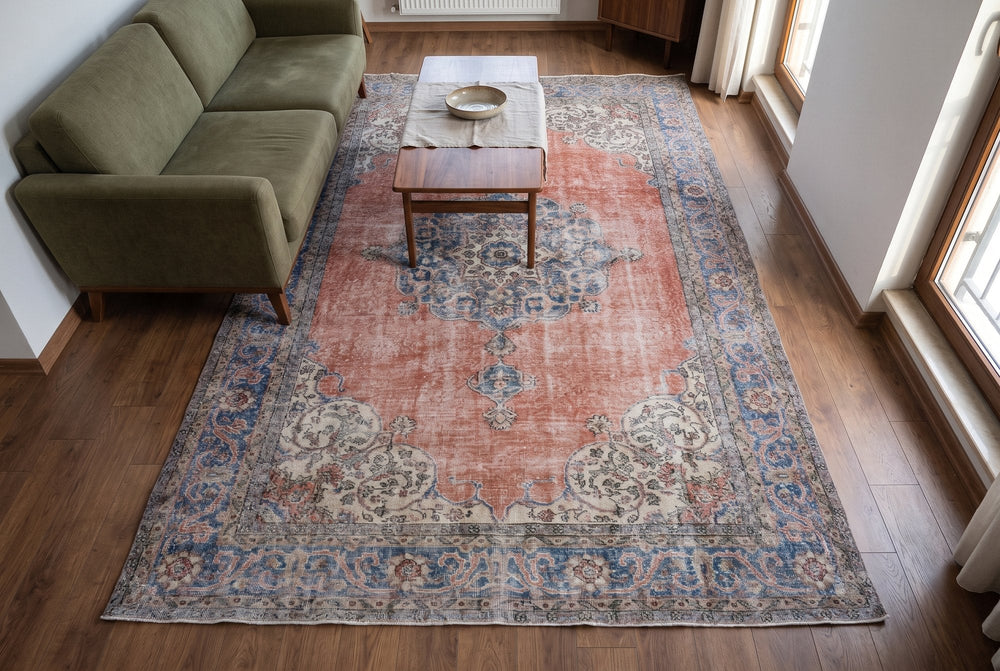
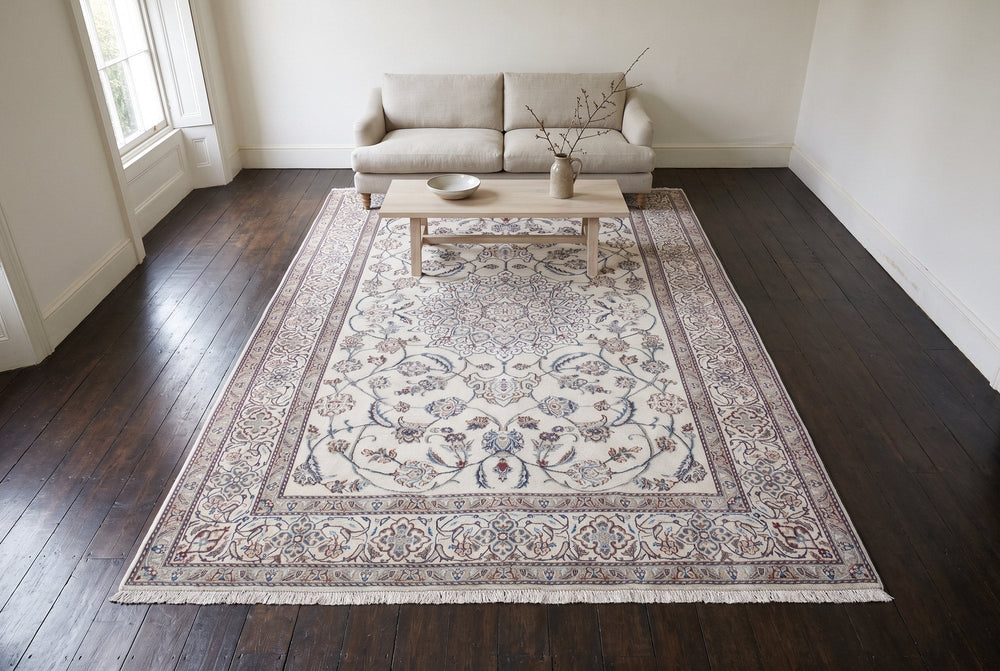
Most Manisa rugs follow one layout. A single medallion sits in the middle of an open field, usually pointed at both ends. Corner pieces echo it. The field is the main background inside the borders, and on a Manisa it is left mostly plain.
Cream is the most common field color, followed by dusty rose and muted pink. Greige, taupe and sage do the drawing. Many rugs have blue in the border, from powder blue to a soft turquoise, and a few have navy.
It is the same pale Turkish palette as Isparta. The colors were soft to begin with, and fifty years of light and washing have softened them more.[2] Set a Manisa next to a Hamedan or another Persian village rug and it looks almost washed out. Next to a new rug, it looks like something with a past. If that is the look you want, the wider neutral collection is worth a browse too.

How to recognize one
The medallion, centered and unhurried. It is usually a single shape in the middle, with corner pieces answering it and plenty of empty field around it.
The open field. A Manisa leaves space. Village weaving tends to fill it.
The evenness. The borders keep their width from end to end. The pile, the wool surface you walk on, is short and even across the whole rug.

Sizes: almost all the same
This is where Manisa is unusual. The sizes cluster tightly, and most rugs are close to 5 by 9, 6 by 9 or 6 by 10 feet. There are almost no runners and no oversized pieces. If you need either of those, look at runners or oversized rugs instead.
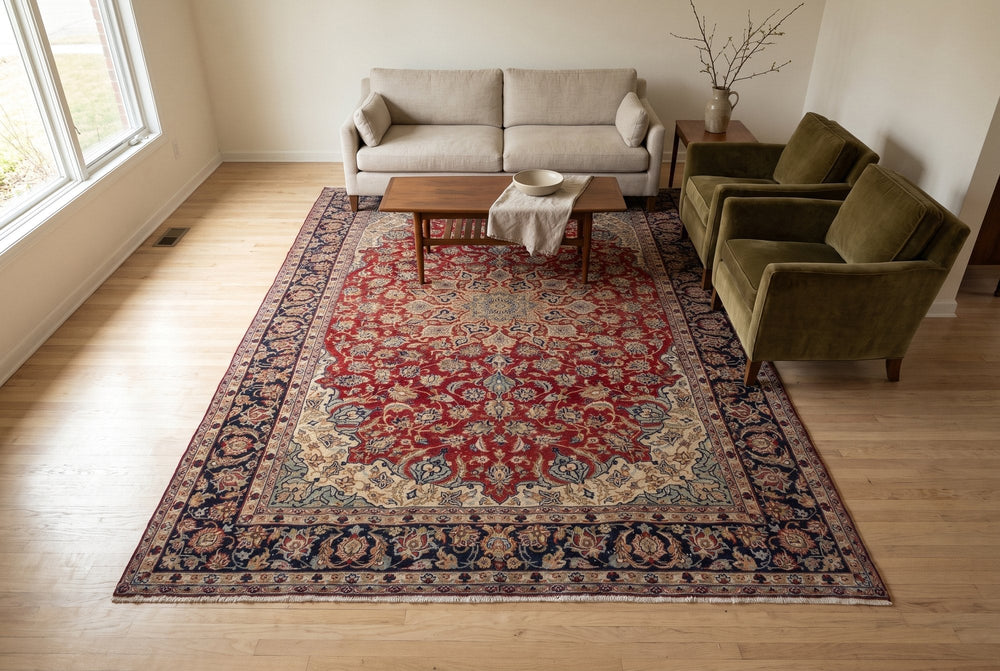
That size range suits a small or medium living room. Lay the rug in front of the sofa, with the front legs of the sofa and chairs on it. A simple check: the rug should be at least as long as the sofa, with 12 to 18 inches of bare floor between its edges and the walls. In a bedroom, a 5 by 8 or 6 by 9 can go across the lower part of a queen bed, with the ends showing on both sides. Our guide to the rug size for a queen bed shows the layout. If your room really needs an 8 by 10 or larger, a Manisa will look too small. Our comparison of 8x10 and 9x12 rugs helps you decide which of the larger sizes fits, and the size guide covers every room.

What a Manisa costs
Most cost between $350 and $550. The narrow range is itself a sign of how consistent the weaving was: similar sizes, similar wool, similar work. For a hand-knotted rug that has already lasted fifty years, it is one of the more affordable ways into vintage.
Manisa or Isparta?
The two are close cousins and often confused. Both are pale, low-piled Turkish workshop rugs from the mid twentieth century. A Manisa is the more uniform of the two, with a medallion on most rugs and a tighter spread of sizes. An Isparta gives you more variety, including all-over repeats of small flowers and a few smaller pieces.
If you want two rugs for rooms that open into each other, Manisa makes that easier, because the sizes and palettes are so alike. If you want a particular design, Isparta gives you more to choose from.
Looking after a Manisa
A short, even pile is easy to keep. Vacuum once a week without the beater bar.[3] Turn the rug end for end every six months so wear and daylight spread evenly. Pale rugs show grit sooner than dark ones, so a doormat at the nearest entrance helps. Strong sun will keep softening the colors, and our note on protecting a rug from sun, pets and spills covers the simple fixes.
When you are ready to look, browse the Manisa collection. Measure your room first, and check that the front legs of your seating will reach the rug.


Sources
- Discover Manisa Travel and Culture Guide. GoTurkiye, Turkish Ministry of Culture and Tourism.
- Caring for textiles and costumes. Canadian Conservation Institute, 2024.
- Mechanical Surface Cleaning of Textiles (CCI Notes 13/16). Canadian Conservation Institute, 2010.