For a queen bed, the usual rug is an 8 by 10 or a 9 by 12.[1] Lay it across the bed, so it runs under the bed and both nightstands. In a smaller room, a 6 by 9 or 7 by 10 under the lower two thirds of the bed works well. In a very small room, a pair of runners is the answer. The rug should show on both sides of the bed, not stop under it. The same applies in a spare room, which our guest room rug post covers.
A queen bed is 60 inches wide and 80 inches long.[2] A rug that looks generous in a product photo can disappear under the frame once the nightstands go in. This guide walks through the three layouts that work, the sizes that fit each one, and the mistakes that make a bedroom feel smaller than it is.
Queen bed rug sizes at a glance
- Under the bed and both nightstands: an 8 by 10 or 9 by 12, about 245 by 305 to 275 by 365 cm, laid sideways.
- Under the lower two thirds: a 6 by 9 or 7 by 10, about 185 by 275 to 215 by 305 cm.
- Beside the bed: two runners 2½ to 3 feet wide and 7 to 9 feet long, about 75 to 90 cm by 215 to 275 cm.
- In a very small room: a 5 by 8, about 150 by 245 cm, across the foot of the bed.
If you want one number, an 8 by 10 is the smallest rug that goes under the whole bed, and a 9 by 12 is the most comfortable.
Start with the bed, not the room
Most people measure the room and buy the biggest rug that fits. In a bedroom, that rarely gives the best result. The bed is the anchor, and the rug’s job is to frame it. It gives you something soft to step onto in the morning, and it pulls the bed, the nightstands and a bench into one group.
So measure the bed and the nightstands first. The bed plus both nightstands is usually 100 to 110 inches wide for a queen. Then decide how much rug should show on each side of the bed. Eighteen inches (45 cm) is the minimum that looks intentional.[1] Twenty-four to thirty inches looks settled and generous.

Layout one: the rug under the whole bed
This is the classic layout and the one that makes a bedroom feel finished. The rug runs under the bed and the nightstands and extends past the foot of the bed. Lay it sideways, with the long side parallel to the headboard.[3]
An 8 by 10 is the smallest rug that works this way. It gives about 30 inches of rug on each side of the mattress, just enough for the nightstands, and about a foot past the foot of the bed. A 9 by 12 is more comfortable. The nightstands sit well inside it, and about two feet of rug shows at the foot.
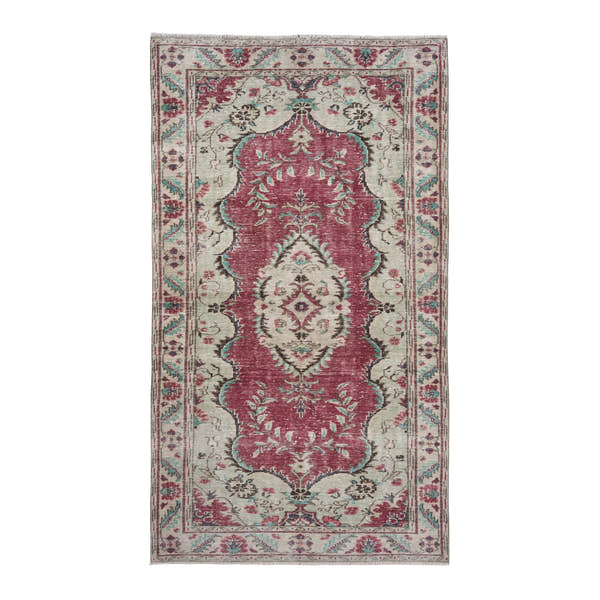
Vintage rugs are not cut to modern retail sizes, so look at anything between 8 by 10 and 9 by 13. A rug that measures 8 feet 4 inches by 11 feet 3 inches works well here, even though it matches no standard size.
Layout two: the rug under the lower two thirds
If the nightstands are large or the room is narrow, slide the rug down. Start it just below the nightstands and let it run past the foot of the bed. The nightstands sit on the floor, the bed sits on the rug, and you still get a soft landing on both sides.
This layout takes a smaller rug. A 6 by 9 laid across the bed is the smallest that works for a queen, and a 7 by 10 gives more rug at the foot. It also suits a rug with a strong medallion (a large central motif). Part of the medallion shows past the foot of the bed, instead of hiding under the mattress.

Layout three: runners on each side
Two runners, one on each side of the bed, are the right answer in a small bedroom. They also suit a room with wall-to-wall carpet you do not want to cover. Choose runners 2½ to 3 feet wide and roughly the length of the bed, so 7 to 9 feet long.
They do not need to match. A pair of vintage runners from the same region in related colors looks more considered than two identical pieces. If you would rather use a small rug on each side, where to put a small rug covers the bedside sizes.

A queen bed in a small bedroom
In a small bedroom, check the width of the room before the size of the rug. A queen needs about 24 inches of space on each side to walk around it comfortably.[2] In a room about 10 feet wide, that leaves little floor to fill. A 6 by 9 laid across the bed leaves only about 6 inches of floor to each wall, and the room looks crowded.
There are two better answers. The first is a pair of runners, as in layout three. The second is a 5 by 8 laid across the foot of the bed. It covers less of the bed than the layouts above, but it still shows about 18 inches of rug on each side of the mattress.
In a small room, a queen bed often stands with one long side against the wall. Then one rug along the open side does the job, tucked a few inches under the frame. A 3 by 7 runner or a 5 by 8 laid lengthwise runs about the length of the bed. Our guide to a full or twin bed covers beds against a wall and in a corner in more detail.
The mistakes that shrink a room
- A rug that ends under the bed. If the rug stops before the edge of the mattress on the sides, it looks like a bath mat. Go up a size or switch to the two-thirds layout.
- Measuring the mattress, not the frame. Platform beds and upholstered frames can be several inches wider and longer than the mattress. Measure the frame, or the rug will show less than you planned.[4]
- Ignoring the door swing. Measure from the door to the bed. A thick rug in the path of a door will catch.[3] Most vintage Persian rugs are low pile, which is one reason they suit bedrooms.
- Forgetting the bench. If there is a bench at the foot of the bed, the rug should extend past it by at least a foot, or stop before it entirely.
Which vintage rugs suit a bedroom
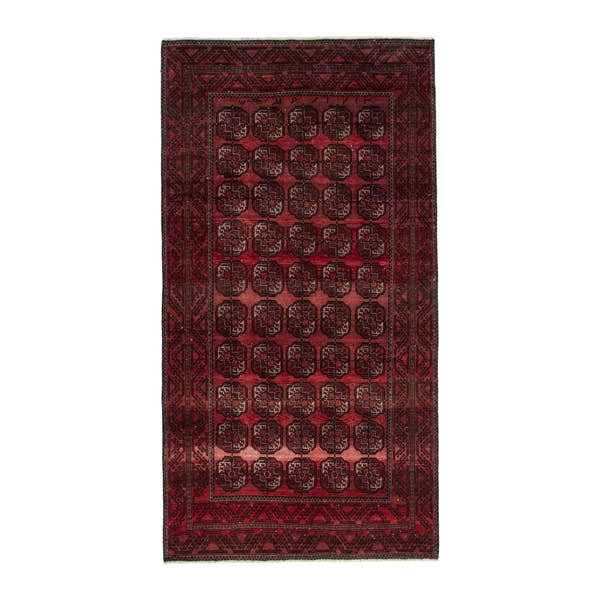
Bedrooms see little foot traffic, so a finer city rug such as a Kashan is safe here. Hamedan village rugs in deep red are a classic choice too. In a quiet, neutral room, a Turkish Isparta with a cream or faded pink field (the main background) warms the floor without competing with the bedding. For a modern room, an all-over pattern in one color family, such as a deep burgundy Baluch, keeps the floor calm.
Every rug in our collection lists its exact measurements in feet and centimeters. Check the size against the layout you want before you fall for the pattern.
For a bigger or smaller bed, see what size rug goes under a king bed and what size rug for a full or twin bed. If you are sizing more than one room, how to choose the right rug size sets out the method, and placing a rug in an open-plan living space takes on the harder case. Then browse bedroom rugs or read the full size guide.


Sources
- How to Place a Rug in a Living Room, According to Designers. House Beautiful, 2024.
- Mattress Sizes 101: Finding Your Perfect Fit. Sleep Foundation, 2025.
- How to Find the Perfect Rug to Match Your Queen Bed. Elle Decor, 2023.
- How to Find the Best Rug Size for Your King Bed, According to Designers. Elle Decor, 2023.