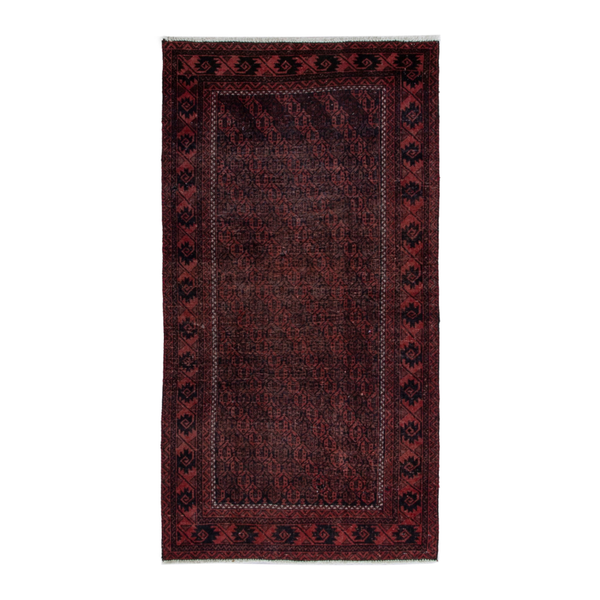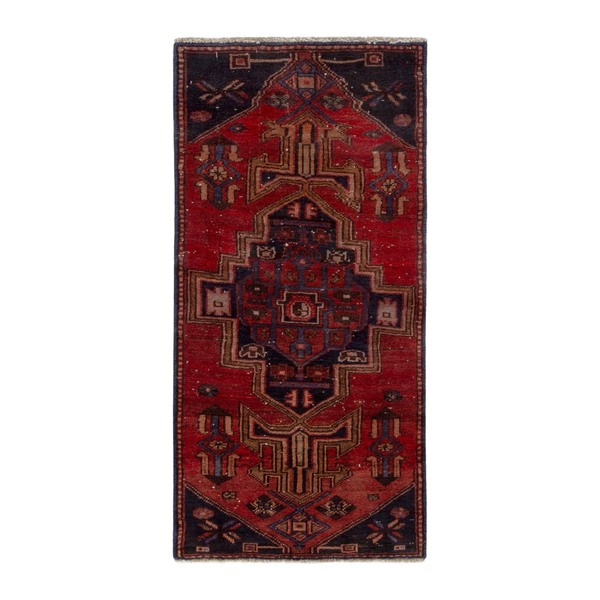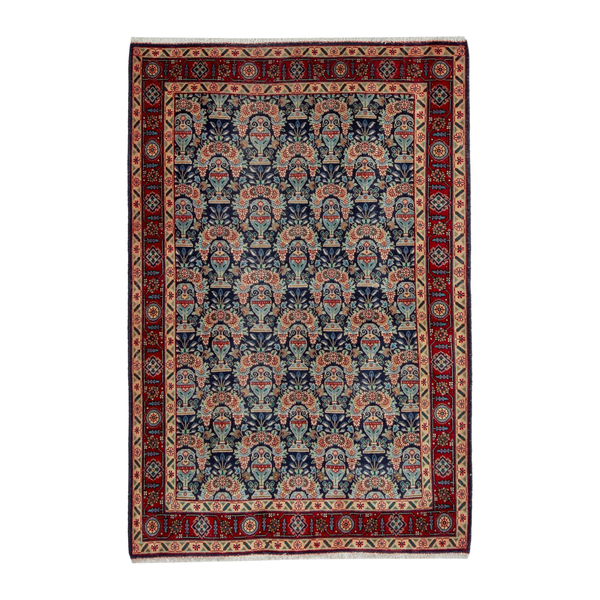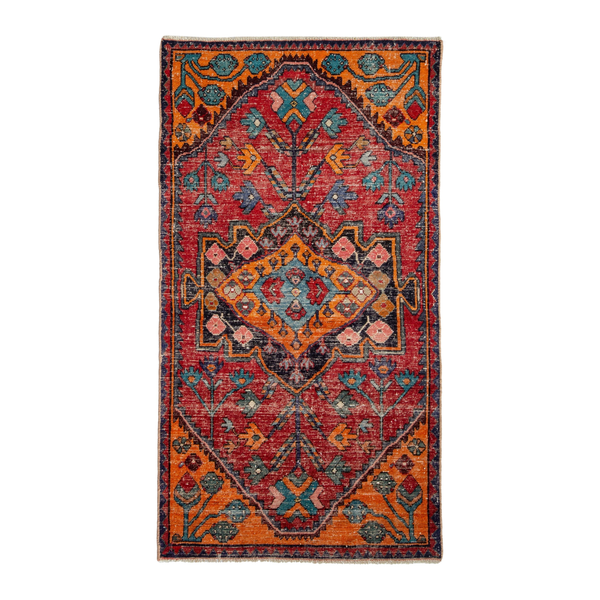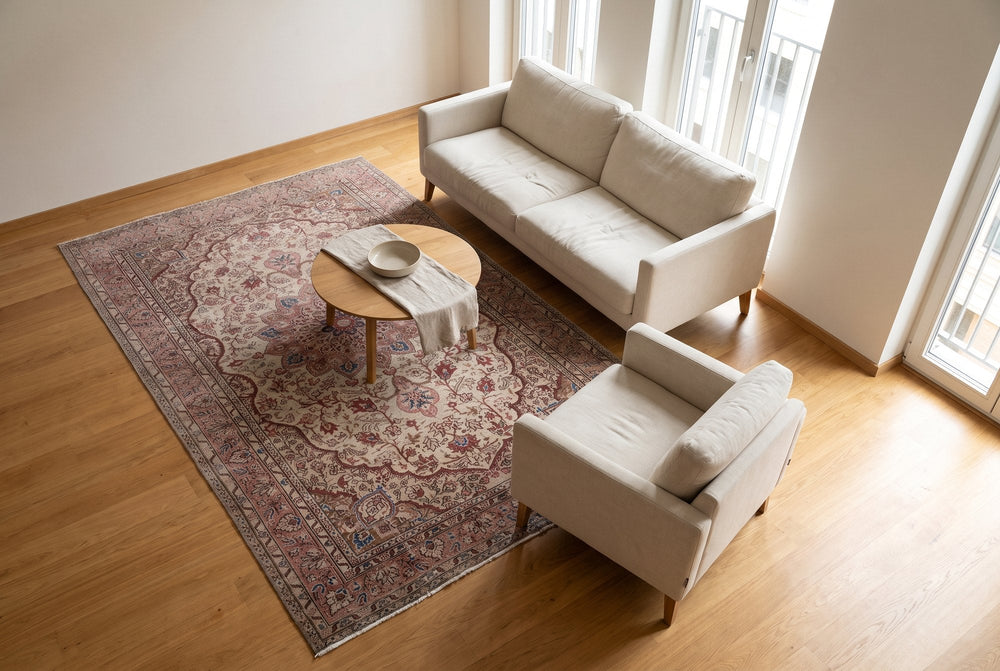
A 6x9 rug is 6 feet wide and 9 feet long: 72 by 108 inches, about 183 by 274 cm, and 54 square feet of floor. It fits a small living room with the front legs of the seats on it, the lower part of a queen bed, or a full bed with rug to spare on both sides. It is too small for most dining tables and for a king bed. On a vintage hand-knotted rug, the label is rounded, so the real size can be a few inches off. Check the measured size, and use the size guide to convert it.
How big is a 6x9 rug, really?
The 6 by 9 is one of the standard area rug sizes, the step between a 5 by 8 and an 8 by 10. Our list of standard Persian rug sizes sets it beside the others and the older Persian formats behind them. A foot is exactly 30.48 cm, so a true 6 by 9 is 183 by 274 cm.[1]
A vintage rug was knotted to the loom, not to that number. A rug sold as a 6 by 9 can be anywhere from 5 feet 6 inches to 6 feet 6 inches wide, and from 8 feet 6 inches to 9 feet 6 inches long. In centimeters that is roughly 168 to 198 by 260 to 290. About two thirds of our 6x9 rugs are narrower than 6 feet. In a tight room, those missing inches matter more than the label.
So do every sum below with the measured size on the listing, which gives feet, inches and centimeters.

A 6x9 rug in a living room
A 6 by 9 suits a small living room, about 9 by 11 feet up to 9 by 12. Designers suggest leaving 12 to 18 inches of bare floor between a room-filling rug and the walls.[2] In a room of 9 by 12 feet, a true 6 by 9 leaves about 18 inches on every side, which is the generous end of that range.
Lay the 9-foot side along the sofa. That gives 108 inches, so a 7-foot sofa has a foot of rug past each arm, and a loveseat has more. Then tuck the rug a few inches under the front legs of the sofa and the chairs opposite. Designers ask for at least those front legs on the rug.[2] Our post on rug placement in a living room explains the three layouts, and front legs on is the one a 6 by 9 does best.
Once the sofa is 8 feet long, or the room is 11 by 13 feet or more, the 6 by 9 starts to look small. That is the point where 8x10 vs 9x12 takes over.
Is a 6x9 rug big enough for a queen bed?
Yes, for the lower part of the bed. A queen mattress is 60 by 80 inches.[3] A rug in a bedroom is usually laid perpendicular to the bed, so its long side runs across it.[4] Laid that way, a 6 by 9 shows about 24 inches of rug on each side of a queen mattress. Designers ask for at least 18 inches at the sides, so it passes.[5] It starts below the nightstands and runs past the foot of the bed.
The queen bed guide calls this the lower-two-thirds layout and compares it with a rug under the whole bed. A 6 by 9 cannot do that second job. Under a king, a 76-inch mattress leaves only about 16 inches each side, which looks like a mistake.[3]

A 6x9 rug for a full or twin bed
A full mattress is 54 by 75 inches.[3] A 6 by 9 laid across it shows about 27 inches on each side, which is comfortable rather than tight. The full and twin bed guide calls the 5 by 8 the minimum and the 6 by 9 the better rug when the room takes it.
Under a twin, a 6 by 9 is more rug than most children’s rooms need. It makes sense when the twin sits in a guest room you also use as a study, so the rug can hold a chair as well.

Where a 6x9 comes up short
Under a dining table is the most common mistake. A dining rug should run at least 24 inches past the table on all sides, so the chairs stay on it when pulled out.[2] Even a 36-inch table then needs a rug 7 feet wide, and a 6 by 9 falls short. What size rug goes under a dining table gives the sizes by number of seats.
The other places it falls short are a king bed, a long sofa and a large sectional. Under an L-shaped sofa, a 6 by 9 is only the smallest rug that works. Under an L-shaped desk it does better, because it gives a rolling chair room to travel.
6x9, 5x8, 6x10 or 8x10?
A 5 by 8 is a foot narrower and a foot shorter, 40 square feet instead of 54. It is the minimum for a full bed and a good size for a reading corner. Our 5x8 rugs and the post on the 5x7 rug cover the smaller sizes.
A 6 by 10 has the same width with about a foot more length. That extra foot runs past both arms of a longer sofa, or shows more rug beside a queen bed. In our stock, 6x10 rugs are as easy to find as 6 by 9s, so look at both.
A 5 by 9 is the narrow neighbor. It suits the length of a bed or a wide hall more than a seating group, and our 5x9 rugs are almost all Turkish.
A 7 by 10 or an 8 by 10 is the step up for a medium living room or a whole queen bed. Our 7x10 rugs are mostly Persian and cost noticeably more.
What our 6x9 rugs are like
Most of our 6 by 9 rugs are Turkish, woven in Isparta and Manisa, and about half have a cream or ivory field. Soft rose and pink fields come next, then terracotta and celadon. About one in ten is Persian, most often a Tabriz. The Isparta guide explains why the Turkish ones run so pale.
Most cost between about $450 and $540, and the whole range runs from about $350 to $2,000, with the Persian rugs at the top. Like every rug we sell, each is hand-knotted wool on a cotton foundation and about fifty years old.
Before you choose, tape the rug’s outline on the floor and leave it down for a day, as how to choose the right rug size describes. Then compare it with the measured size of each rug in our 6x9 rugs, and check the 6 by 10s if a few more inches of length would help.
Sources
- U.S. Survey Foot. National Institute of Standards and Technology.
- How to Choose the Right Rug Size, According to Designers. Country Living, 2026.
- Mattress Sizes 101: Finding Your Perfect Fit. Sleep Foundation, 2025.
- How to Find the Perfect Rug to Match Your Queen Bed. Elle Decor, 2023.
- How to Place a Rug in a Living Room, According to Designers. House Beautiful, 2024.