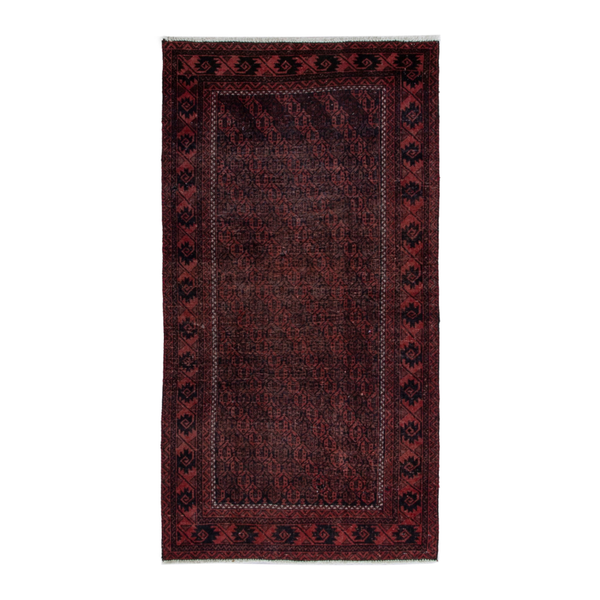
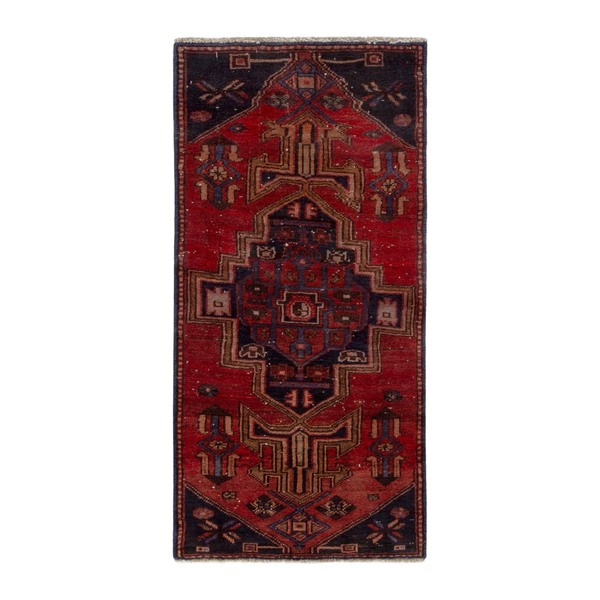
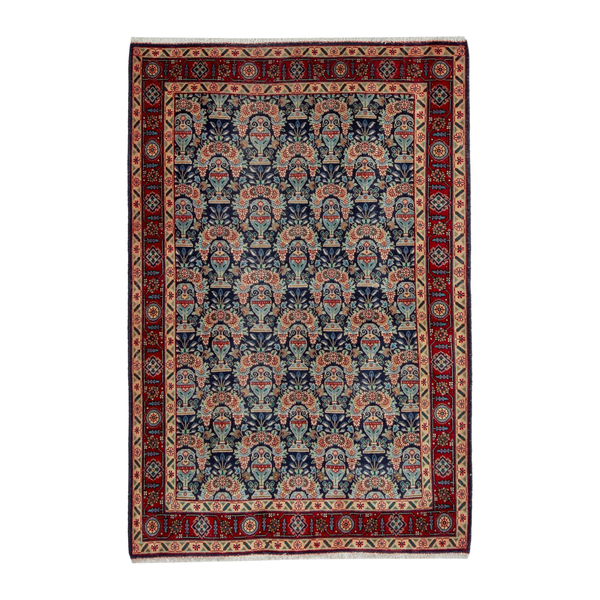
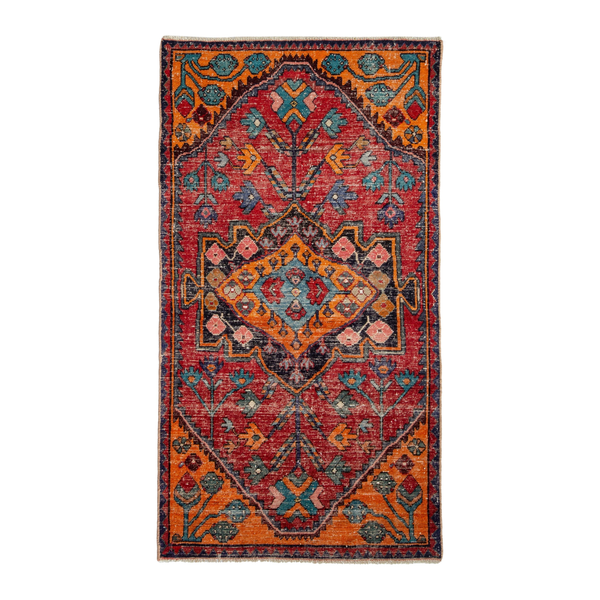
A burnt orange rug is one whose field, the main background inside the borders, is an orange pulled toward brown: rust, terracotta or, at the pale end, apricot. In vintage Persian and Turkish rugs these colors come mostly from red dyes that leaned orange from the start or softened that way over fifty years. They warm a room the way a red rug does, with less weight, and they look best next to wood, leather, blue and green. Our orange rugs gather them in one place.
Rust, terracotta and apricot: three different oranges
The names cover a wide range, and the difference matters once the rug is in a room.
Rust is the darkest of the three. Dictionaries describe it as reddish yellow, reddish brown, or yellowish red.[1] On the floor it reads like old brick or saddle leather, and it hides dirt well.
Terracotta sits in the middle. It is named after fired clay, and the word comes from Italian for “baked earth, cooked earth.”[2] As a color it means a brownish orange like that of unglazed terracotta.[2] It is the warmest and brightest of the three in a sunny room.
Apricot is the palest, a soft peach that sits close to pink. We see it only on a few pale Turkish rugs.
An orange field is rare. Only about one rug in twenty-five that we sell has one, but rust or terracotta shows up in the border or the drawing of about one rug in five. If you love the color and cannot find the right size, look at red, cream and navy rugs that carry it as an accent. The deepest reds belong to a different family, covered in our posts on red Persian rugs and oxblood rugs.
Where the orange in an old rug comes from
Most old rust colors start with madder. In the Turkmen weaving at the Met, warm reds and reddish browns obtained from madder root dominate the palette.[3] Orange was used as a color in its own right too. A nineteenth-century tribal carpet from Fars at the V&A lists light orange among its nine pile colors, next to red, light red and yellow.[4]
Age moves the color as well. Most plant dyes are highly sensitive to light, and oranges are on that list.[5] So a red that leaned orange can drift toward rust, and a bright orange can settle into terracotta or apricot. Our post on natural dyes explains how old colors age.
Which rugs come in rust and terracotta
About two thirds of our orange-field rugs are Persian and a third are Turkish, and the two groups look different. The Turkish ones come mostly from Isparta and Manisa. They are terracotta or apricot fields with a blue, sage or cream border, mostly room sizes from about 5 by 8 to 7 by 11 feet, and most cost from about $350 to $750. Our Manisa guide describes that soft Turkish palette.
The Persian ones are deeper, more often rust than terracotta, and they come from many places in small numbers: Hamedan, Shiraz, Kashan, Baluch, Birjand, Kerman and others. Every orange runner we sell is Persian, and most of those cost from about $415 to $1,050. Several are village runners with a small repeat covering the rust field, like the Arak below. Our Hamedan guide covers those village rugs, and the terracotta rugs hold the paler end of the range.
What goes with a burnt orange rug
Blue. Blue is the complement of orange.[6] Placed side by side, complementary colors make each other look brighter.[6] That is why so many of these rugs already have a navy or dusty blue border, and why a navy sofa over a terracotta rug is such a sure pairing. Our post on what color rug goes with your couch covers sofas color by color.
Green. Olive, sage and moss share the same earthy depth as rust. A green velvet chair or a row of plants against a terracotta rug looks settled rather than loud.
Wood and leather. Mid-brown oak, walnut and teak all sit easily on a rust rug. Cognac leather is the same color family, so it works only when the leather is clearly lighter or darker than the rug, as our post on a brown leather sofa explains.
Cream. A burnt orange and cream rug is the easiest version to place. The cream border or drawing lightens the field, and white walls repeat it.
Brown. Chocolate brown and rust together make a warm, enclosed room. Keep one large surface light, such as the walls or the sofa, or the floor turns into one dark block.
Gray. A rust rug brings back the warmth a gray room is missing. On a terracotta tile floor, though, an orange rug is too close to the clay, and rugs for gray or terracotta floors explains what works there instead.
Is an orange rug good for a modern room?
Yes, as long as it is the one warm color in the room. White walls, black metal, pale wood and plain upholstery let a rust or terracotta rug carry the room on its own. Faded oranges help here, because they look like a material, closer to leather or clay than to paint. Rooms built on walnut, teak and simple lines take these colors especially well, and our post on vintage rugs in a mid-century modern room goes further. If you still worry that a patterned rug will look dated, are Persian rugs out of style takes that question on.
Rooms a rust rug warms up
A north-facing room or a basement with cool, flat light gains the most from a rust rug, because the floor starts doing the work of a warm lamp. Rooms with blue walls suit terracotta especially well, and our post on what color rug goes with your walls has the details. In a hall, a rust runner with a small repeat hides grit and footprints between vacuums. Under a wooden dining table, a rust or brick field forgives spills better than cream and looks warm in evening light.
To browse, start with the orange and terracotta collections above, or go to rugs by color to see rust next to its neighbors in red and pink.
Sources
- Rust Definition & Meaning. Dictionary.com.
- Terracotta Definition & Meaning. Dictionary.com.
- Storage Bag Faces (Art of the Islamic World, Image 39). The Metropolitan Museum of Art.
- Carpet, possibly Lur or Kashkuli (Qashqai), Fars, 1840-1875. Victoria and Albert Museum.
- Agent of Deterioration: Light, Ultraviolet and Infrared. Canadian Conservation Institute.
- Complementary Colors. Tate.