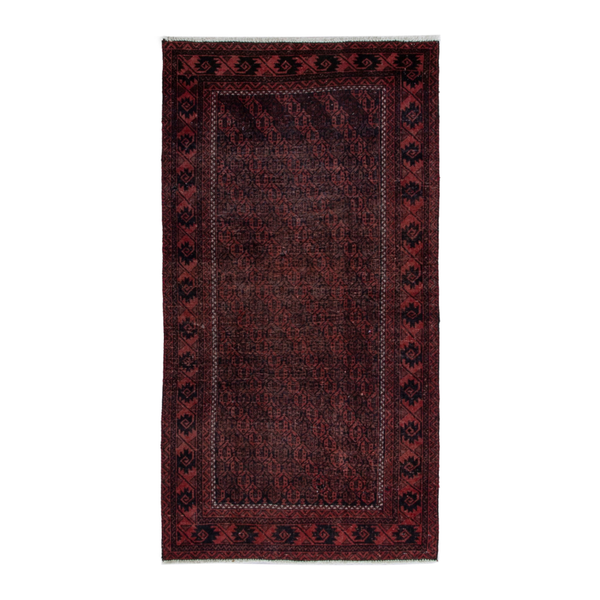
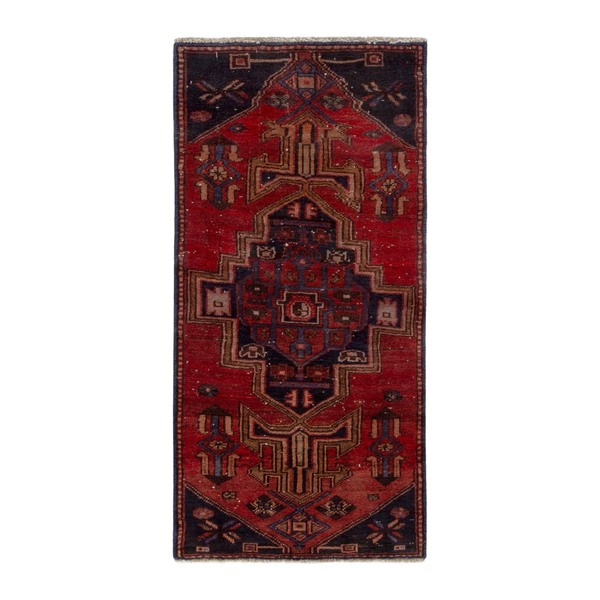
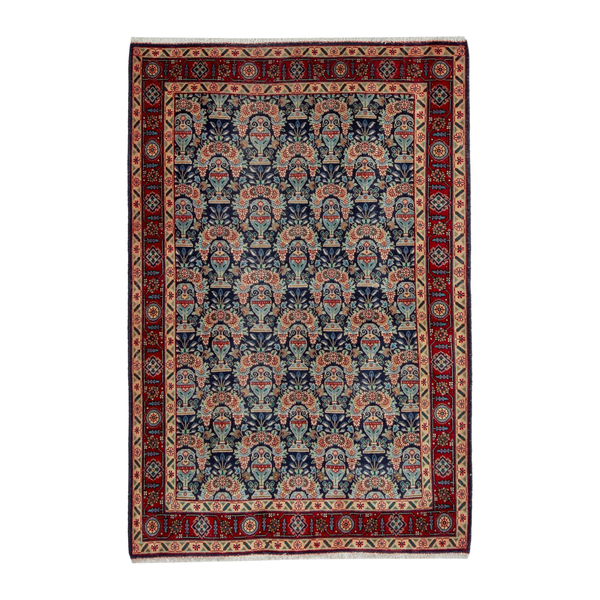
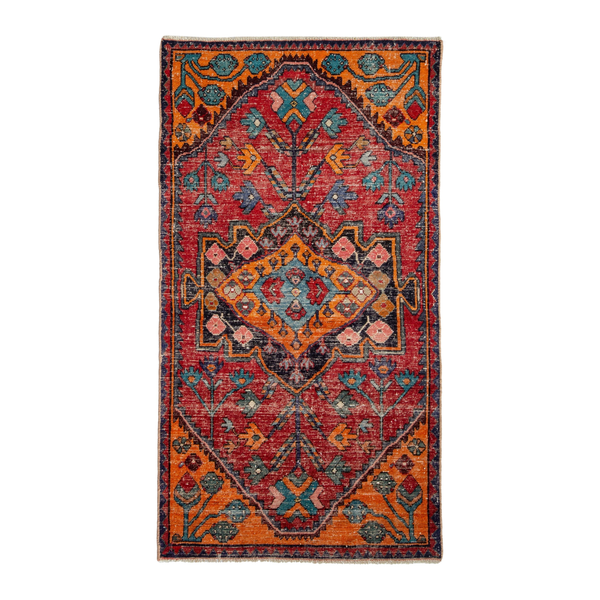
A vintage hand-knotted rug suits a mid-century modern room when its pattern is geometric or small in scale, or when its ground has faded to a soft, neutral color. Those rugs sit well with low furniture on tapered legs, warm walnut and teak, and the clear shapes the style is known for. Our rugs are about fifty years old, so they are close in age to the furniture they join. The best place to start is a tribal or village rug, such as the geometric weaving in our Baluch rugs.
What makes a room mid-century modern
A few ideas run through mid-century modern design. One is warmth. In the 1930s, a warmer organic design appeared in Scandinavia, with its emphasis on wood and natural materials.[1] Another is new ways of making things. Charles and Ray Eames turned their wartime work with molded plywood into an inexpensive, mass-produced chair that became hugely influential.[1]
The rooms built around that furniture liked pattern, as long as it was bold and simple. Wallpapers of the period reflect a trend for lively abstraction in mid-century interiors.[2] By the 1960s, geometric patterns dominated surface design.[2] So the look you are after is low, warm and uncluttered, with one or two strong shapes.
Why a handmade rug belongs in a modern room
Some of the best-known mid-century designers lived with old, handmade things. The Eames House in Los Angeles is the best-known example. The Historic American Buildings Survey of the house describes how rugs, paintings, folk art and personal mementos softened its modernism.[3] Screens and textiles countered the transparency of its steel and glass shell.[3]
A vintage rug does the same job. A room of smooth wood, molded shapes and plain upholstery can feel like a showroom, and a hand-knotted rug gives it texture and small irregularities. Age helps as well. Every rug we sell is about fifty years old, from around the 1970s. That puts it in the same era as much of the furniture people collect. Our post on whether Persian rugs are out of style has a short note on mid-century rooms. This post goes further into which designs work.
Which of our rugs suit a mid-century room
Geometric tribal and village rugs
Rugs drawn from memory on village and tribal looms tend toward straight lines, steps and repeated shapes. That is the closest match to mid-century pattern. Our post on tribal, village and city rugs explains where the difference comes from. Look at Baluch rugs, Ghoochan rugs, Heriz rugs and the repeating guls of Turkmen weaving. On most Turkmen weavings the main motif is the gul, an eight-sided shape repeated in rows.[4] Most of our Baluch rugs are runners and small rugs in deep red and burgundy, which suits a hall, a bedside or a reading corner.
Small, all-over patterns
A design that repeats across the whole rug, with no big central medallion, reads almost like a woven textile. It holds the floor without competing with a sculptural chair or a statement lamp. Rows of Turkmen guls work this way, and so do the small repeats of many village runners. A large, curving floral medallion in strong colors can feel formal next to clean lines. Save it for a room where the rug is meant to lead.
Faded and neutral grounds
If your room is pale, with white walls and light oak, a rug whose ground has softened to cream, taupe or sand fits better than a saturated red. About half of our Turkish rugs have a cream or ivory field, often with the pattern worn soft by age and washing. Browse our neutral rugs and Turkish rugs for those.
Scale with low-slung furniture
Mid-century sofas and chairs sit low and often stand on slim, tapered legs, so you see a lot of floor beneath them. That makes the rug more visible than it would be under a skirted sofa. It also makes a rug that is too small look like an island. Let the front legs of the sofa and chairs rest on the rug, and leave an even band of floor around the edge. Our guide to rug placement in a living room explains why.
In most living rooms that means an 8 by 10 or a 9 by 12. Vintage rugs rarely match those labels exactly, so measure the room and compare our sizes with 8x10 vs 9x12. Room-size tribal rugs are scarce. Turkmen rugs, for example, tend to be small because the people who wove them had to pack up and follow their flocks.[5] For a large geometric rug, look at Heriz and the bigger Turkmen pieces in our living room rugs.
Beyond the living room
The same thinking carries through the rest of a mid-century house. Under a teak or walnut dining table, the chairs must stay on the rug when they are pulled out. Dining room rug size gives the margins. Dining chairs on slim legs slide easily over a low pile, and nearly all our rugs are low pile. In a hall, a tribal runner with a row of small medallions makes a strong line under a long, low sideboard. In a bedroom, a narrow geometric rug laid lengthwise beside a platform bed gives you a warm place to step in the morning, like the Ghoochan above.
Wood tones and color
Walnut and teak are warm, orange-brown woods, and they look good with the reds, rusts and browns of a village rug. On a dark walnut floor, choose a rug with a lighter ground or plenty of cream in the drawing, so the edge stays visible. Mid-century upholstery often comes in mustard, olive, orange and teal. A red or rust rug sits well with all of them, and what color rug goes with your couch goes through each color. If the sofa or curtains have their own pattern, a patterned rug with a patterned sofa explains how to mix them.
If your taste runs more relaxed and layered than strictly modern, our post on boho vintage rugs covers that look. Otherwise, start with the geometric designs on our rugs by design page.
Sources
- Design, 1925-50. The Metropolitan Museum of Art.
- Women Making Wallpaper. Cooper Hewitt, Smithsonian Design Museum, 2023.
- Eames House, Historic American Buildings Survey. Library of Congress.
- Tent door cover (engsi), Yomut Turkmen. Powerhouse Museum.
- Turkman Carpets (audio guide). The Metropolitan Museum of Art.