Boho Rugs: Using a Vintage Persian or Turkish Rug in a Boho Room
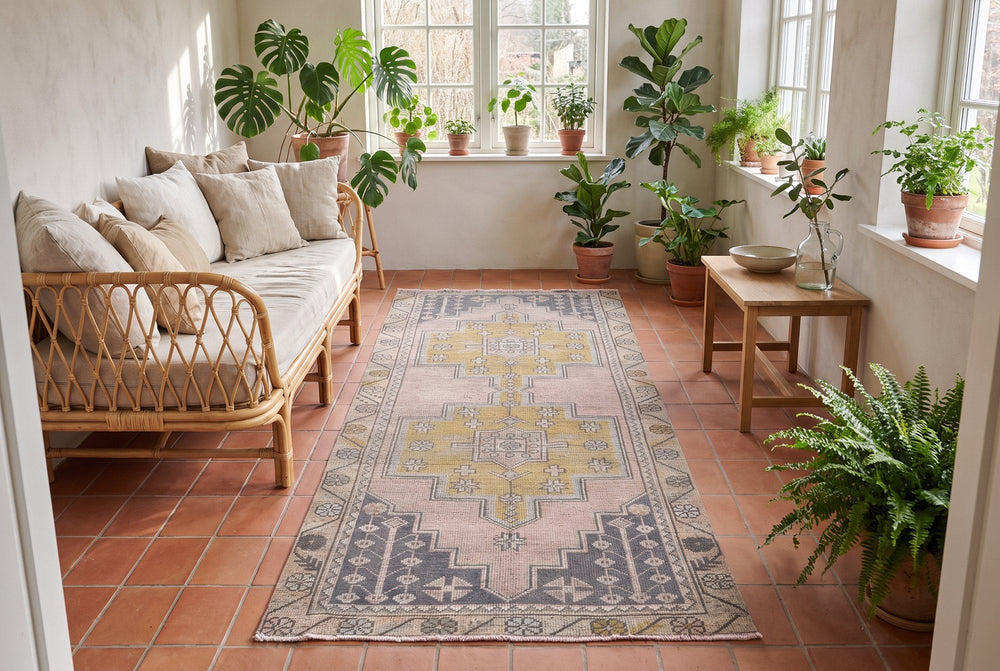
A vintage Persian or Turkish rug is one of the most natural rugs for a boho room, as long as you choose a village or tribal rug rather than a formal city carpet. Geometric drawing, faded color and a few signs of use are what make a boho room feel collected rather than bought in one trip. Small, colorful rugs suit the style best, and they mix and layer easily. Our colorful rugs are a good place to begin.
What makes a room boho
Boho is short for bohemian. In French the word came to mean an unconventional way of living by the 1830s, and Henri Murger’s stories of the late 1840s made it popular.[1] In decorating it still means a room that looks lived in by someone with wide tastes. Think plants, rattan and cane, low seating, floor cushions, baskets, books and textiles that came from many places.
A boho rug, then, is one that looks collected rather than matched: patterned, warm in color, usually handmade and a little worn. It sits under all of that, so it needs to hold its own without looking new. A hand-knotted rug about fifty years old does this well. Its colors have softened, its drawing is a little irregular, and it looks as though it has already lived somewhere else.
Which vintage rugs suit a boho room
Look for tribal and village rugs, whose drawing usually comes from memory rather than from a design on paper. Rugs sold as tribal are generally smaller and woven on horizontal looms laid out on the ground.[2] Our post on tribal, village and city rugs explains what each label tells you.
Three groups are worth knowing for this style:
- Baluch rugs: small, dark and drawn in steps and hooks. They are generally smaller and more varied than the Turkmen carpets woven by their neighbors.[2] The Baluch guide covers them in depth.
- Southern Persian tribal rugs: the Qashqa’i rugs of the Shiraz area are usually geometric, with flowers and animals drawn so simply they blend into the pattern.[3] See the Shiraz guide. Our Lori rugs, covered in the Lori guide, have the same bold, straight-line drawing.
- Anatolian village rugs: Turkish village rugs in soft, faded colors. Villages and small towns across Anatolia developed their own designs over time, which is why so many types exist.[4] The Anatolian guide shows what to expect.

Color: warm, faded and a little mismatched
Boho color is warm and slightly worn, and so is tribal color. On a group of Turkmen storage bags at The Met, warm reds and reddish browns from madder root dominate the palette.[5] After fifty years those reds have often eased toward rust, rose or brick. Why vintage colors age so beautifully explains the change.
For a lighter boho room, look at faded Turkish rugs in pink, apricot and sage. Many of our pink rugs are Turkish village and workshop rugs whose reds have softened over time. They suit white walls, pale wood and lots of green. For a darker, cozier room, a deep red or navy tribal rug works better, especially with leather, wood and brass.

Persian or Turkish for a boho room
Both work, and the choice mostly comes down to how light you want the room. Persian tribal and village rugs lean dark: deep red, navy, rust and brown, with bold geometric drawing. Turkish village rugs lean pale: cream, rose, apricot and faded blue. If you are not sure which one you are looking at, Persian and Turkish rugs: how to tell them apart covers the differences in drawing and knot.
Two rugs often linked with boho rooms are flatweave kilims and thick Moroccan piles. We do not sell either. If you are weighing those, the kilim guide and Persian vs Moroccan rugs compare them fairly with what we do sell.
Layering and mixing rugs
Layering is one of the easiest boho moves. A small tribal rug over a large plain one brings in pattern without covering the whole floor in it. Layering rugs over carpet and hardwood covers the sizes and the pads.
To layer rugs boho style, start with a large, plain base such as jute or a flatweave. Lay a smaller patterned rug on top so the base shows 12 to 18 inches beyond it on every side. Setting the top rug at a slight angle, rather than perfectly square, gives the relaxed look the style is after. Jute vs wool rugs gives the size pairings for a vintage rug over jute.
Mixing several vintage rugs in one room is also very boho, and it works best when they share one color. A red Baluch by the door, a rose Anatolian by the bed and a rust Lori by the reading chair hang together because the warm red runs through all three. Avoid putting two busy rugs edge to edge. Leave some bare floor between them so each one reads on its own.
Sizes for a boho living room, bedroom or hall
Boho rooms often use smaller rugs than other styles, because so much of the seating sits low. Still, a living room needs one rug big enough to hold the main seating together. Use a medium or large village rug there, then add small rugs at the edges. Where to put a small rug has ideas for the smaller pieces, and rug placement in a living room covers the main rug.
In a boho bedroom
In a bedroom, the rug mostly shows beside the bed and past its foot. A pair of small tribal rugs, one on each side, can do the work of one large rug and adds pattern where your feet land. If you prefer one rug, lay a medium village rug across the bed and pull it under the lower part. Rug placement in a bedroom gives the sizes for each bed.
Boho runners
A tribal runner brings the same warmth to a hall, a kitchen or the open side of a bed. Most of our Baluch runners are narrow, about 2 to 4 feet wide, mostly on deep red and burgundy fields. Runners for halls and kitchens explains how to choose the length.
Most of our Baluch rugs are around 3 by 6 feet or smaller, or narrow runners, and most cost between about $250 and $600, which makes them easy to add one at a time. Our Anatolian rugs are all about 4 feet wide and 7 to 11 feet long, so none is room size. On a hard floor, put a thin pad under every rug. A good underlay protects the rug and cushions the unevenness of the floor and the weight of furniture.[6] It also stops a small rug from sliding when someone sits down on a floor cushion.

Where to start
Pick the main rug first, then add smaller ones around it. For dark, geometric tribal rugs, browse the Baluch rugs. For soft, pale village rugs, start with the Anatolian rugs.
Sources
- Bohemian (n.). Online Etymology Dictionary.
- Afghan Carpets. Penn Museum, Expedition Magazine.
- Portable Storage: Tribal Weavings from the Collection of William and Inger Ginsberg, The Tribes. The Metropolitan Museum of Art.
- Prayer Rug with Niche Design. The Metropolitan Museum of Art.
- Storage Bag Faces. The Metropolitan Museum of Art.
- Basic care: Carpets and rugs. Canadian Conservation Institute.


