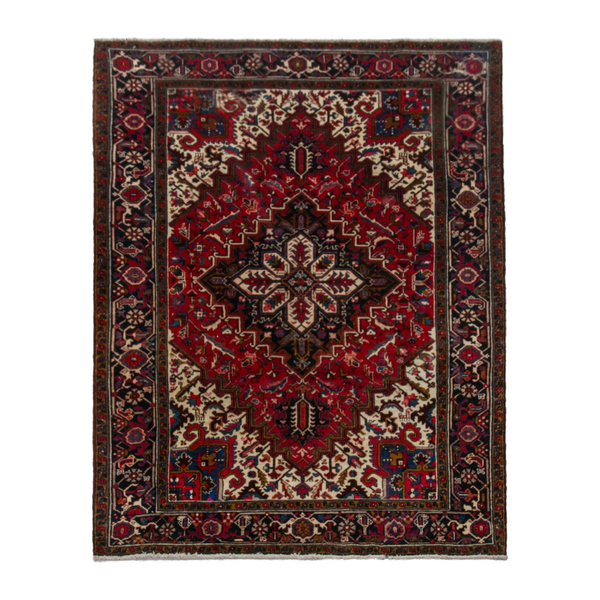
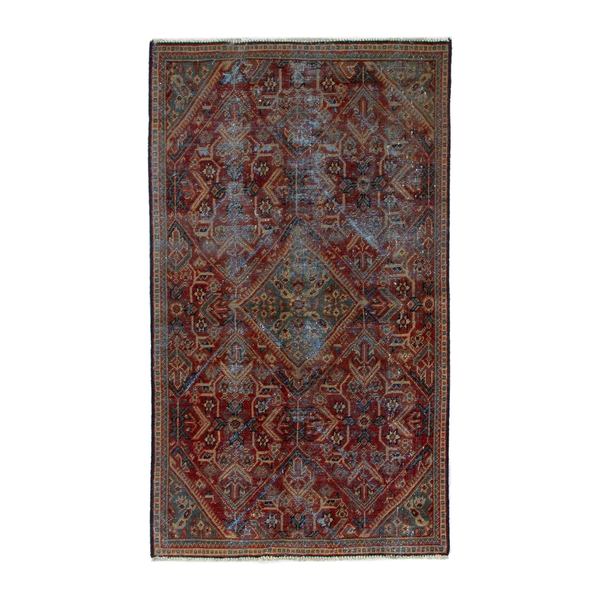
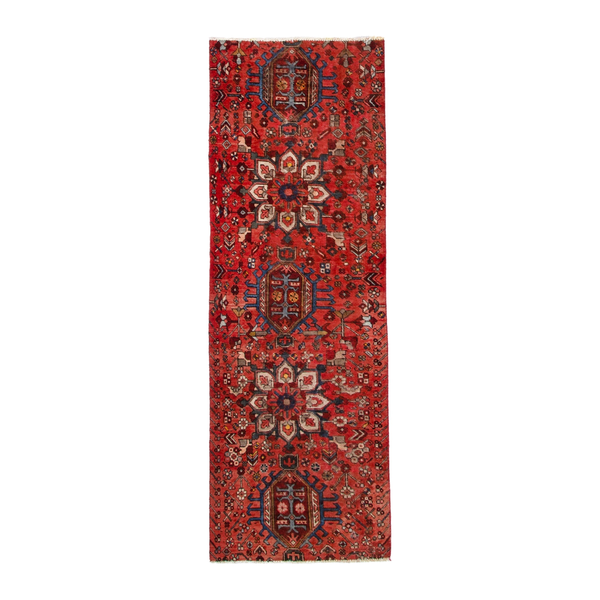
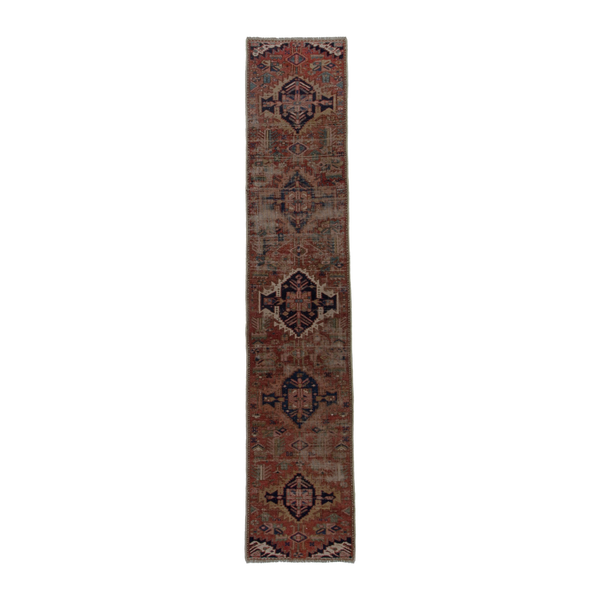
We hold 49 Shiraz rugs. Twenty-eight of them are under 25 square feet, sixteen more are under 45, and the largest single piece on the shelf is a five by nine. Not one is what anyone would call a room rug.
That is not a gap in our buying. It is the most informative thing about the origin, and it is where this guide starts.

Why they are all small
Shiraz sits in Fars province, in the south-west of Iran, and the weaving the city gave its name to came out of tribal and village looms rather than urban workshops. A loom that has to be taken apart, carried and set up again is a loom with a limit, and that limit is written into every rug that came off it.
Compare it with Kerman, where two thirds of what we hold is over 75 square feet, and the contrast is complete: same country, same century, opposite constraint. One was weaving for export and formal rooms, the other for the floor of a tent or a village house.
Red, and then everything else
Deep red leads 27 of the 49, then burgundy 11, navy 9, rust 8, cream 7. It is a warm, saturated, slightly unruly palette — and "unruly" is the right word, because tribal weaving allows itself things a workshop would not. You will see a border change width, a motif appear once and never again, two greens that do not quite match because the second batch of wool was dyed later.
Those are not faults. They are the difference between a rug someone made and a rug someone manufactured, and they are the reason a rug with motifs you can read is more interesting than a perfect one.

What they cost
From $220 to $1,820, with a median of $500 — slightly under the $600 median across all our Persian rugs, which makes sense given the sizes. Our price breakdown shows that small rugs are the most expensive per square foot on this site; a Shiraz is cheap in absolute terms and not cheap by area, and both of those things are true at once.
Forty-eight of the 49 have a low pile.
Where a rug this size actually earns its place
An accent rug is easy to buy badly. It ends up floating in the middle of a room, too small to anchor anything, doing nothing. The places where this size genuinely works:
- Beside a bed, one each side, so your feet land on wool. This is the single best use of a two by three and the reason we never have enough of them.
- In an entryway, where the rug takes the grit and the wear and can be turned end for end every few months.
- Under a chair or a small table, to close off a corner of a larger room.
- Layered over a larger plain rug or over carpet — we covered how that works in layering rugs over carpet and hardwood.
What it will not do is furnish a living room. If that is the job, start with the size guide and then look at Isparta or Mahal instead.
Shiraz or Baluch
They are the two tribal shelves here and people compare them, reasonably. The short version: Baluch is darker and quieter — reds that read nearly brown, black borders, and a palette that recedes. Shiraz is louder, with more red showing and more willingness to put a teal or a slate blue next to it.
If the room needs the rug to disappear, Baluch. If it needs one small warm thing on the floor, Shiraz.
The shelf is at Shiraz rugs.