Spend a little time with an old hand-knotted rug and you soon see it is more than decoration. Shapes repeat. Borders frame the edges. A center holds it all together. Learning a few rug motifs lets you slow down and read a piece like a page. You are not reading word for word. You are noticing what the weaver chose, and why it may have mattered to them.
This is a gentle guide, not a codebook. The meanings people give these shapes are real and old. But they change from one region to the next, and from one weaver to the next. Enjoy them as stories, not fixed facts.
How to “read” a rug
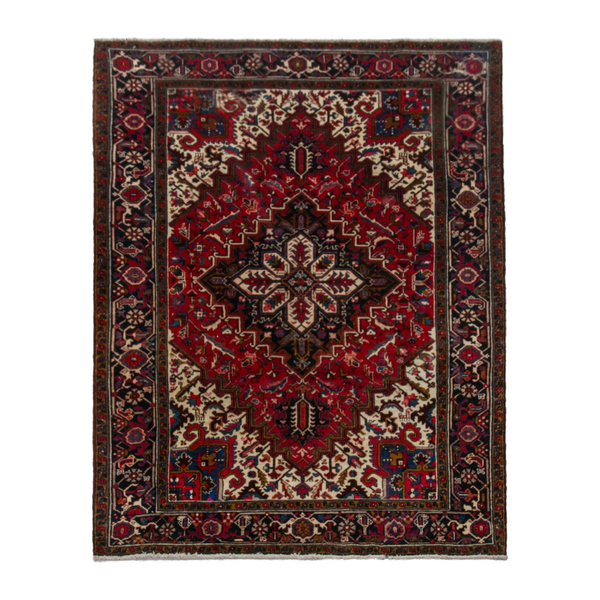
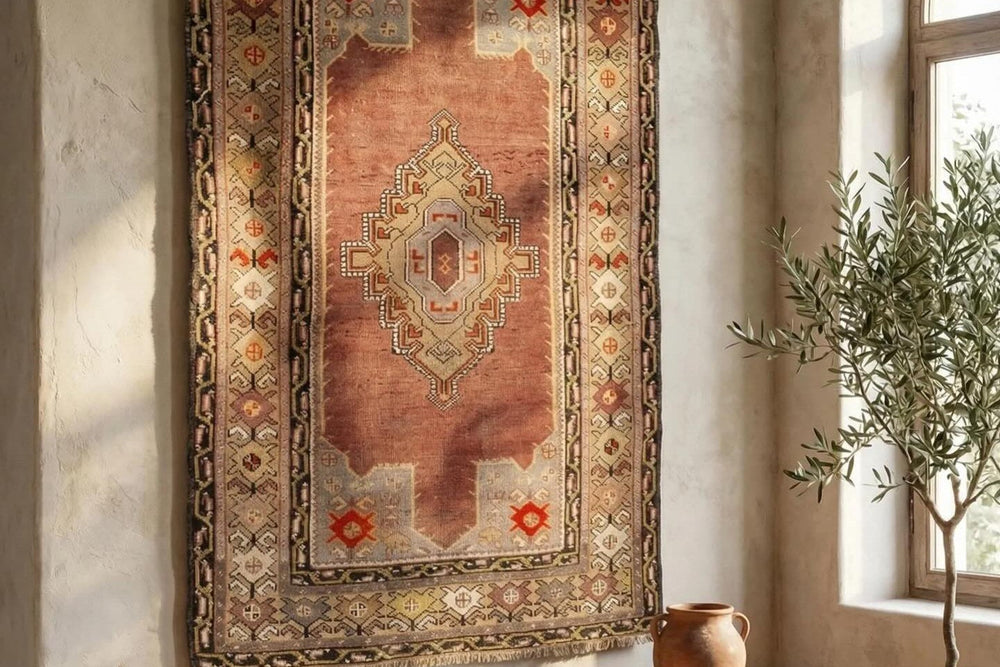
Before you study any single motif, look at the whole layout. Most Persian and Turkish rugs are built from three simple parts. Once you spot them, you will see them everywhere.
- The field, this is the main open ground of the rug, where the pattern sits. It may be covered edge to edge, or left fairly plain around a central shape.
- The medallion, this is the central shape that anchors many designs. It is often diamond-shaped or round. Sometimes small pendants reach out from its top and bottom.
- The borders, these are the frames that run around the edge. Usually there is one wide main border, with narrow guard borders (thin stripe borders) on each side. Each carries its own repeating pattern.
Once you can name the field, the medallion and the borders, the smaller motifs make more sense. You can see how a little shape in the field links to the larger design around it.

The boteh (paisley)
The boteh is a teardrop shape with a curved, bending tip. The West came to know it as paisley. You will find it scattered in neat rows across a field, or worked small into a border. Some are plain and pod-like. Others are filled with tiny flowers and leaves.
People have linked the boteh to many things: a leaf, a pinecone, a flame, a drop of water, a bending cypress tree. It is often tied to life, growth and fertility. That wide range is part of its charm. No single reading is the whole truth, and weavers loved it as much for its rhythm as for any one idea.

The herati (fish pattern)
The herati is one of the most common field patterns you will meet, above all in Persian weaving. It is a small rosette (a round flower shape) set inside a diamond, with a curved leaf on each of the four sides. Those leaves are often said to look like fish circling a pool. That is why it is also called the fish pattern, or mahi.
Because it repeats so evenly, the herati can fill a whole field with a quiet, all-over hum. It is often linked to water and plenty. Yet for many weaving families, it was simply the pattern they knew and passed down. You will see lovely examples among Tabriz rugs, where fine knotting keeps the little leaves crisp.
The gul (tribal medallion)
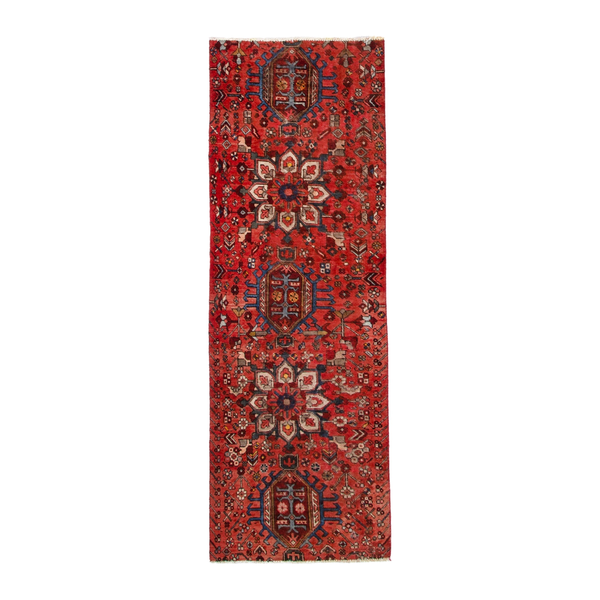
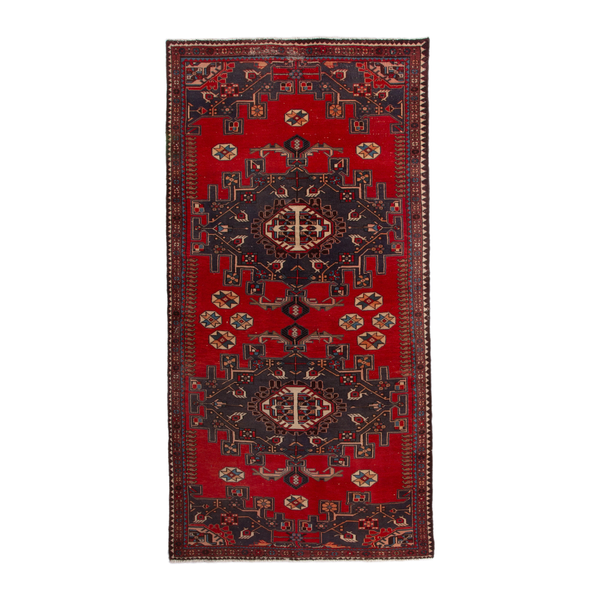
A gul is a small medallion, often eight-sided or angular, repeated across the field in rows. A city rug might have one grand medallion in the center. Tribal and village weaving often uses many smaller guls instead. The word is usually linked to the Persian for flower, though the shapes are geometric rather than floral.
Some guls became closely tied to a certain tribe. People sometimes read them almost like a signature of origin. Still, patterns traveled, were copied and were changed. So a gul tells you about tradition and family line more than any strict rule. They are a lovely thing to look for across Persian rugs when you want to trace a weaving back to its roots.

The central medallion
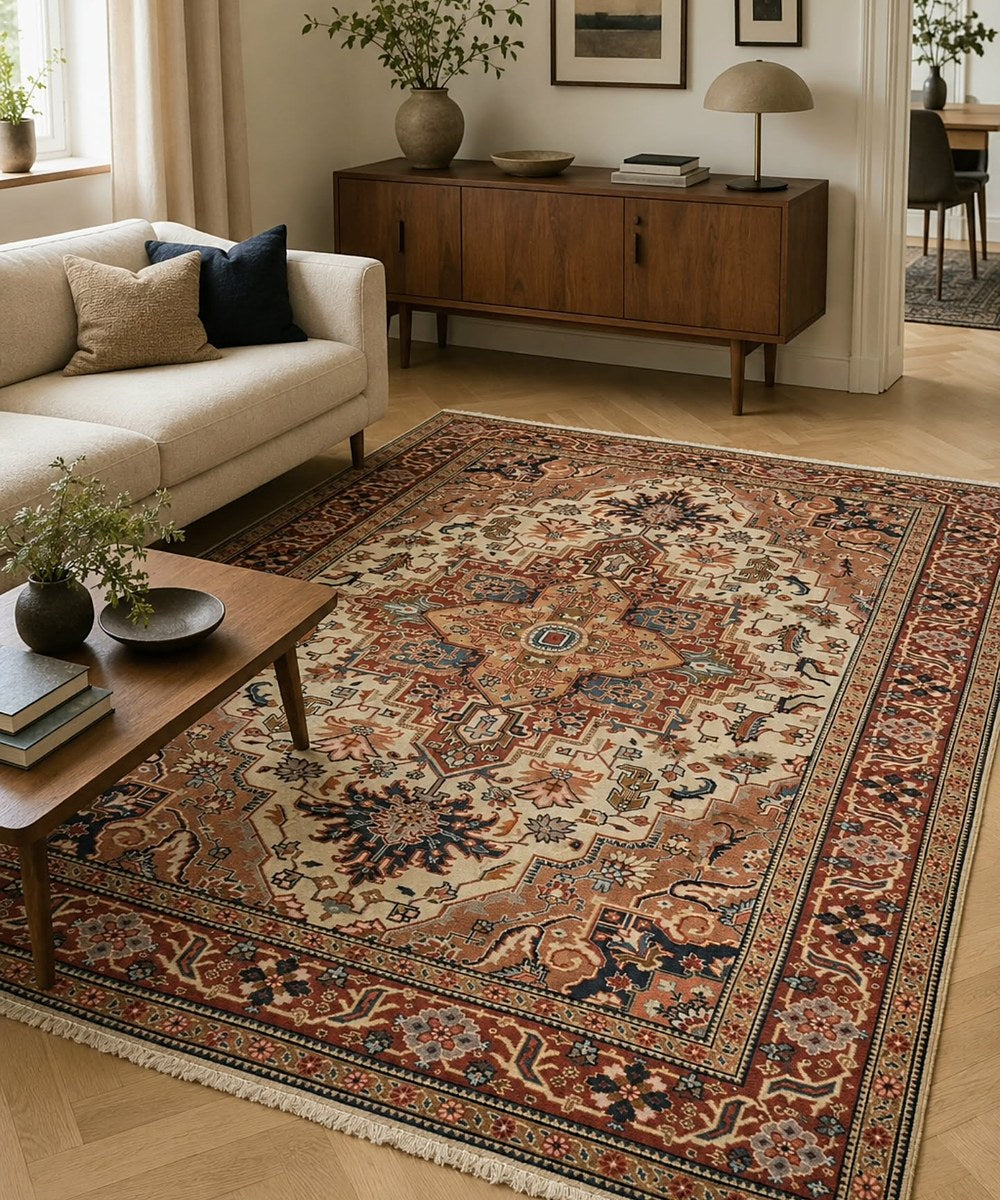
The central medallion is the grand statement at the heart of many formal rugs. It pulls the eye straight to the middle and gives the whole design a sense of order. In town and city workshops it can be rich and detailed. Fine floral tendrils spill out into the field, and matching corner pieces echo its shape.
Its meaning is often read as a center point: a pool, a dome seen from below, a garden viewed from above, or a sense of the sacred and the whole. Whatever the weaver meant, it also does a practical job. It organizes everything around it, so the borders and field feel like one design. Many of the most refined examples sit within our Turkish rugs and their Persian counterparts.
The tree of life
The tree of life is one of the most storied of all rug motifs. It is a growing tree, rising from the base of the rug and branching upward with leaves, blossoms and sometimes birds in its limbs. Unlike an all-over repeat, it has a clear top and bottom. So the rug reads in one direction.
Across many cultures it is linked to growth, continuity and the bond between earth and sky. It is often tied to paradise and the idea of an eternal garden. It is a motif worth sitting with. No two weavers draw their tree the same way, and each one feels a little like a personal vision.

Birds and animals
Look closely at borders and fields and you will often find living things tucked into the pattern. There are birds among branches, a peacock, a stylized lion, deer, or the small creatures a weaver saw nearby. In geometric weaving these can be so simplified that you might miss them at first, a bird cut down to a few angular lines.
The meanings vary widely. Birds are sometimes linked to messengers, the soul or good luck. The peacock stands for beauty and, in some stories, protection. The lion means strength and guarding. As always, treat these as invitations to wonder, not settled facts. Part of the pleasure is deciding what a creature seems to be saying in that one rug.
Reading, not decoding
The best way to enjoy these rug motifs is to hold them lightly. A boteh might mean fertility in one village and be pure ornament in the next. A herati field might be a symbol of water, or simply the pattern a grandmother taught. The symbolism is real, but it was never one fixed code. Weavers mixed memory, habit and imagination as they worked.
So let the shapes tell you a story. Notice the field, find the medallion, follow the borders, then look for the smaller motifs and ask what they might mean. And happily accept that another reading could be just as true.
If you would like to practice with real pieces, browse our full collection and see how many of these motifs you can spot for yourself. Each rug is one of a kind, and every one has a little reading of its own waiting for you.
Colour carries meaning too: natural dyes and why vintage colors age so beautifully. For where a drawing comes from, Persian and Turkish rugs: how to tell them apart.