Malayer Rugs: Village Weaving Between Hamedan and Arak
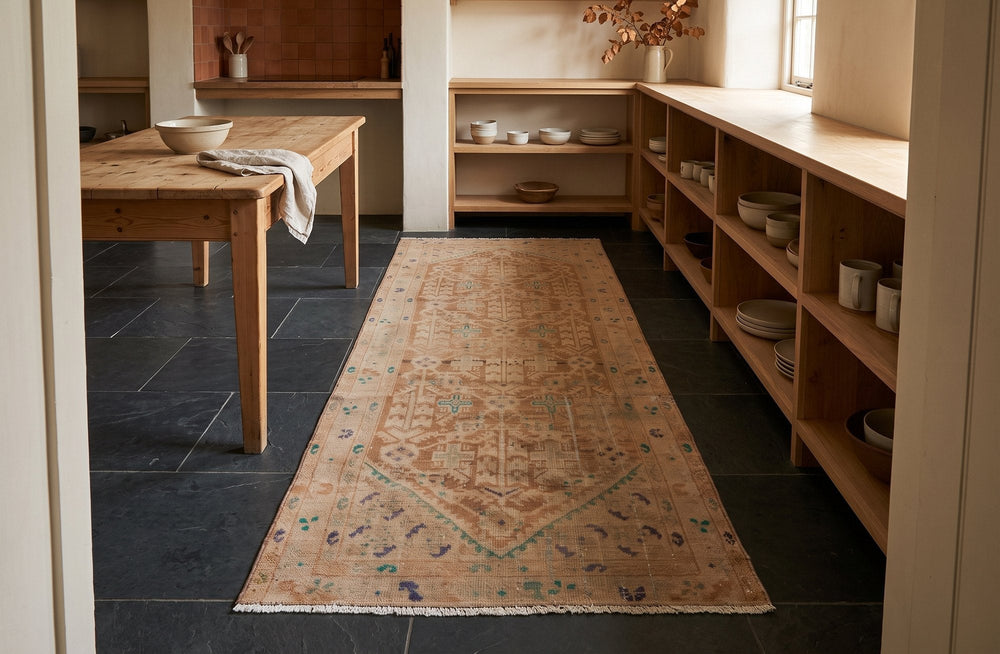
A Malayer is a village rug from the country around Malayer, a market town in the Hamedan weaving area of western Persia. Most are small rugs and runners, with either a dense all-over pattern or a single medallion. The colors run from deep red and navy to the soft tans and teals that come with age. The ones we sell are about fifty years old, woven in the 1970s for everyday use.

Where Malayer rugs come from
Malayer sits south of the city of Hamedan, on the side of the district that faces Arak. Rugs from the villages around Hamedan were brought into the city to be sold, so many of them carry the market’s name.[1] A few towns became known well enough to keep their own, and Malayer is one of them. Each village also kept its own stock patterns, which is why the drawing changes so much from one place to the next.[1]
To the southeast is Arak, where the carpets called Sarouk were made in the city and its nearby villages for the American market.[2] Malayer lies between these two weaving areas, and our rugs show both sides. Some are drawn in the straight, stepped lines of a Hamedan village rug. Others have curving stems and a rounder medallion, closer to the Arak look.
The Hamedan guide covers the wider district, and the Arak guide and the Mahal guide cover the weaving to the southeast. Tribal, village and city rugs explains what the village label tells you.
The design you will see most: the fish pattern
Most of our larger Malayers have an all-over repeat. Small rosettes sit between pairs of curved leaves, and a thin lattice links them across the whole field. In the trade this is the Herati, also called the fish pattern, because the leaves look like little fish.[3] You will also see it labeled mahi, from the Persian word for fish.[4] The Victoria and Albert Museum lists a carpet in this design from 1850 to 1875 as possibly Hamedan or Malayer.[5]
With no center to place, the repeat looks right at any length, so it suits runners well. Reading a rug explains the other motifs you will meet.

Some Malayers frame the repeat. A big six-sided medallion is cut out of the field and filled with the same small flowers, with tan corners around it, like the navy rug at the top of this page. On others the medallion is only an outline, drawn in a darker shade on a pale field.
Small Malayers with a single medallion
The small Malayers are mats of roughly 2 by 3 feet. Most have one medallion in the middle, ringed in cream, with flowers around it and darker corners.

A mat this size works at a door, beside a bed or in front of a reading chair. Where to put a small rug has more ideas, and the 2x3 collection gathers mats from every origin.

What colors Malayer rugs come in
Deep red is the usual field on the small mats, with cream drawing and a burgundy border. The larger rugs lean cooler, with navy, dark blue or teal fields and borders in dusty rose, antique gold or terracotta. Some have pale fields in beige, tan or taupe, and the odd mat has a black field. Rust, ochre and sage turn up in the detail.
Some of these rugs show bands where the color shifts across the field. That is abrash, the natural variation you get when wool is dyed by hand in small batches.[6] It is part of why a vintage rug looks alive, and natural dyes explains how it happens.

How to recognize a Malayer
Go by the drawing and the colors. The looks we see most under this name are a dense fish pattern on navy or teal, a big six-sided medallion with tan corners, and a small red mat with a cream-ringed medallion. Malayers sit so close to Hamedans that even a museum catalog can hedge between the two.
Every Malayer we sell is hand-knotted wool pile on a cotton foundation, like the Hamedans around it. Most have a low pile that lies flat and clears a door, and a few of the small mats are thicker. To read the knots on the back yourself, see Persian and Turkish rugs: how to tell them apart.
Malayer sizes: mats, runners and long rugs
About half are small mats, from 1 foot 8 inches by 2 feet 6 inches up to 2 feet 4 inches by 3 feet 2 inches, with a few rugs around 3 by 5 and 3 by 6 feet. Then there are runners and long rugs, 3½ to 5½ feet wide and about 10 to 16¾ feet long. Room sizes are the least common, and the ones we see are close to 7 by 10 feet.
The longest runners suit a long hall or a landing. Measure first and go by the exact size, not the label. Choosing the right runner length shows how.
What Malayer rugs cost
The small mats cost about $340 to $420, and the 3 by 5 and 3 by 6 rugs about $450 to $510. Runners and long rugs run from about $910 to $1,310, and room sizes cost more, around $2,100. On a hard floor, a thin pad under the rug protects it and helps it last longer.[7] Rug pads 101 covers what to put underneath.
Antique and vintage Malayer rugs
In the trade, an antique Malayer usually means one woven a century or more ago. The few that survive in good order are collectors’ pieces, like the V&A carpet from the mid-1800s mentioned above. The Malayers we sell are vintage, woven in the 1970s and used for about fifty years since. Antique vs vintage rugs explains where those lines fall.
Age alone does not set the price of an old Malayer. Size comes first, because a bigger rug took more hours to weave. Condition comes next: a low, even pile is normal at this age, but a bad repair or color added to hide wear takes value away. What determines the cost of a rug covers the rest.
Where to go next
You will find them all in the Malayer collection. The wider district is in Hamedan rugs. For small rugs from every origin, browse mini and accent rugs, and for halls, the runners.
Sources
- Hamedan rug. Encyclopaedia Britannica.
- Sarūk carpet. Encyclopaedia Britannica.
- Herati Design. ClipArt ETC, University of South Florida, from G. Griffin Lewis, The Practical Book of Oriental Rugs, 1913.
- A Comprehensive Persian-English Dictionary: māhiyān. F. Steingass, Digital Dictionaries of South Asia, University of Chicago, 1892.
- Carpet, Mahi design, possibly Hamedan or Malayer, 1850 to 1875. Victoria and Albert Museum.
- Talish Carpet. Springfield Museums.
- Basic care: Carpets and rugs. Canadian Conservation Institute.


