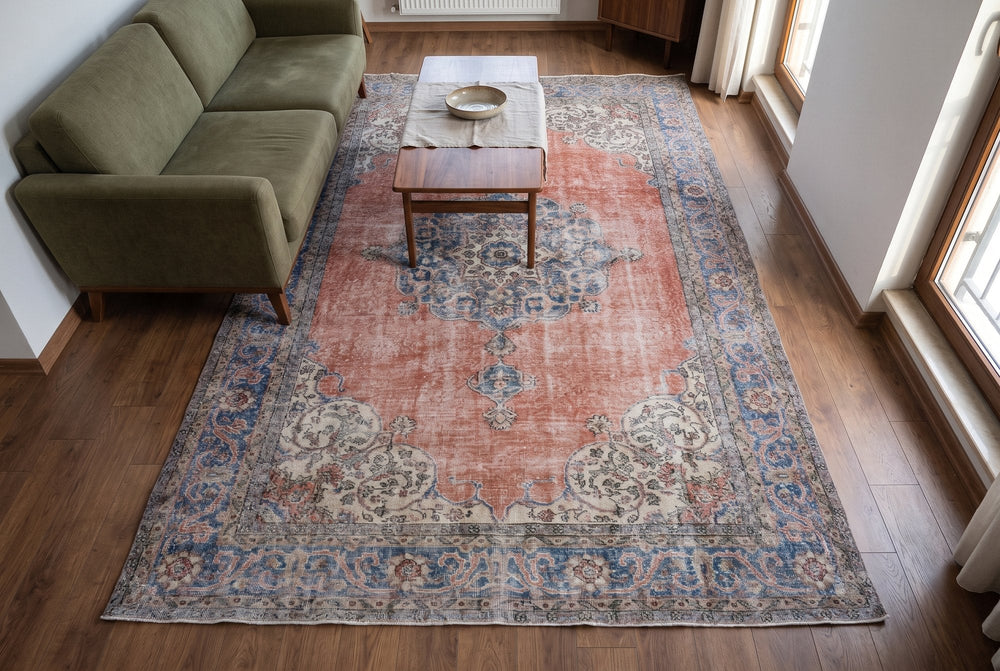
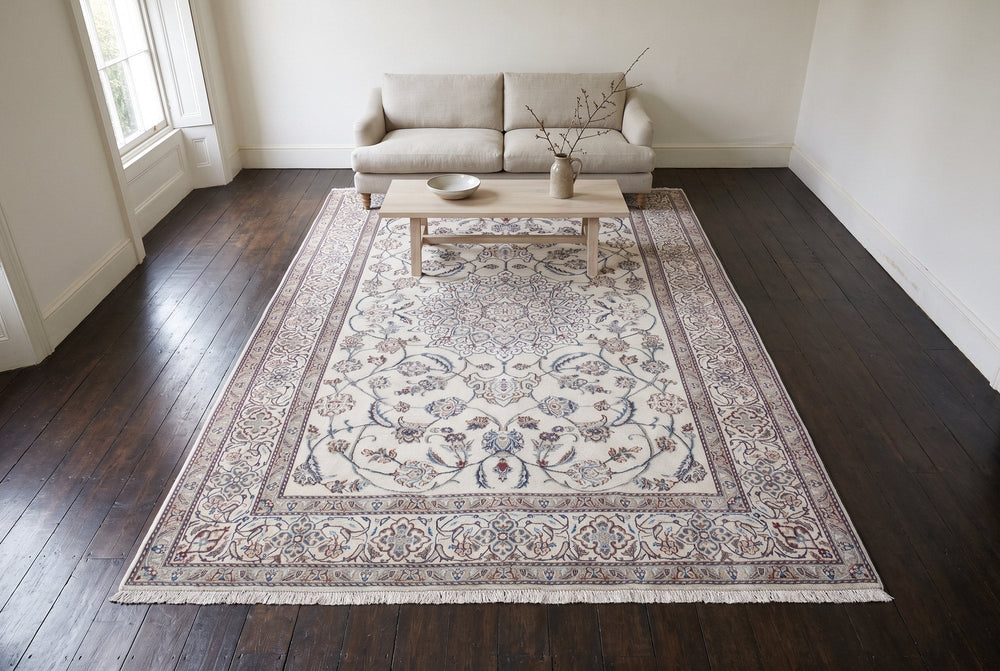
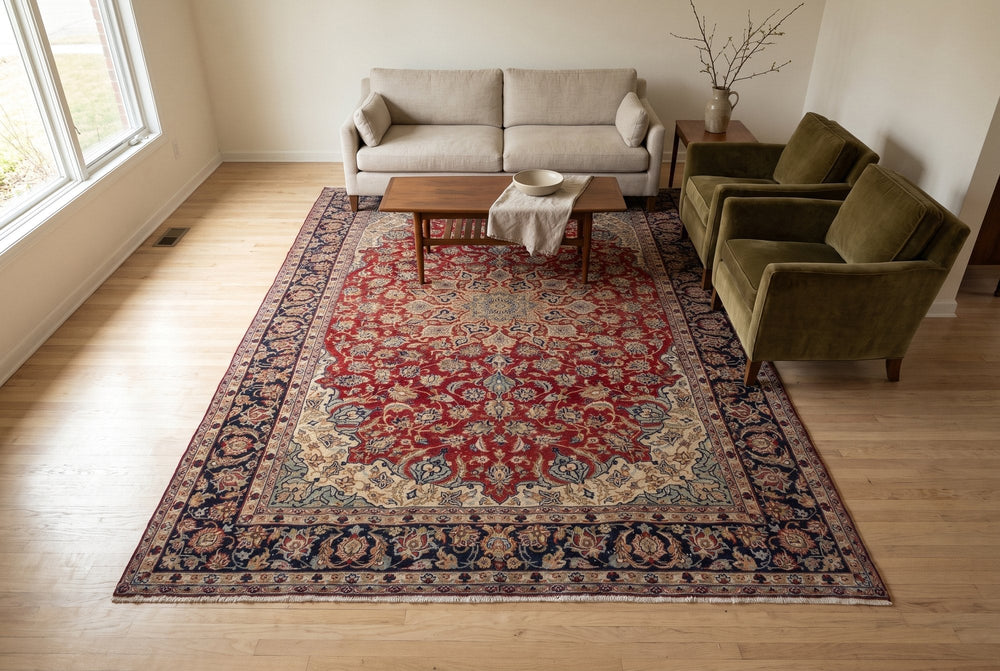
Arak is a city in central Persia that was called Sultanabad until the 1930s, and the old name still carries weight in the trade.[1] Arak rugs are best known for the boteh, a small teardrop repeated in rows across a red field. About half of the Arak rugs you will find are runners. The rest range from small mats to room-size carpets, so the name covers more sizes than most.

Sultanabad and Arak: one city, two names
In the rug trade, Sultanabad usually means the older carpets woven in and around the city for export, a century or more ago.[2] Those are antiques and priced like them. The Arak rugs we sell are younger, mostly woven between the 1940s and the 1980s. If the difference between those labels matters to you, antique vs vintage rugs explains how the trade uses them.
The area around Arak gave its names to several well-known weaves.[3] Mahal is one of them, a grade of large, coarser carpets made to fill big rooms, and our Mahal guide covers it. A rug listed simply as Arak comes from the same area without one of those grade names. Our Sarouk guide covers another name from the same district.
The boteh
The motif you will see most is the boteh, a teardrop with a bent tip. On many Arak rugs it is small and repeated in rows across the whole field. It is the same shape that European weavers copied, and the town of Paisley in Scotland eventually gave its name to it.[4]
On a rug the repeat does what the Torkaman gul does. It turns the field into a texture rather than a picture. In the trade, this all-over boteh design is often called Serabend, also written Saraband, after a district near Arak.[5]
You will also see some of our listings use the word Botteh. It is the same family. The trade has not fully agreed on which name to put on which piece, so we keep the name the rug came with rather than tidying it. The Botteh collection is worth a look alongside the Arak one.

Colors and pile
Deep red and burgundy are the ground on most Arak rugs, with cream and navy in the borders. A few have a navy, taupe or warm gray field instead. Those read quieter in a room and are worth looking for if red feels like too much.
Most Arak rugs are low pile, like nearly every rug we sell. Arak does have more high-pile pieces than most origins, though, mainly among the runners and room sizes. A higher pile feels softer and heavier underfoot. It also shows footprints and vacuum marks more, so check the listing if that matters to you.

Sizes: plenty of runners
Most Arak runners are 30 inches to 4 feet wide and 9 to 11 feet long. That is a good fit for a standard hallway. A few are longer, and the odd one runs well past 12 feet. The trade name for a runner in Persian is kenareh, and our page on standard Persian rug sizes lists the others.
The room sizes are mostly around 7 by 10 and 8 by 11, with a few larger. Between the two you will find small mats and some 3 by 5 and 4 by 6 rugs.

How to recognize an Arak
Start with the field. The most common Arak look is rows of small botehs on red, framed by a cream border. If there is no repeat, look for a curving floral medallion instead. Some Arak rugs have one, and they can look close to a city rug.

Then turn a corner over. The back of an Arak is neat and even, and the white cotton of the foundation shows at each end as fringe.[5] A thicker pile than usual is another hint, since Arak has more high-pile rugs than most origins.
What an Arak costs
Most Arak runners cost between $600 and $1,000. The small mats cost less, and the room-size carpets more. That puts Arak between the village rugs and the fine city workshop rugs.
Where an Arak fits
An all-over boteh rug is more forgiving than a medallion rug in a room where furniture covers part of the floor. There is no center to hide, so the rug still looks whole when a table or a bed covers the middle. That makes Arak a sensible choice for a dining room or a bedroom. See bed sizing for the measurements, or dining room rug size for the table.
The same repeat suits a hallway, because the pattern reads the same from either end. For how long a runner should be, see choosing the right runner length.
Caring for an Arak
Care is the same as for any wool rug. Vacuum with suction only, or with the beater bar raised.[6] Turn a runner end to end every six months or so, because the end by the door takes most of the grit.[6] On a hard floor, put a thin pad underneath so the rug does not creep. Our rug care page covers spills and washing.
You can browse every one in the Arak collection.


Sources
- The Ardabil Carpet. Victoria and Albert Museum.
- C.R. Smith Archive. Victoria and Albert Museum.
- Sarūk carpet. Encyclopaedia Britannica.
- Paisley. Encyclopaedia Britannica.
- Seraband rug. Encyclopaedia Britannica.
- Basic care: Carpets and rugs. Canadian Conservation Institute.