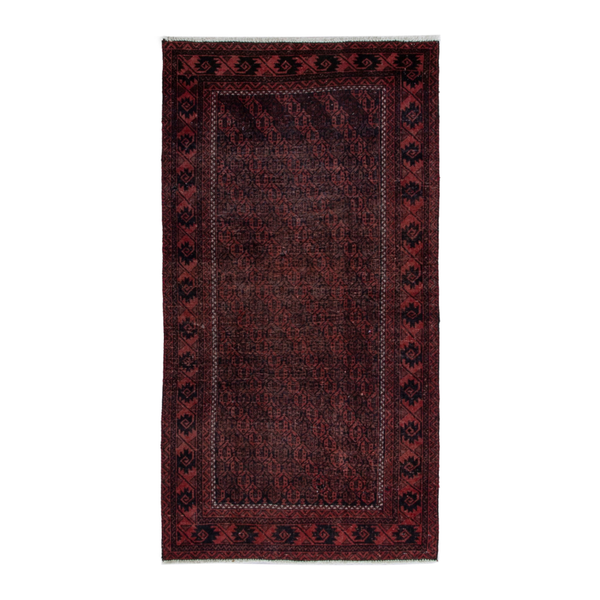
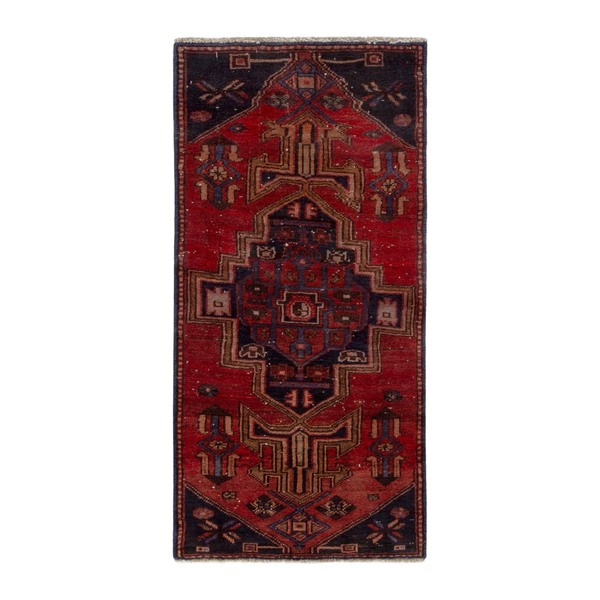
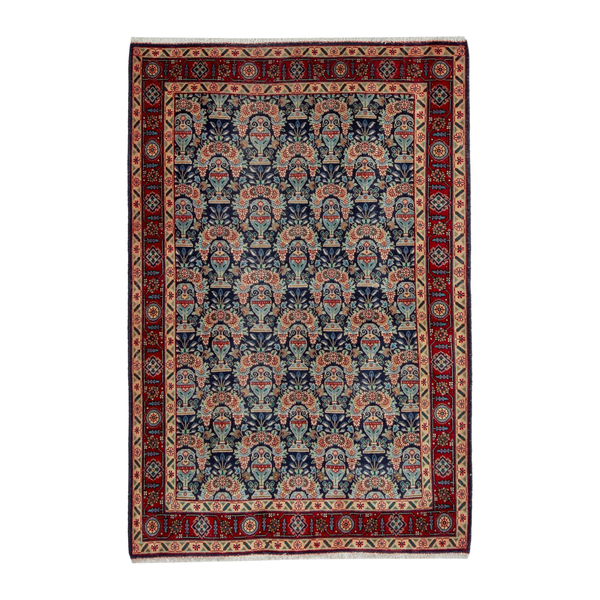
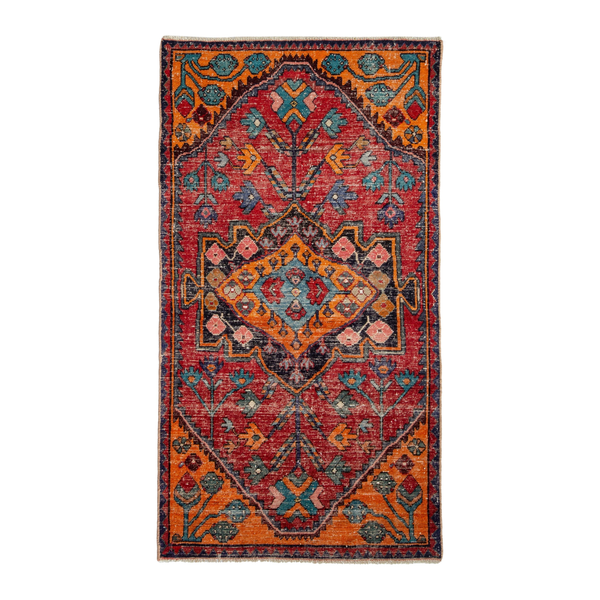
A low pile rug is a rug whose pile, the short tufts of yarn standing up from its foundation, is clipped close, so the surface feels firm, lies flat and shows the design sharply. Doors swing over it, dining chairs slide across it and crumbs stay on top where the vacuum reaches them. Most vintage hand-knotted rugs are low pile, and almost all of ours are; a deep, shaggy rug sits at the other end of the scale.
What pile is, and how its height is measured
The carpet trade defines pile as the visible wear surface of a carpet, made of yarn tufts in loop or cut form.[1] Pile height is the length of those tufts, measured up from the backing.[1] On a machine-made or tufted rug, that backing is a cloth the yarn is fixed into.
A hand-knotted rug has no backing cloth. Each knot is tied around the lengthwise threads of the foundation, and its two loose ends stand up as pile. The weaver then shears the ends to an even height, which can be anything from under 5 millimeters to 10 or more.[2] That is roughly a fifth of an inch to two fifths.
Height is only half of it. The trade also measures density, and the higher the density, the more compact the pile.[1] A short, dense pile feels firm and springs back. A short, sparse one can feel thin and crush flat.
Low, medium and high pile compared
There is no single industry line between low, medium and high pile, and shops draw it in different places. So read the words as a rough scale, and look for a measured height or a photo of the rug’s edge when it matters.
- Low pile. Short, dense and firm. The design reads crisply, furniture stands level, and dirt sits near the surface. Most vintage Persian and Turkish rugs are here.
- Medium pile. Softer underfoot, with more give. It shows footprints and the marks of a vacuum more than a low pile does.
- High pile and shag. Long, loose tufts that you sink into. Warm and soft for bare feet, but chairs drag on it and it holds onto crumbs and grit.
One useful benchmark comes from US accessibility rules. On an accessible route, carpet pile may be no more than half an inch, or 13 millimeters, high.[3] A hand-knotted rug clipped low sits well under that. If someone in the house uses a wheelchair or a walker, rugs for wheelchairs and walkers covers pads and edges as well as pile.
The thick end of the scale is easiest to picture with a Moroccan rug, and Persian vs Moroccan rugs sets the two side by side. Tufted rugs are made differently again, as hand-tufted vs hand-knotted rugs explains.
Low pile vs flatweave
A flatweave is not a very low pile rug. It has no pile at all: the pattern is woven into a single layer of cloth, which makes it thin and often reversible. Our guide to kilim rugs explains the difference and where a flat-woven rug works. We do not sell flatweaves; every rug on this site is hand-knotted pile.
Where a low pile is the better choice
Under a door
A door that opens over a rug needs room for the rug and the pad together. Designers advise checking that both clear the bottom of the door before you buy.[4] A low pile usually clears an interior door that a shag would catch, but swing the door over the spot to be sure.

In a dining room
Chairs slide across a low, dense pile instead of catching in it, and spilled food stays on the surface. The size matters as much as the pile here, and what size rug goes under a dining table gives it by number of seats. Our dining room rugs gather the sizes that fit.

In a kitchen or a hall
A kitchen floor gets crumbs, drips and constant traffic, and a low pile is far easier to keep clean than a deep one. Our post on a rug in the kitchen covers placement and care, and the kitchen rugs are sized for it. In a hall, a low runner lies flat along its whole length, and most of our runners are low pile.

Under furniture, wheels and robots
A sofa or a cabinet stands level on a low pile, and the dents it leaves stay shallow. How to put a rug under heavy furniture covers moving it into place. A robot vacuum also handles a low pile far better than a deep one, as a robot vacuum on a wool rug explains.
When a higher pile makes sense
A deep pile earns its place where feet are bare and traffic is light: a bedroom or a quiet reading corner. If you love the look of a vintage rug but want more give underfoot, add the softness with a pad rather than a thicker rug. Rug Pads 101 compares the pads.
Living with a low pile rug
Low does not mean hard. Wool fibers are crimped, and crimp helps wool recover its shape after being pressed down.[5] That is why a short wool pile feels springy rather than flat, and why footprints fade from it quickly.
Conservators advise vacuuming with a standard head rather than a power head, on low suction.[6] They also advise going in the direction of the pile.[6] Run your hand along the rug: the smooth way is the direction the pile lies. Our rug care page has the full routine, and do wool rugs shed? explains the loose fiber a vacuum picks up.
An even, low pile is how a vintage rug was made, not a sign that it is worn. Wear shows as patches lower than the pile around them, where the knots start to show from the front.
Almost all our rugs are low pile, and each listing says whether the pile is low or high. If you are buying for a dining room or a busy hall, the dining room rugs and the runners above are the place to start.
Sources
- The Carpet Primer. The Carpet and Rug Institute, 2020.
- Afghan Wars, Oriental Carpets, and Globalization. Penn Museum, Expedition Magazine, 2011.
- ADA Accessibility Standards. U.S. Access Board.
- How to Find the Perfect Rug to Match Your Queen Bed. Elle Decor, 2023.
- What is the Wool Fiber? The Woolmark Company.
- Basic care: Carpets and rugs. Canadian Conservation Institute, Government of Canada, 2018.