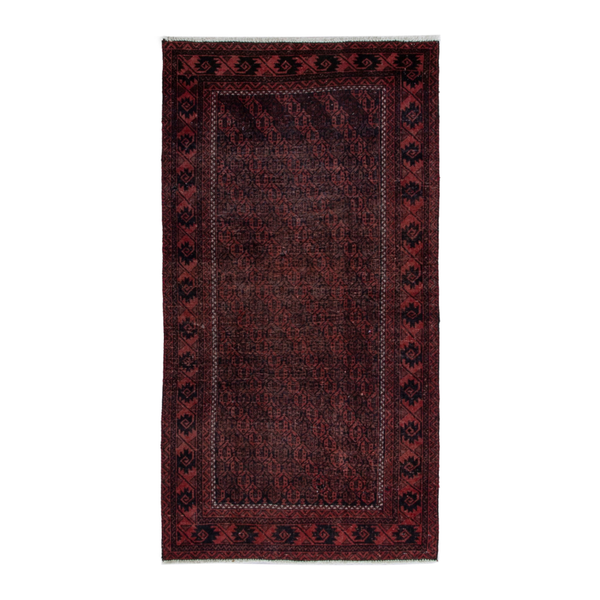
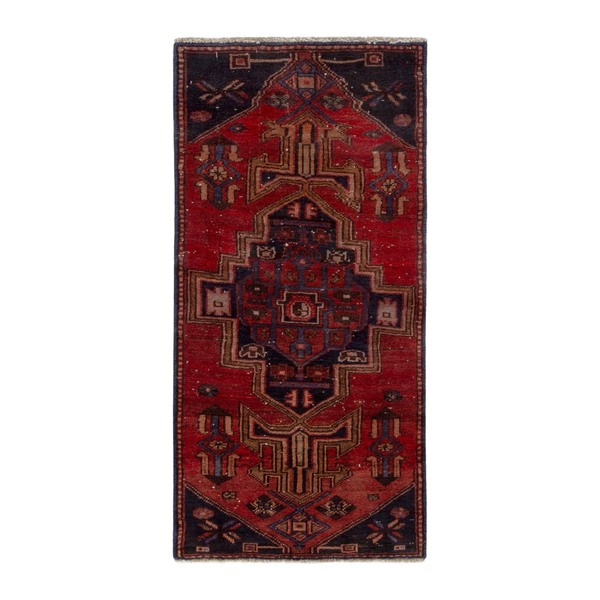
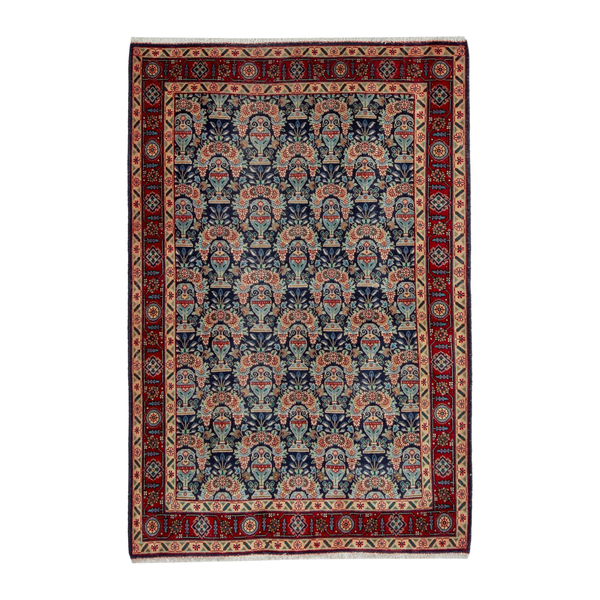
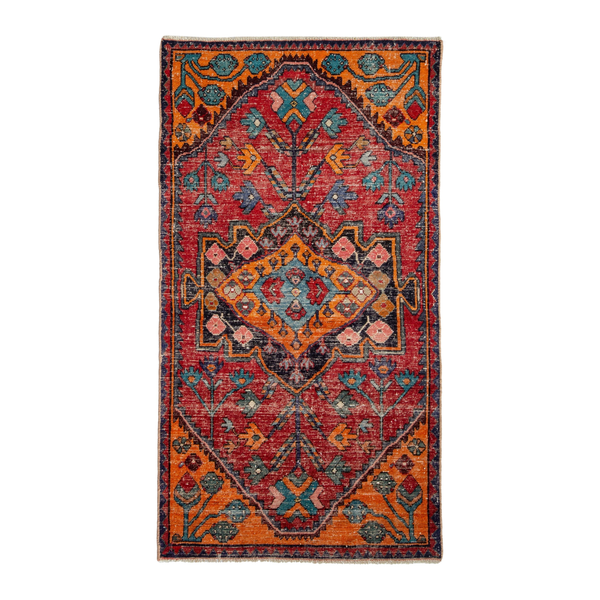
A hand-knotted rug is built knot by knot. The weaver ties every tuft of wool around the threads of the foundation, so the pile and the rug are one structure. A hand-tufted rug is made faster, by punching yarn into a ready-made backing cloth with a hand-held gun and then gluing the back with latex. Knotted rugs cost more and last for generations, because they can be washed and repaired. Tufted rugs cost less, look good when new, and are usually replaced rather than restored.

How a hand-tufted rug is made
Tufting starts with the backing, not the pile. In tufted carpets, the yarn is pushed by a needle into a fabric that already exists.[1] On a factory machine, a whole row of needles does this at once. A hand-tufted rug uses a single needle in a tufting gun, which a worker moves over a cloth stretched on a frame. Wool is the usual yarn for this kind of hand tufting, and both powered and manual guns are in use.[1]
At this stage the yarn is only pushed through the cloth, and a tug would pull it out again. So the back is coated with synthetic latex, and a second fabric is laid over it.[1] That second layer is there to anchor the tufts and keep the rug stable.[1] The carpet industry describes the same parts in every tufted product: face yarn, a primary backing, a bonding compound that is usually latex, and often a secondary backing.[2]
The finished rug looks like a pile rug from the front. Underneath, it is a cloth sandwich held together by glue.
How a hand-knotted rug is made
A knotted rug has no backing cloth to start from. Its foundation and its pile are built together, row by row, on the loom.[1] The weaver ties rows of knots around pairs of warp threads, the threads that run the length of the rug.[3] After each row, cross threads called wefts are woven in before the next row of knots.[3]
Each tuft is separate from the next, so the weaver can put any color anywhere.[1] Nothing is glued. Our post on why hand-knotted rugs outlast machine-made ones walks through the build in more detail. All those hours of knotting are why a knotted rug costs more, as what a rug costs and why explains.
What the difference means on your floor
How long each one lasts
A tufted rug lasts as long as its glue. When the latex dries out, the backings can separate, which the trade calls delamination.[2] At that point the rug is usually finished. A knotted rug wears more gently. The pile gets lower where people walk, but the knots stay tied, and a worn patch can be rebuilt with new knots.

Shedding
Every new wool rug gives up some loose fiber. A tufted rug can keep shedding for years, because only the glue holds its tufts. Do wool rugs shed explains why, and why a washed vintage knotted rug sheds very little.
Smell
A new tufted rug can smell of its latex backing for its first days. A knotted rug has no backing to smell. If a wool rug of either kind smells later, damp is the usual cause, and why a wool rug smells covers what to do.
Cleaning
A knotted rug is built to be washed. Washing it in water and brushing it is a normal part of finishing a new one.[1] A tufted rug needs more care, because its backing is the weak point. The carpet industry warns not to let a spot-cleaning solvent reach the backing, since it can damage the latex that holds the two backings together.[4] We would not soak a tufted rug. Read its care label, and choose a cleaner who knows how it is built. For a knotted rug, our guide to cleaning a wool rug at home has the routine.
Repair
A knotted rug can be rewrapped at the sides, secured at the ends and rewoven where it has a hole. Persian rug repair sets out what can be fixed and when it is worth it. A tufted rug offers much less to work with, because there are no knots to retie and the backing is what holds everything.
How to tell them apart in a minute
Turn a corner over. A knotted rug shows its pattern on the back in small, slightly uneven knots, while a tufted rug has a plain cloth backing with no design at all. How to tell if a Persian rug is real goes through the other checks.
Then look at the ends. On a knotted rug, the ends of the warp threads are left as fringe at each end of the rug.[3] Follow a strand and it runs straight into the body of the rug. A tufted rug has no warps, so any fringe it has is a strip sewn or glued along the end. Our post on rug fringe explains why the warp fringe should never be cut off.

What “hand-tied” and other labels mean
Labels blur these differences. “Handmade” and “hand-loomed” can both be used for tufted rugs, because a person held the tool. If a listing says “hand-tied” rather than “hand-knotted,” ask the seller which they mean. Then ask for a photo of the back, because knots tied around the warps are the thing you are paying for.
A flat-woven rug is another category again. It has no pile at all, and our kilim guide explains how it is made.
When a tufted rug is the sensible buy
A tufted rug is a fair choice in a few situations. A single gun can place a tuft of any color anywhere, so tufting suits bold, custom designs.[1] It can be made to an exact size or shape, and it costs much less because it takes far less labor. In a rental you will leave in two years, or a playroom that will be outgrown, that can be the right trade. Machine-washable rugs are a separate choice again, and washable rugs vs wool rugs compares them honestly.
We do not sell tufted rugs. Every rug we sell is hand-knotted wool on a cotton foundation, about fifty years old, and washed before it is listed. If price is what pushes you toward tufted, look at our rugs under $500 first. Otherwise start with our Persian rugs or Turkish rugs, and read our authenticity page for what we can tell you about each one.
Sources
- Wool Carpet Manufacture (Wool Processing, lecture 13). Australian Wool Education Trust and University of New England, 2009.
- The Carpet Primer. The Carpet and Rug Institute.
- Afghan Wars, Oriental Carpets, and Globalization. Penn Museum, Expedition Magazine, 2011.
- Spot Solver: Grease. The Carpet and Rug Institute.