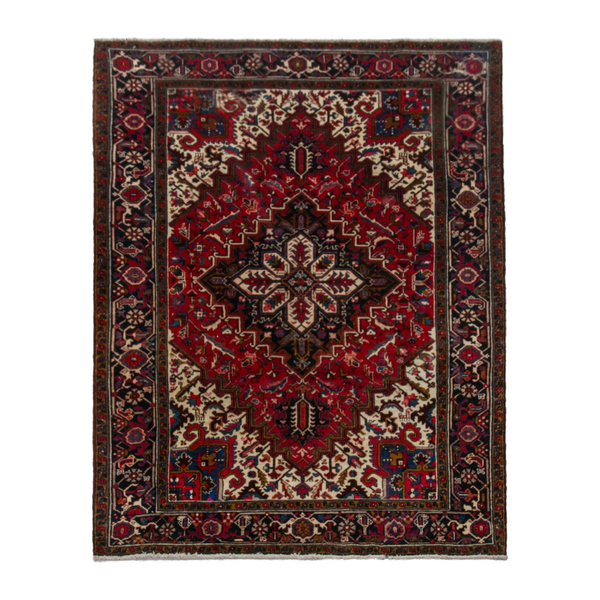
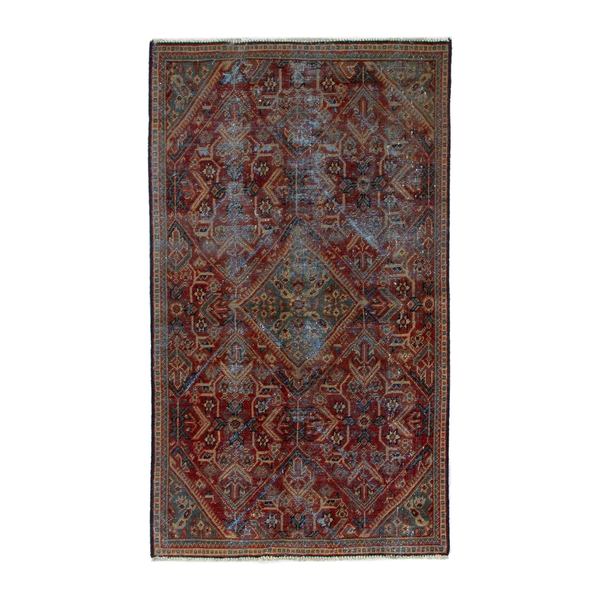
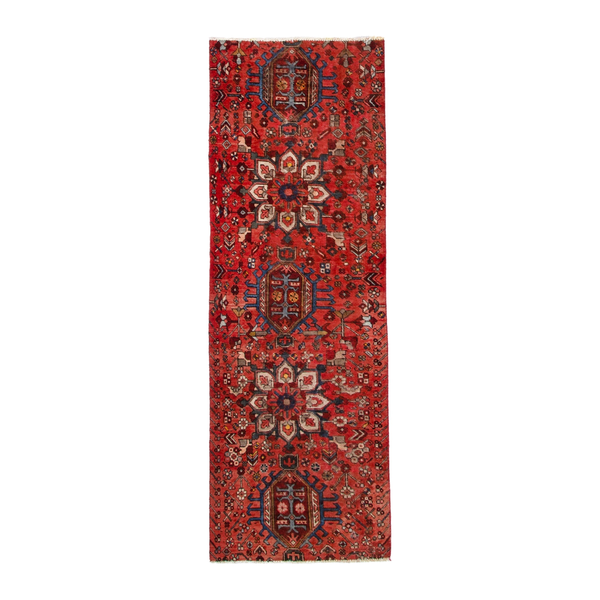
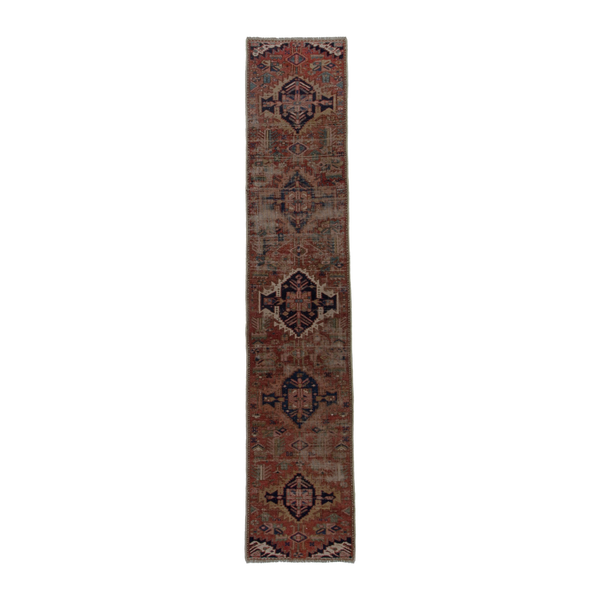
Have you ever wondered why one rug lasts a century while another looks tired within a few years? The answer usually comes down to how it was made. The whole question of hand-knotted vs machine-made rugs is really a question about construction. Once you understand what is happening beneath the surface, the difference in lifespan stops being a mystery. A hand-knotted rug is built to be repaired, re-used and handed on. A machine-made or tufted rug, for all its convenience, is built to be replaced.
This is not about snobbery. Both kinds have their place. But if you want a floor covering that ages into something better than it started, it helps to know exactly what you are buying.
How a hand-knotted rug is actually built
A hand-knotted rug begins as bare vertical threads, the warp, stretched tight on a loom. A weaver then ties thousands upon thousands of individual wool knots by hand, one at a time. Each is tied around a pair of those warp threads. After each row of knots, one or more horizontal weft threads are passed across. These are beaten down firmly to lock everything in place.
The result is a dense, interlocked structure. The wool pile you walk on is not stuck to anything, it is the rug, anchored by the knots into the foundation. On the vintage and antique pieces we sell, that foundation is typically cotton (sometimes wool), with a wool pile on top. Nothing is glued. Every part is either knotted or woven. That is precisely why these rugs can be taken apart and put back together decades later.

How machine-made and tufted rugs differ
Machine-made rugs are produced on power looms. The pattern is fed in by computer, and synthetic or blended yarns are woven mechanically at speed. They can look neat and cost very little. But the yarns are usually held in place by the weave structure and a backing rather than by hand-tied knots.
Tufted rugs are different again. A tool punches loops of yarn through a pre-printed cloth backing. Those loops are held in place by a layer of latex glue, then sealed with a second backing cloth. There are no knots at all. The entire rug depends on that adhesive skin holding.
You can often feel the difference in seconds. Fold the corner of a hand-knotted rug and it flexes; the knots on the back mirror the pattern on the front. Fold a tufted rug and you meet a stiff, rubbery layer. The plain cloth back tells you nothing about the design.
Why knots and wool mean durability
Because each knot in a hand-knotted rug is an independent unit, wear stays local. If a patch gets thin or a corner frays, a restorer can rebuild that area knot by knot. They can re-warp a damaged end, or reweave a section using the same techniques the original weaver used. This is ordinary, well-understood work, and it is why so many of the rugs we carry are described as professionally restored. They have been through it and come out sound.
Natural wool helps enormously here. Wool fibers are springy and resilient, they resist crushing underfoot, and their natural oils shrug off everyday spills. Wool also takes natural dyes in a way that mellows gracefully over the years rather than looking flat.
- Repairable: individual knots can be replaced without disturbing the rest of the rug.
- Resilient: wool pile recovers its shape and resists matting.
- Structurally sound: nothing relies on glue that can fail.
- Serviceable: ends, edges and foundation can all be reworked.
Why tufted and glued rugs cannot truly last
The weakness of a tufted rug is the same thing that makes it cheap to produce: the glue. Latex adhesive degrades with time, heat and cleaning. As it breaks down, the rug begins to shed fibers, and eventually the layers separate. This is a problem known as delamination, where the backing peels away from the pile. Once that starts, there is no honest fix. You cannot re-knot what was never knotted, and re-gluing a whole rug is neither practical nor lasting.
Many machine-made rugs face a milder version of the same fate. When the surface wears through, there is little underneath to rebuild, because the pile was never anchored by hand. At that point the rug has simply reached the end of its life.

Ageing into character, not wearing out
Here is the quiet advantage of good hand-knotted work: it improves with use. Decades of footsteps burnish the wool to a soft sheen. Natural dyes settle into gentle tonal variation, the effect collectors call abrash. Small signs of a long life, a slightly worn field, a re-wrapped edge, read as history rather than fault.
A well-made and well-kept hand-knotted rug can remain in use for generations. That is not a marketing promise; it is simply what happens when every fiber is anchored by hand and the whole thing can be maintained. A tufted rug, by contrast, tends to look its best on the day it arrives and slowly downhill from there.
What this means for value
Durability and value go hand in hand. Because they last and can be restored, quality vintage and antique hand-knotted rugs tend to hold their worth. Genuinely fine or rare examples can even appreciate. Each is one of a kind, tied by a particular weaver in a particular place. No power loom can reproduce that.
A tufted or machine-made rug is a consumable. It does a job for a while and is then thrown away, with little to no resale value. Neither approach is wrong, but if you are weighing what to spend, it is worth knowing whether you are buying something to keep or something to discard.
If you would like to see how this looks in practice, browse our full collection of one-of-a-kind rugs. You could also start with our hand-knotted Persian rugs. You can also read more about how we source and restore every piece we sell. Take your time, feel the difference in the weave, and choose a rug you will still be glad to own decades from now.
Related: what makes a vintage rug worth keeping applies this to a rug in front of you, and reading a rug: motifs and what they mean turns to the drawing.