Have you ever stood over two lovely rugs and wondered where each one came from? It is one of the oldest questions in the trade. The Persian vs Turkish rugs question comes up again and again. The two weaving worlds share centuries of history, yet they pull in different directions. Learning how to tell Persian and Turkish rugs apart is not about memorising rules. It is about learning to read a rug, its knots, its patterns and its colors. Once you know what to look for, the differences start to feel clear.
At Storied Rugs we handle one-of-a-kind vintage and antique pieces every week. Most are 40–80 years old, and no two are the same. So treat what follows as reliable signals, not hard borders. There is real overlap between the two traditions, and plenty of honorable exceptions.
The knot: the one difference that never lies
The best way to tell the two apart is the knot. A knot is the loop of wool tied to the base of the rug to make the surface. That base is called the foundation. The soft surface it forms is the pile. The knot is a structural fact, not a matter of taste.
Persian weaving usually uses the asymmetric knot, also called the Senneh knot. Asymmetric means one-sided. The yarn wraps fully around one warp thread and only loops behind the next. Warp threads are the base threads that run the length of the rug. This one-sided wrap lets the pile lie in a way that suits fine detail. That is why so many Persian city rugs can hold flowing, curved lines.
Turkish and Anatolian weaving usually uses the symmetric knot, also called the Ghiordes knot. Symmetric means even on both sides. The yarn wraps around both warp threads and pulls up evenly between them. It is a sturdy, balanced knot. It suits bold, upright, geometric shapes.

How to check the back
Turn the rug over and look closely at the back, ideally in good light. On a symmetric (Turkish) knot, the two small nodes sit evenly, like a balanced pair. On an asymmetric (Persian) knot, the tuft leans to one side, so the knots look slightly offset. A magnifying glass helps. So does patience, the pattern becomes clear once you have studied a few rows.
One honest note: some Persian regions use the symmetric knot too, especially around Tabriz in the northwest. So the knot points you in a strong direction. But read it alongside the design before you decide.
Design language: curves versus corners
If the knot is the science, the design is the personality. It is usually the first thing people notice. It makes a good second opinion after you have looked at the back.
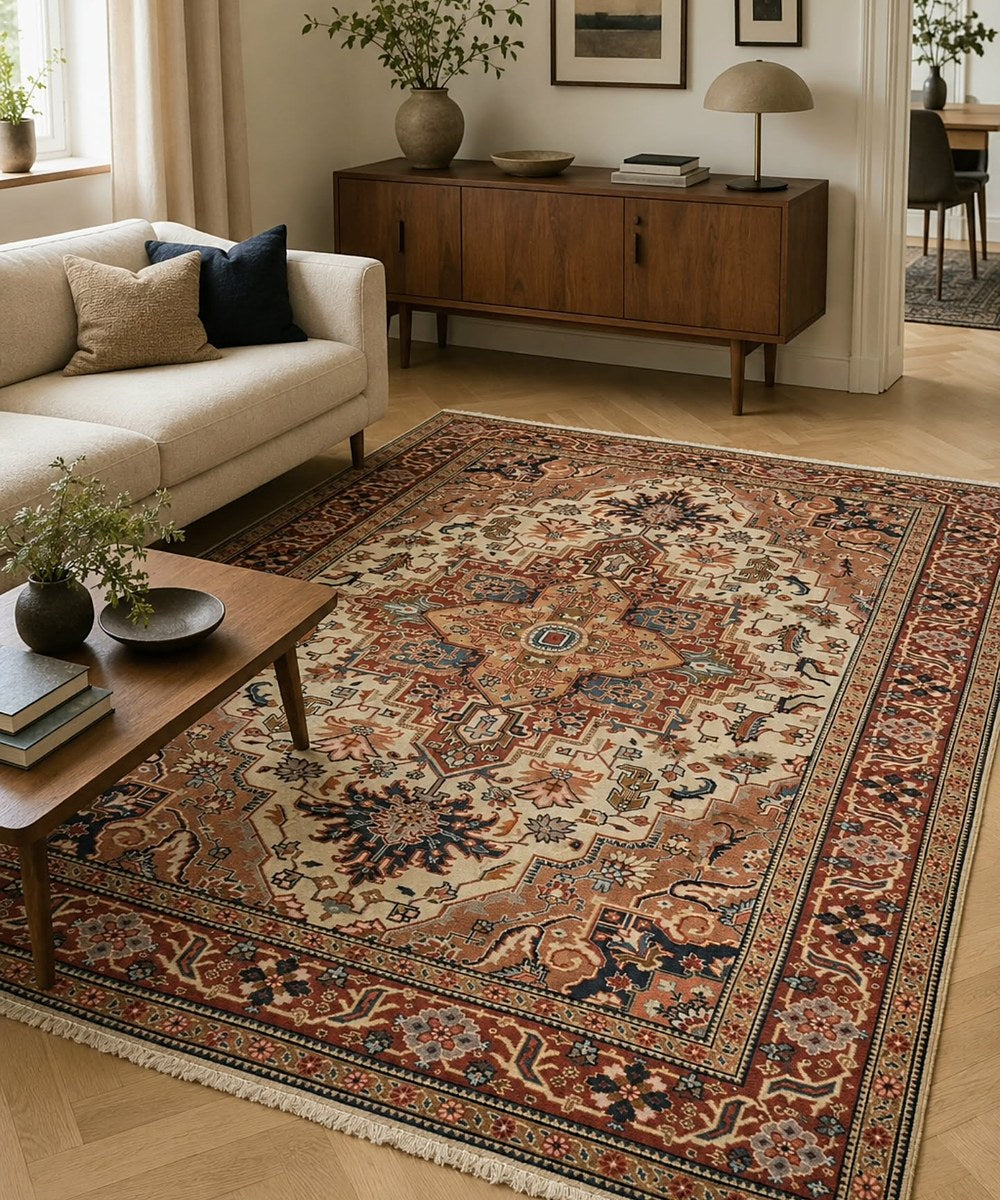
Persian city rugs lean curvilinear, which simply means built from flowing curves. Picture a central medallion, a large shape in the middle of the rug, floating on a field of scrolling vines, palmettes and flowers. Elegant corner pieces often frame the whole design. Weaving centers such as Tabriz, Kashan, Mashhad and Kerman became famous for this refined, garden-like style. The weaver works from a drawn plan, so the curves stay graceful and precise.
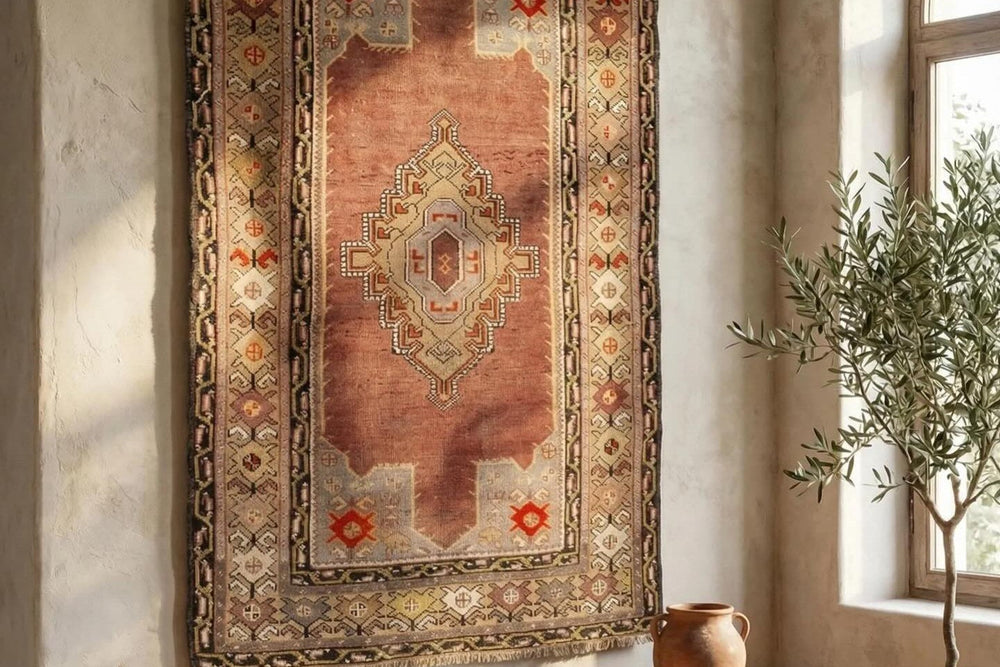
Turkish and Anatolian rugs lean bold and geometric. Instead of soft floral curves, you tend to see strong outlines, stepped medallions, hooked shapes, stars and simple stylized forms. Two types stand out. The prayer rug has a pointed niche, called the mihrab, at one end. The flat-woven kilim is built entirely from geometric blocks of color.

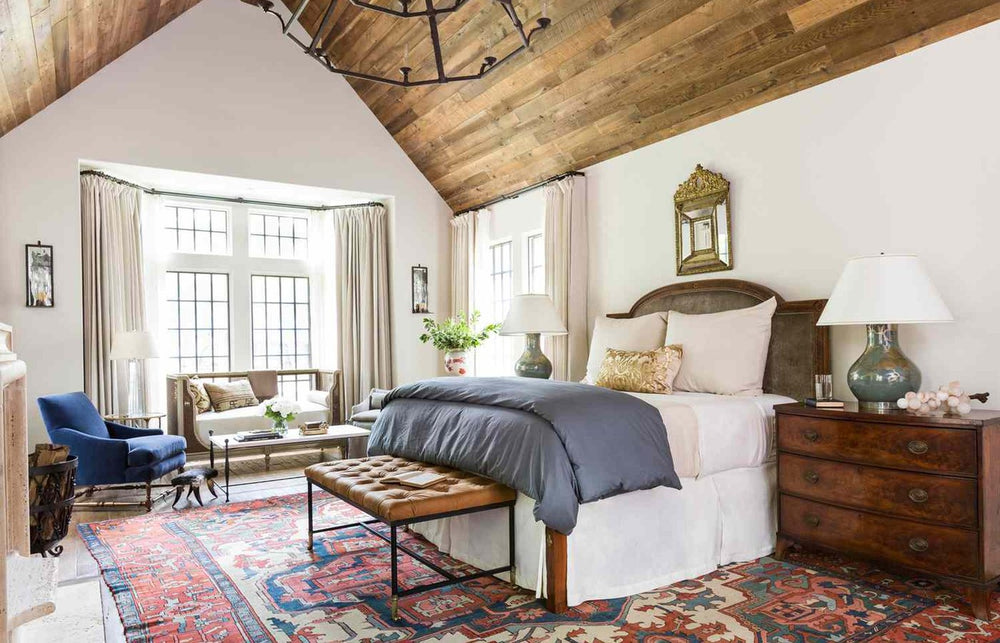
That said, plenty of Persian rugs are proudly geometric too. Tribal and village weaving favors angular medallions and repeating motifs. Tribal means made by nomadic or rural groups from memory, not from a drawn plan. Areas such as Hamedan and Shiraz work this way. So “geometric” alone does not make a rug Turkish, it just tells you to keep checking.
Palettes and regions
Color is the least reliable clue on its own, because dye traditions traveled freely. Still, it adds useful context.
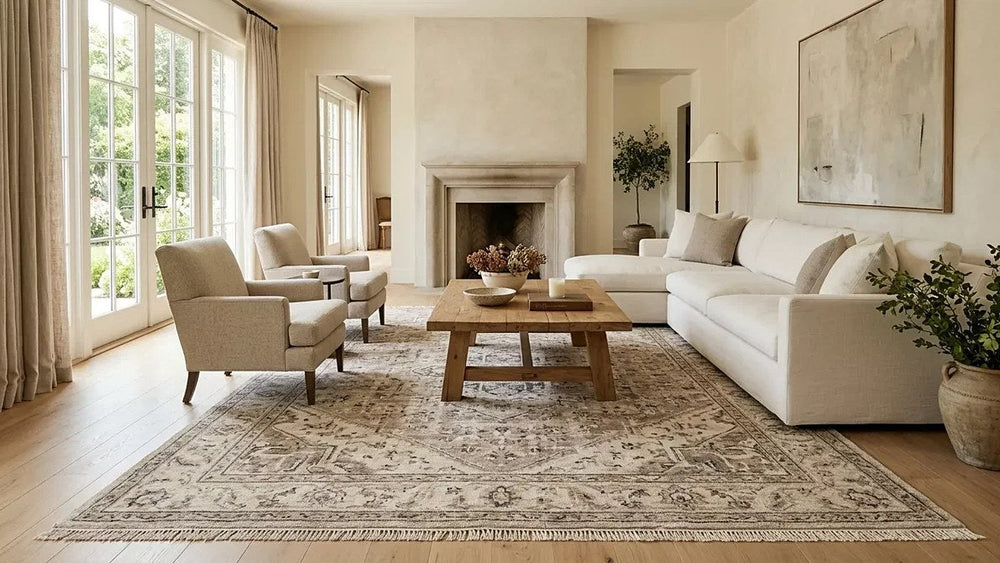
Persian city rugs often reach for deep, jewel-like tones, indigo blues, madder reds, soft ivories and rich accents. These are arranged in careful, balanced schemes. Many Persian rugs feel measured and formal in their color.
Turkish and Anatolian rugs often favor warm, earthy palettes, terracotta, saffron, madder red, ochre and undyed wool. These come from local plants and regional flocks. Weaving towns such as Isparta and Manisa each have their own color habits. Browse the wider Turkish rugs and Anatolian rugs collections, and you will start to feel these regional signatures for yourself.
A practical “how to tell” checklist
When a rug is in front of you, work through these signals in order. No single one decides it, you are building a picture.
- Check the knot on the back. Even, balanced knots point to Turkish or Anatolian weaving. Offset, one-sided knots point to Persian.
- Read the lines. Flowing curves, vines and floral medallions suggest a Persian city rug. Strong angles, hooks and stepped forms suggest Turkish or tribal weaving.
- Look for a prayer niche or a kilim. A pointed mihrab, or a flat-woven geometric field, strongly suggests the Anatolian tradition.
- Consider the palette. Earthy terracotta and ochre lean Turkish. Deep jewel tones and formal ivories lean Persian city.
- Weigh it all together. Let the knot lead. Then let the design and color confirm or complicate the story.

Overlap, exceptions and honest borders
It would be tidy to say every Persian rug is floral and every Turkish rug is geometric. But that is simply not true, and pretending otherwise does the rugs a disservice. Weavers moved, and patterns were shared across borders. The northwest of Iran in particular blends both worlds, symmetric knots under curvilinear designs.
So think of the two traditions as overlapping circles, not separate boxes. The knot gives you the firmest ground to stand on. The design and color add confidence. When a rug sits right on the border, that is not a failure of your eye. It often shows exactly where and when the piece was made.
What matters most is simple. Whichever tradition a rug belongs to, it was made by hand, one knot at a time, and it has survived long enough to reach you. Every piece we list is professionally cleaned and restored before it goes online. Shipping is fully insured, and free in the US and Canada.
Ready to see the difference for yourself
The quickest way to train your eye is to look at many rugs side by side. Spend some time with our Persian rugs and Turkish rugs collections. Compare the knots and the lines, and this guide will soon feel like second nature. Each rug is one of a kind. So when a piece speaks to you, it really is the only one we have.
Going one level closer: Heriz vs Tabriz compared sets two Persian classics side by side, and reading a rug: motifs and what they mean explains the figures themselves.