Anatolian Rugs
Anatolian rugs come from the village and tribal looms of Turkey's interior, home to the oldest unbroken weaving tradition anywhere.
These are pieces made for a family's own floor rather than an export order, bold stepped geometry, protective folk symbols, flatwoven kilims and palettes of madder red, walnut brown and undyed ivory. Many were worked from memory, so the pattern breathes and shifts as it climbs the loom. Let a weaver's own hand pick your rug.
Anatolian is the broad name for rugs woven across the Anatolian plateau of central Turkey, outside the named production centres. These are village and nomadic weavings: made on wool foundations, knotted with the symmetric Turkish knot, and designed from memory in the geometric vocabulary of the region.
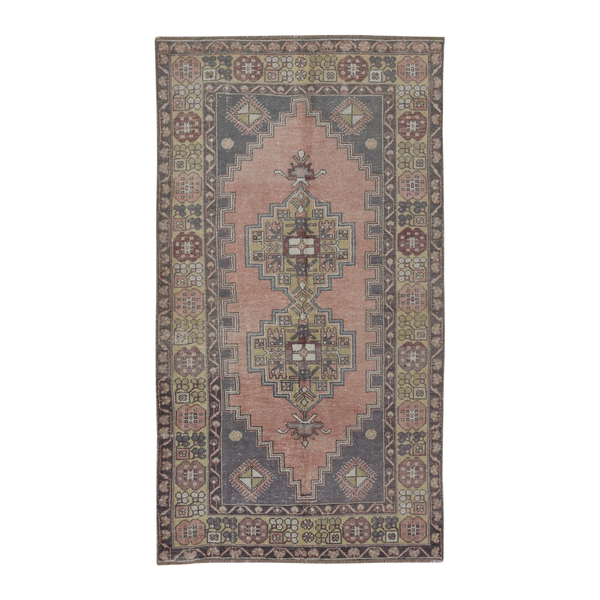
Expect strong colours, madder red, indigo, ochre and undyed ivory and brown, and motifs that repeat across the field: hooked lozenges, star medallions, ram's horns and stylised flowers. The wool is lustrous and the pile is usually cut medium, so vintage pieces have a dry, slightly rustic handle.
Sizes tend to be small to medium, with runners and accent pieces most common. Anatolian rugs bring texture and a handmade feel to entries, kitchens and hallways, and they pair well with the darker Turkish and Persian tribal groups in our collection.




Anatolian: the oldest weaving tradition in Turkey
Anatolia is the great heartland of Turkish weaving, and rugs described simply as Anatolian tend to come from the villages and tribal groups of the central plateau rather than from the commercial towns. They are the boldest, most graphic carpets Turkey produces: strong geometry, high contrast color, and a directness that comes from weaving without a drawn pattern.
Prayer designs with a stepped niche, stacked medallions, latch hook borders and bands of small repeating motifs are all characteristic. The wool is hand spun and often has real luster.
What to look for
- Drawing: strong geometry; prayer niches, stepped medallions, latch hook borders.
- Color: high contrast madder red, indigo, ivory, gold and green.
- Knot: symmetrical Turkish knot, giving a slightly more graphic surface.
- Sizes: mostly small to mid; large Anatolian village pieces are scarce.
Where they work
These are statement rugs at small scale. An Anatolian village weaving is one of the best things you can put in a small room, an entryway or a study, because it delivers a great deal of character in very little floor. They also layer beautifully.
Village and tribal character
Expect irregularity: sides that are not quite parallel, motifs that change slightly as they repeat, and pronounced abrash. In Anatolian weaving these are the signature of an individual weaver working from memory, and they are much of what gives the tradition its character.
Anatolian rug questions, answered
What is a prayer rug?
A rug with a directional niche design at one end, traditionally oriented during prayer. They are widely collected as decorative weavings and are used like any other rug.
Why are Anatolian rugs usually small?
Village and tribal looms were narrow and portable. Large formats were the province of commercial workshops such as Isparta, not of village weavers.
How do I tell Turkish from Persian?
Turkish weaving uses a symmetrical knot and tends to be more geometric and graphic. Persian work more often uses an asymmetrical knot suited to curved floral drawing.
Choosing your Anatolian rug
Buy on character. These are the pieces where the weaver is most visible. Every one is unique.