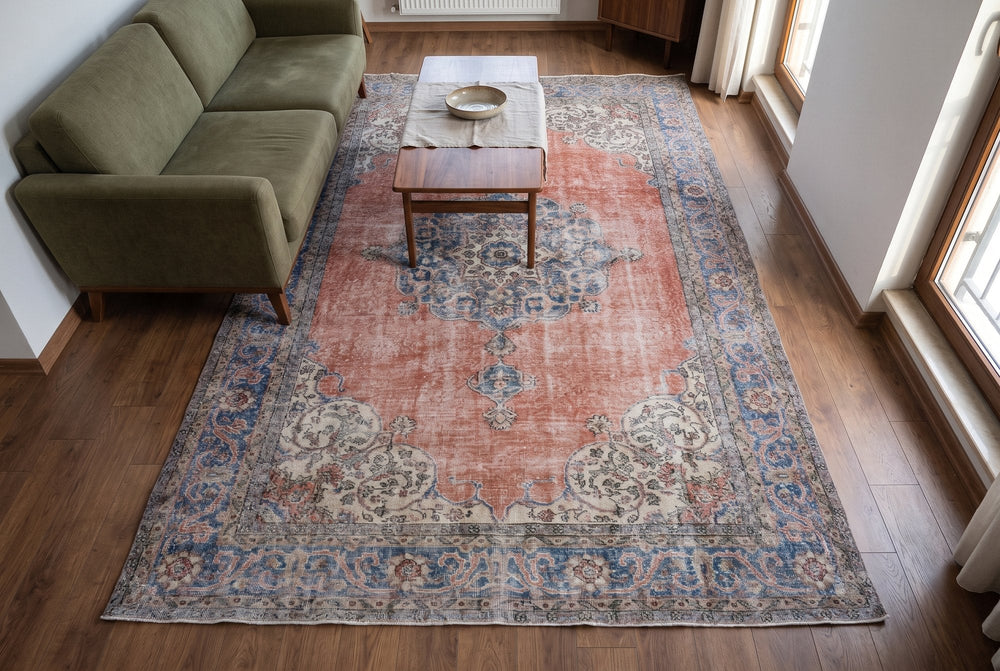
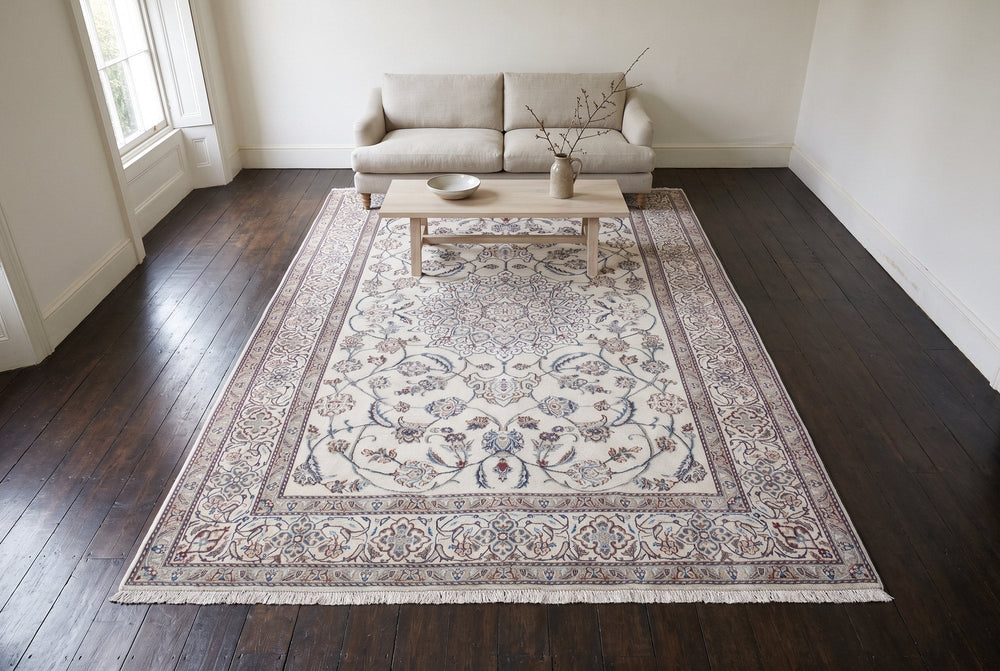
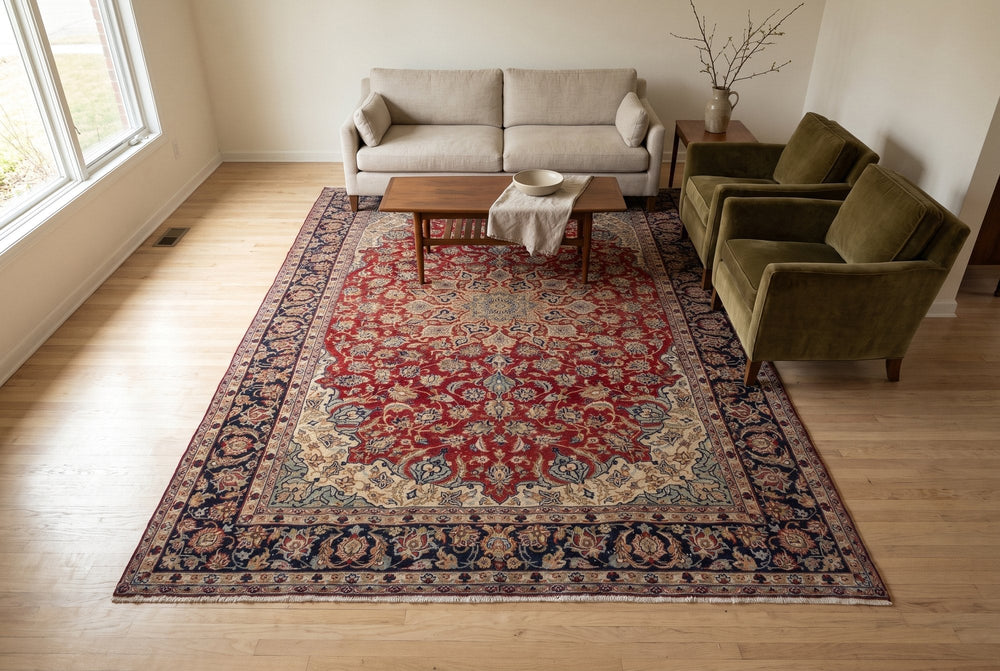
A Mashhad rug, also spelled Mashad or Meshed, is a hand-knotted city rug from Mashhad, in the far northeast of Persia close to the Afghan and Turkmen borders. The rugs that carry its name are big, red and formal, and the city is one of the country’s great commercial weaving centers.[1] Most are room size, and nearly all have a deep red or burgundy field. If you have a large, warm room that needs anchoring, a Mashhad is one of the most direct answers. Kurdish villages in the same corner of Persia wove the rugs in our Ghoochan guide.

Why most Mashhad rugs are room size
Mashhad wove in city workshops, as did Kerman and Kashan. The looms were built for the job, the designs were drawn in advance, and weaving was an industry rather than a household craft.[2] Big looms made big rugs.
The opposite case is Shiraz. There, much of the weaving was done by nomads on looms they had to take apart and carry, so most Shiraz rugs are small.[3] If you have a room to fill rather than a corner to finish, Mashhad is the better place to look.
Mashhad is also the main city of Khorasan, the old name for the whole northeast of Persia. Rugs from towns across the region were sold through its bazaar. Birjand, further south, wove the same curving drawing in paler colors. If you like the Mashhad look but not the red, our Birjand guide shows the difference. For a Khorasan rug with a busier field, see our Kashmar guide.
Red, where Kerman runs cool
Deep red leads, and burgundy comes next. Blue appears in many Mashhad rugs, usually in the border or the drawing, but it is rarely the main background. That is the most useful difference between Mashhad and Kerman. They share the same scale and the same formality, but a Kerman carries far more blue.
So the choice is simple. If the room is warm, with wood, brass, leather or terracotta, choose a Mashhad. If the room is cool and a red rug would fight it, choose a Kerman. That one rule will save you more time than any amount of reading about knot counts.
A deep red rug changes with the light, and it asks a little of the rest of the room. Our note on decorating with a deep red rug covers the colors that work around it.

How to identify a Mashhad rug
Look for five things: a formal medallion plan, curving drawing, a red that leans toward burgundy, a low pile and the knot on the back.
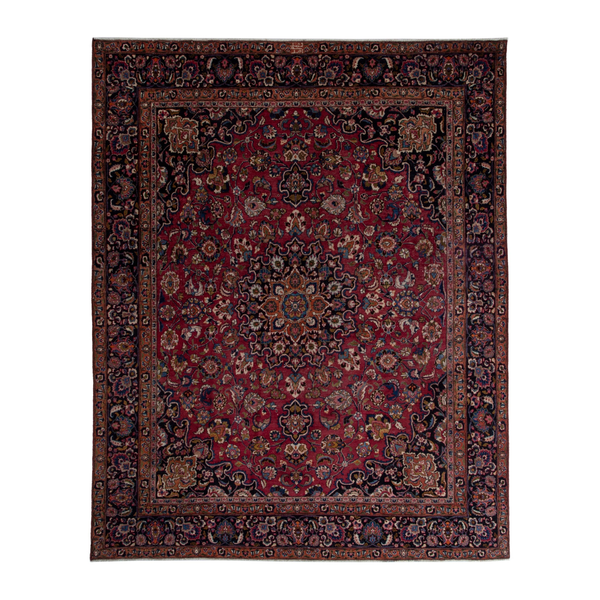
A formal plan. Most have a medallion in the center, corner pieces that echo it, and a field of flowing vines and flowers. The field is the main background inside the borders. The medallion is often unusually round, and the border is built from more narrow stripes than most.[4]
Curves, not steps. The drawing is curved and dense, like a Kashan, not stepped and angular like a village rug.
A red that leans toward burgundy. The reds are deep, and many fields are burgundy rather than bright red. The borders are often burgundy, dark brown or navy. Older Mashhad reds were dyed with cochineal, an insect dye, and together with the blue in the drawing that gives many of them a purplish cast.[4]
A low pile. Nearly all are low pile. On a rug this size, that keeps the drawing clear from standing height instead of turning into a blur of red.
The knot on the back. Many Mashhad rugs are tied with the jufti knot, which is tied around four warp threads at once instead of the usual two.[4] To check that a rug is hand-knotted at all, how to tell if a Persian rug is real walks through the tests you can do at home.

Sizes, and the rooms they suit
Most Mashhad rugs are close to 9 by 12 or 10 by 13 feet. Some are nearer 8 by 11 or 7 by 10. That is large enough to hold a sofa, chairs and coffee table together, or a dining table for six with the chairs pulled out. If you are torn between the two classic living-room sizes, our comparison of 8x10 and 9x12 rugs will help.
There are also a few long runners, between about 9 and 13 feet long. One of those suits a hallway that leads into a room with a red rug. Before you commit to a size this large, read placing a rug in an open-plan space and the size guide. Both show how much bare floor to leave around the edges.

What a Mashhad costs
A Mashhad of 9 by 12 feet or larger usually costs $2,000 to $2,600, and the 7 by 10 and 8 by 10 sizes cost about $1,000 to $1,900. That puts it level with Kashan and a little below Kerman. As with every origin, the price is mostly size rather than prestige. Our breakdown of what determines the cost of a rug shows why. The few small pieces cost far less, and they are the cheapest way into the origin.
Caring for a big red rug
Treat spills on a red rug gently. Blot with a white cloth and cold water, and do not rub or use hot water or strong cleaners, because some reds can run.[5] That is also why every color is tested before a rug is washed. Mashhad rugs are woven from soft wool, many with the jufti knot, so they are not the hardest-wearing Persian rugs.[4] Put a pad underneath, turn the rug once a year so wear and sun even out, and vacuum without the beater bar.[6] Our rug care page has the rest.
Who should buy one
Someone with a large, warm room that needs anchoring, who is not afraid of red. A Mashhad does not sit quietly. It sets the temperature of the room, and everything else has to agree with it.
If that sounds like too much commitment, the same scale in a cooler register is Kerman. The same warmth in a normal room size, for much less, is Hamedan. When you are ready, browse the Mashhad collection.



Sources
- Carpet (Mashhad, 1870-1875). Victoria and Albert Museum.
- Carpets from the Islamic World, 1600-1800. The Metropolitan Museum of Art, 2003.
- Beyond Utility: Rugs of Southwest Persia. Georgia Museum of Art.
- Khorāsān carpet. Encyclopaedia Britannica.
- Cleaning and Maintenance. The Carpet and Rug Institute.
- Mechanical Surface Cleaning of Textiles (CCI Notes 13/16). Canadian Conservation Institute, 2010.