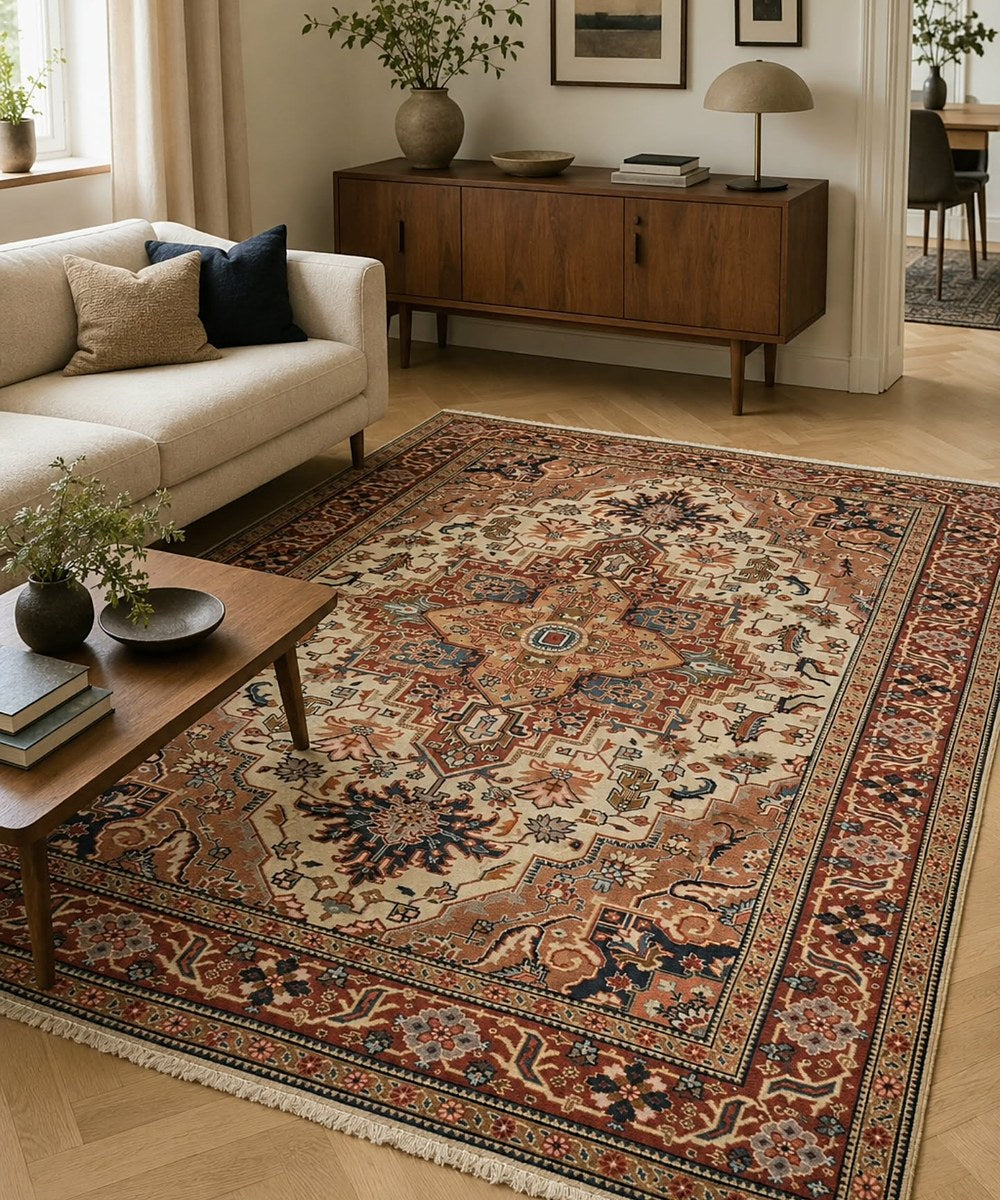
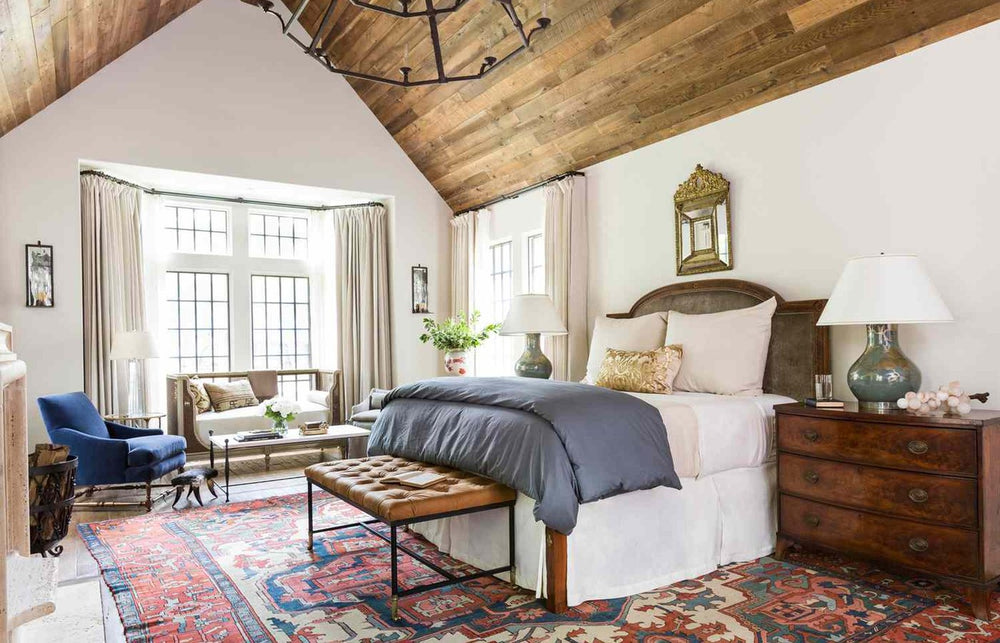
Getting a rug in an open-plan living space right is one of the more satisfying decorating puzzles to solve. One big room holds the sofa, the dining table and the path between them. Without a bit of structure, it can feel like a barn. The good news is that you don’t need walls to create rooms. A few well-chosen rugs do the quiet work for you. They divide one big space into places that each know what they’re for.
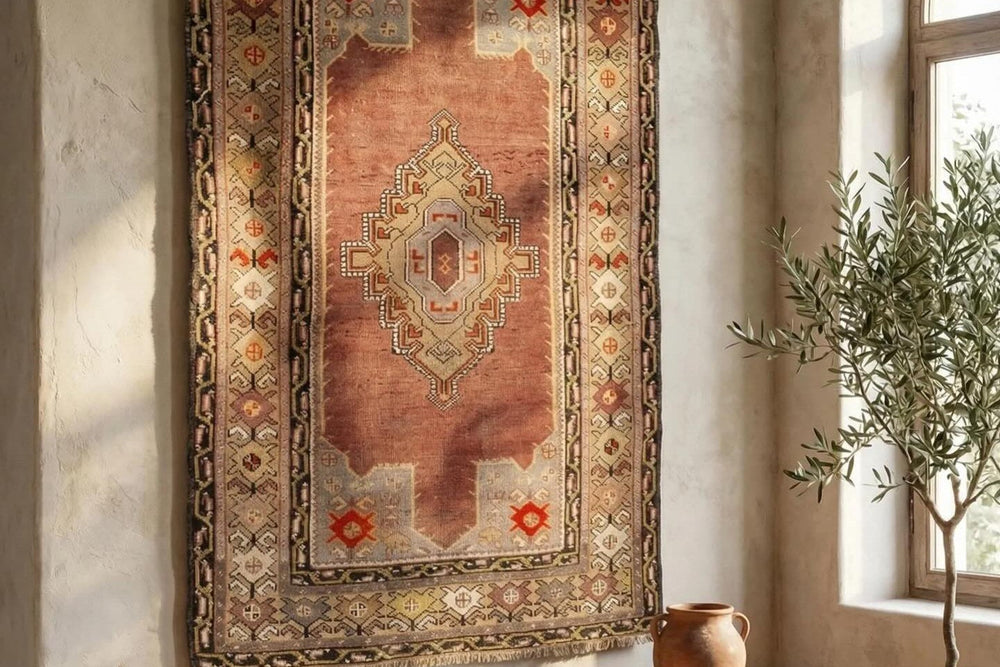
This is what people mean by zoning with rugs. You use rugs on the floor to say “this is where we sit” and “this is where we eat”. No partitions are needed. Vintage and antique hand-knotted rugs are especially good at it. Their patterns and colors carry enough character to hold a zone on their own.
Why zoning with rugs works
An open-plan room reads as one flat space until you break it up. Your eye needs landmarks. A rug gives the seating area a soft edge and a center of gravity. The sofa and chairs then stop looking like nearby furniture. Instead, they start to look like a room.
Do the same under the dining table and along the main walkway. Now the space has a rhythm to it. You move from one zone to the next the way you’d move between rooms. The difference is that the changes are gentle and the sightlines stay open. That’s the whole appeal of open-plan living, kept intact.

Size generously so furniture sits on the rug
The most common mistake is choosing a rug that’s too small. In an open-plan room the penalty is doubled. A mean little rug floating in a large space looks even smaller than it is.
Aim for the front legs of your seating to rest on the rug at the very least. That means the sofa and the armchairs. Better still, get all four legs on it. That one detail pulls the furniture into a group. It also tells everyone where the living zone begins and ends. When a rug only reaches the coffee table, the arrangement never quite settles.
For the dining zone, the rug needs to be large enough for the chairs. They should stay on it even when pulled out to sit down. A good rule is to allow roughly 60–75cm of rug beyond the table edge on every side. Watch the back legs of a chair as someone stands. If they drop off the edge each time, the rug is too small. Our size guide walks through the measurements for each situation.
Let the largest rug anchor the main seating
Say you’re working with more than one rug. Give the biggest and boldest to the main seating area. That zone is usually the heart of the room. It deserves the piece that carries the most visual weight.
An oversized rug under the sofa grouping does two jobs at once. It comfortably fits the furniture, and it sets the palette that the rest of the room will answer to. Once the anchor is down, everything else can take its cue from it, the dining rug, a runner, the accent chair. Browse our living room rugs when you’re choosing that anchor. Think about scale before pattern.

Using two or more rugs that relate without matching
You are not trying to buy a matching set. In fact, two identical rugs in one open room look like a showroom rather than a home. The aim is for the rugs to relate. They should feel like they belong to the same family without being twins.
There are a few reliable ways to make separate rugs speak to one another:
- Shared palette: pick pieces that carry a common color, such as a soft madder red, a particular indigo or an ivory ground. This works even when the patterns differ completely.
- Shared era or origin: rugs from the same region or period share a design language. So a Persian village rug and another of similar age will sit together happily.
- Shared mood: keep them all quiet or all lively. A busy geometric rug beside a faded, tonal one can jar.
- Varied scale: let the seating rug be the boldest. Keep the dining or walkway pieces a little calmer, so they support rather than compete.
Every antique rug is one of a kind. So this kind of collected, unmatched look comes naturally. Our area rugs are a good hunting ground when you want two pieces that rhyme without repeating.
Borders and alignment: the tidy details
Once your rugs are chosen, a couple of small habits keep the room looking considered rather than scattered.
Leave a consistent border of bare floor around each rug. Try to keep the same margin between the rug and the wall, or between two rugs, wherever you can. That even gap is what your eye reads as “deliberate”. Uneven margins are what make a room feel slightly off, even when you can’t say why.
Then align the rugs to the architecture, not to each other by guesswork. Run them square to the walls, the windows and the length of the room. In a long open-plan space, let the rugs follow the room’s main axis. That makes the whole floor feel calm and intentional.

Pitfalls to avoid
Two traps catch most people. The first is rugs that are simply too small, which we’ve covered. When in doubt, size up. The second is the “floating island”. Here every zone gets a rug, but none of them relate. The floor becomes a set of disconnected patches rather than one coherent room.
The cure for both is the same. Start with a generous anchor rug for the seating. Then choose the others to share its palette, era or mood. Keep the borders even and everything square to the room. The zones will then read as one connected space with a natural flow between them.
Take your measurements, decide where each zone begins, and let one strong rug lead. When you’re ready to look, our full collection of vintage and antique hand-knotted rugs is the place to find pieces with the character to hold a room together. No two are the same, which is rather the point.
Two that pair with this: how to choose the right rug size for the measuring, and layering rugs over carpet and hardwood if the floor is already covered.