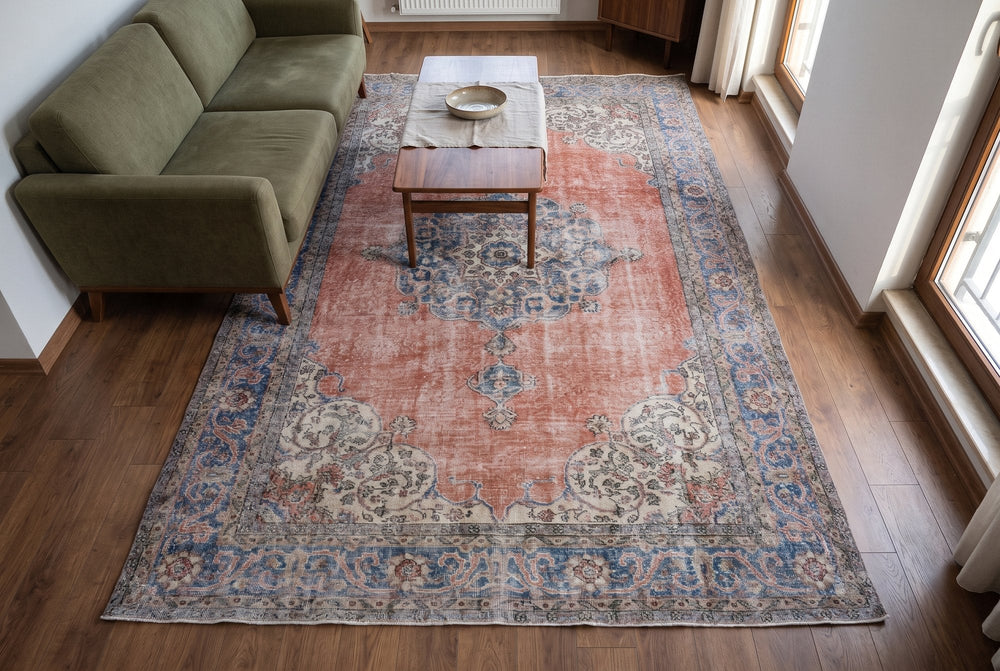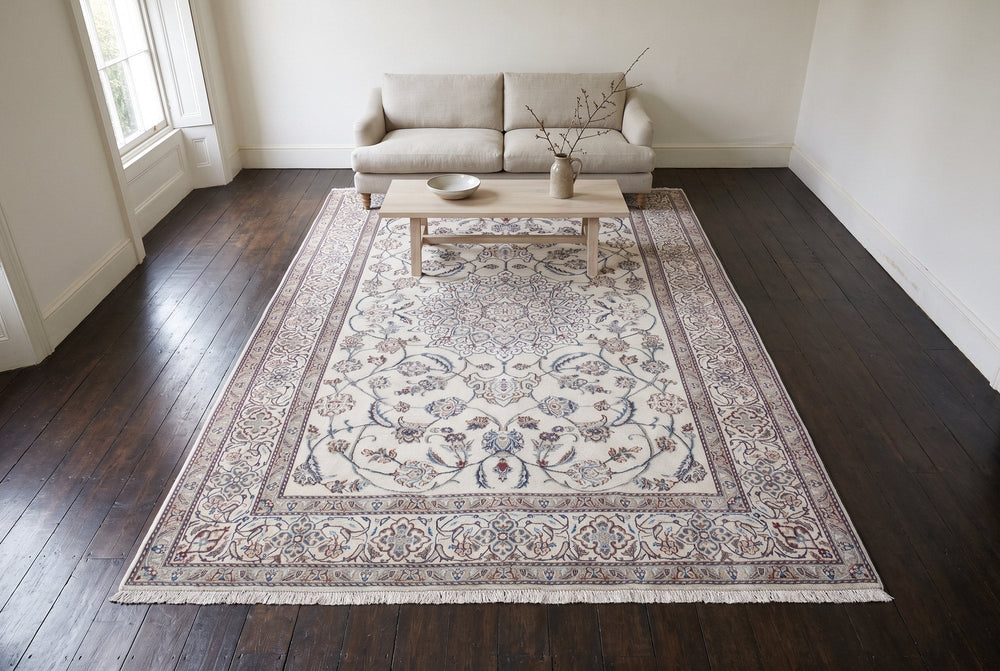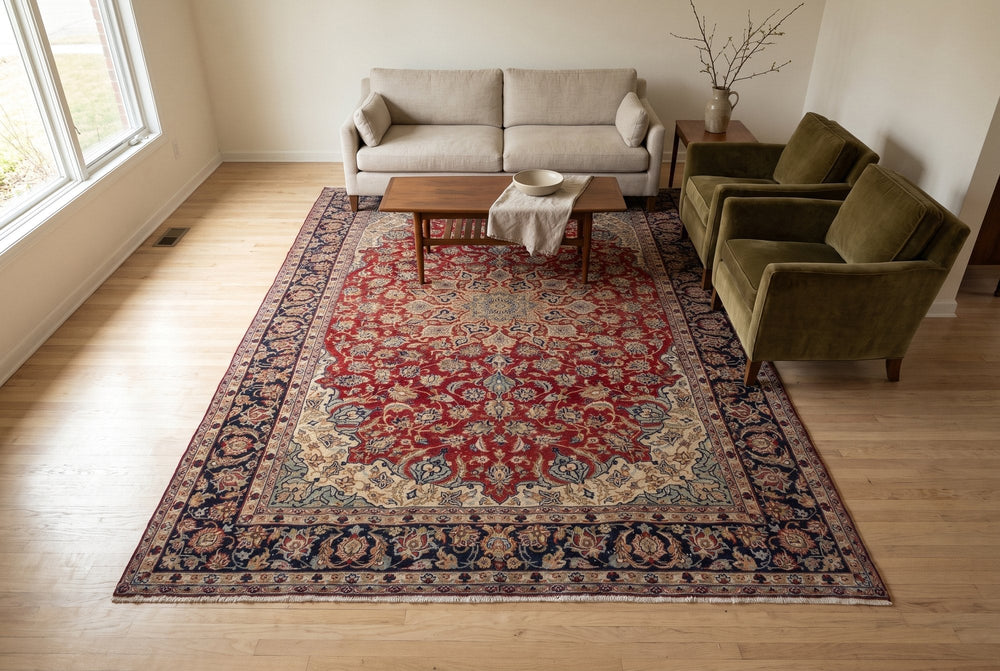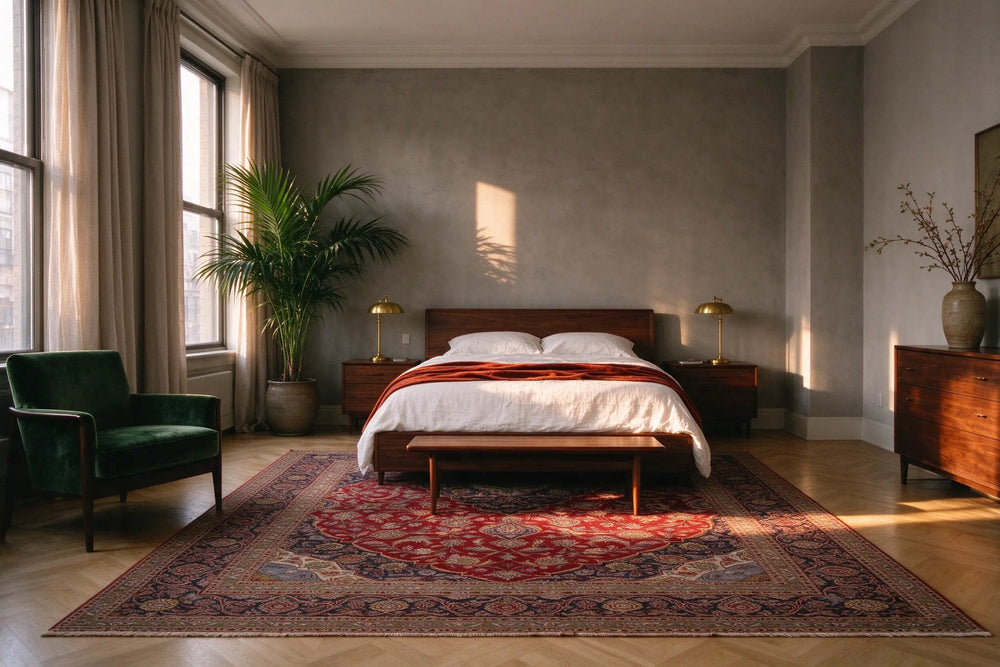
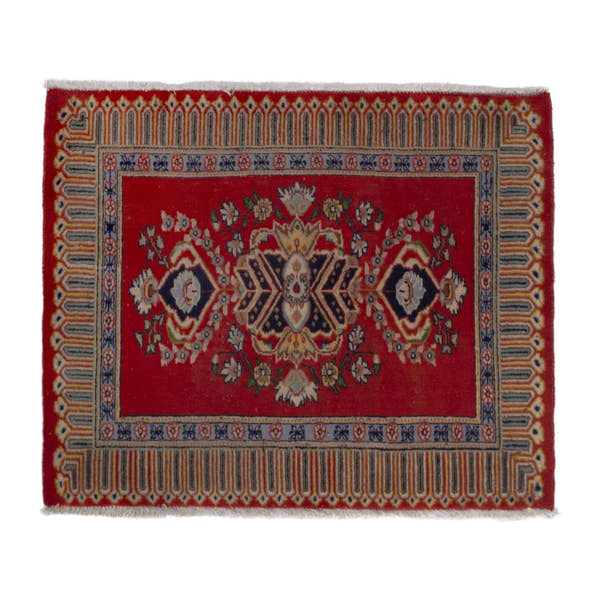
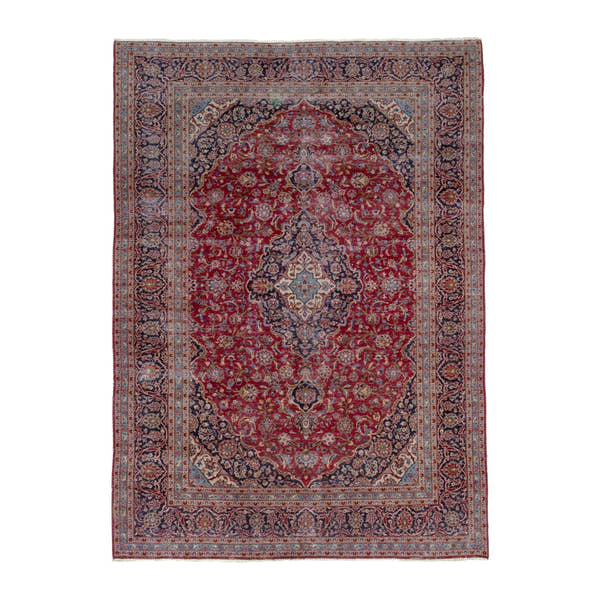
Kashan rugs are formal Persian city rugs. They usually have a central medallion with curving vines and flowers around it. The most common look is a deep red field with navy in the border. Most are room size, big enough for a living room or a dining table. They sit at the upper end of what vintage Persian rugs cost, mainly because they are big.

A city with a workshop tradition
Kashan is a city in central Persia with a weaving history that runs back to the Safavid court.[1] By the twentieth century the name meant organized workshops. A designer drew the whole pattern on squared paper, called a cartoon.[2] Skilled weavers then followed it knot by knot.[2] The result was a rug built to a plan rather than made up at the loom.
That method is what separates a city rug from a village or tribal one. Our guide to tribal, village and city rugs explains the three groups if you want the background.
What a Kashan looks like
Nearly every Kashan follows the same plan. A medallion sits in the center, usually pointed at both ends. Corner pieces, called spandrels, echo it.[3] The rest of the field, the main background inside the borders, is filled with curving vines, palmettes and small flowers.
The drawing is curved where a Heriz is angular. That comes from the method, not from taste. A workshop cartoon can draw a smooth curve. A village weaver working from memory usually builds shapes out of small steps.

Colors: deep red first
Deep red is the most common field by a wide margin. Cream, navy and burgundy come next. Most red Kashans also carry navy or dark blue, in the border or in the drawing. It is a serious combination, and it does serious things to a room. A red Kashan under a dining table looks deliberate in a way a pale rug does not.
Red works best with warm wood, brass, leather and walls in white, cream or a deep color. It can look heavy against cool grays and bright blues. If that is not what you want, the cream Kashans are the quieter option, and the neutral collection goes further in the same direction. For other wall colors, see what color rug goes with your walls.
How to recognize one
The medallion. It sits in the center, usually pointed at both ends, with corner pieces that match it.
The curve. The vines really curve. On a village rug they tend to move in small steps.
The density. Kashan weaving is fine and the pile, the wool surface, is usually low. Turn a corner over and the back shows small, tight knots with the whole design clearly visible.

Sizes, and the rooms they fit
These are room rugs. The sizes you will see most are close to 8 by 11, 8 by 12, 9 by 13 and 10 by 13 feet. Some small mats and runners turn up too, but most Kashans are big. Many of these sizes have old Persian trade names, which our guide to standard Persian rug sizes explains.
Under a dining table, measure with the chairs pulled out, not pushed in. All four chair legs should stay on the rug when someone sits down. The size guide has the numbers. In a living room, most Kashans are big enough for the sofa, the chairs and the coffee table to stand on the rug together. For a very large room, browse all our oversized rugs.
Checking the condition
A Kashan was clipped short when it was made, so a low, even pile is not by itself a sign of wear. Real wear shows as bare patches where you can see the knots from the front, or as a pile that is much lower in one area than the rest. Look at the two ends and the long sides too, because those take the most knocks. Every rug is washed and repaired by specialists we trust before it is listed, and we note any wear, as described in how our vintage rugs are washed and restored.
What a Kashan costs
A room-size Kashan usually costs between $2,000 and $2,500. The small mats cost far less. The price follows size more than anything else, because a bigger rug took many more months of knotting. A Kashan is not more expensive than other Persian city rugs of the same size. It just tends to be larger.
Kashan, Kerman or Mashhad?
All three are large, formal city rugs with curving drawing, and people compare them. A Kerman runs cooler, with more blue and some soft rose fields. Nearly every Mashhad has a red or burgundy field. A Kashan sits between them: deep red with navy, drawn very densely. If your room is warm, any of the three works. If it is cool, look at Kerman first.
Caring for a large formal rug
Put a thin pad underneath, especially under a dining table, so the rug does not creep when chairs move. Turn it end for end once a year so sun and footsteps even out.[4] Vacuum without the beater bar, and sweep crumbs under the table often, because grit wears wool down.[5] A professional wash every few years keeps it clean at the base of the pile.[6] Our rug care page covers the details.
When you have your room measured, browse the Kashan collection. Check the size against your furniture before you look at color.


Sources
- Silk Kashan Carpet. The Metropolitan Museum of Art.
- Carpet (Kerman, dated 1909). Victoria and Albert Museum.
- The Ardabil Carpet. Victoria and Albert Museum.
- Basic care: Carpets and rugs. Canadian Conservation Institute.
- Mechanical Surface Cleaning of Textiles (CCI Notes 13/16). Canadian Conservation Institute, 2010.
- Cleaning and Maintenance. The Carpet and Rug Institute.