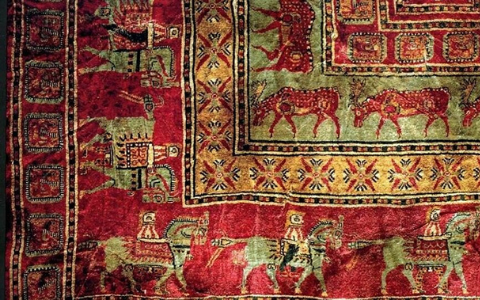
Nobody invented rugs, in the way nobody invented bread. Weaving wool into a warm floor covering is old enough that it has no inventor and no single place of origin — goats and sheep were being kept for fleece thousands of years before anyone wrote anything down about what was done with it.
What we do have is one extraordinary survival, and an argument about it that has been running since 1949.

The Pazyryk carpet
In 1949 the Soviet archaeologist Sergei Rudenko excavated a burial mound in the Pazyryk Valley, in the Altai mountains of southern Siberia. Water had seeped into the tomb and frozen solid, and the ice had preserved what would otherwise have rotted centuries earlier: textiles, a chariot, horses, and a knotted wool carpet roughly 1.83 by 2 meters.
It is usually dated to the fifth or fourth century BC — around 2,400 years old — which makes it the oldest knotted pile carpet that survives anywhere. It is in the Hermitage in St Petersburg.
The thing that surprises people is that it is not primitive. The knot density is around 360,000 knots per square meter, which is finer than most rugs sold new today and finer than anything in our own catalog. The design is fully resolved: a central field of squared rosettes, then a band of grazing deer, then a band of horsemen, some riding and some leading their horses on foot. This is not an early experiment. It is a mature tradition that was already old when it was woven, which tells you the real answer to the question in the title: the invention happened long before, and we have no record of it.
Who made it is still disputed
Three cases get made, and it is worth saying plainly that the question is not settled.
Persian. The rows of horsemen closely resemble the reliefs at Persepolis, and the floral drawing sits comfortably in Achaemenid court art. On design grounds alone the carpet looks Persian.
Armenian. The carpet uses a symmetrical knot, and analyses of the red have pointed to a scale-insect dye associated with the Armenian highlands. Both are used to argue for a Caucasian workshop.
Local. The wool has been matched to sheep from the Pazyryk burials themselves, which is the most physical evidence anyone has, and it argues that whatever the design owes to the south, the carpet was woven where it was found — by Scythian nomads who had every reason to copy the art of the empire next door.
These are not mutually exclusive in the way people writing about them usually assume. A nomadic weaver working local wool to a borrowed court design is an ordinary thing, not a contradiction. What the carpet proves is contact: Siberia and Persia were in the same visual world in 400 BC.
What came after: the Safavid workshops
The next point where the record gets thick is the Safavid period in Persia, roughly 1501 to 1736. Court patronage turned carpet weaving from a village craft into an organized workshop industry with designers, dyers and master weavers, and produced the pieces that European museums still build rooms around.
That period set the vocabulary most people now recognize as "Persian": the centered medallion, the corner spandrel, the dense curvilinear floral field. Almost every rug we sell is a descendant of that drawing, filtered through four centuries and a village loom. A 1970s Kashan is working from the same grammar; a Hamedan is working from a simplified memory of it.
Very few Safavid carpets survive, for the obvious reason: a rug is walked on. Paintings hang. That is also why age alone does not make a rug valuable — we went through what actually determines the price separately.
What this has to do with what we sell
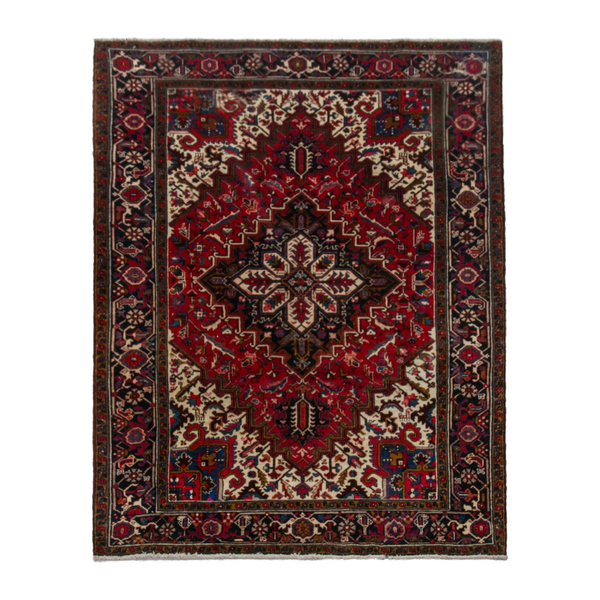
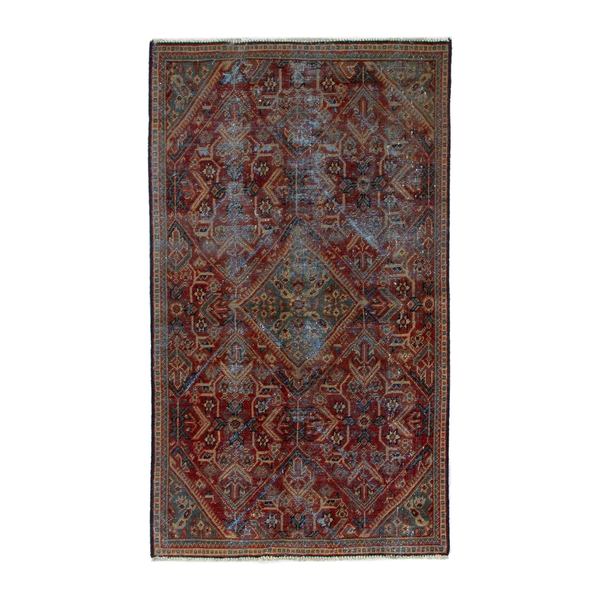
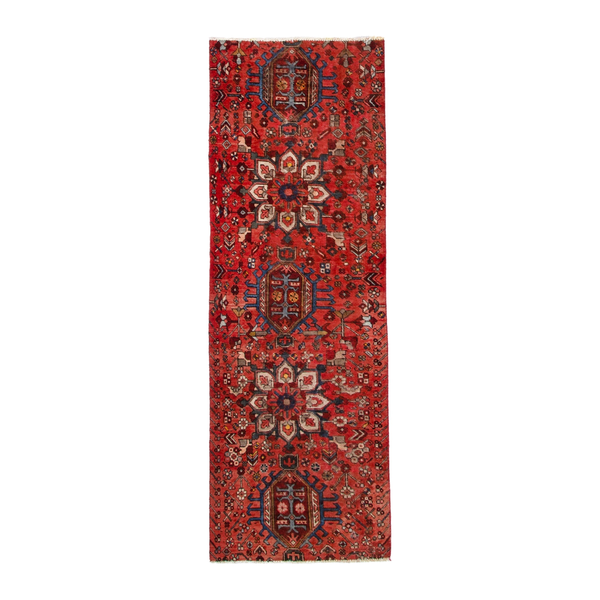
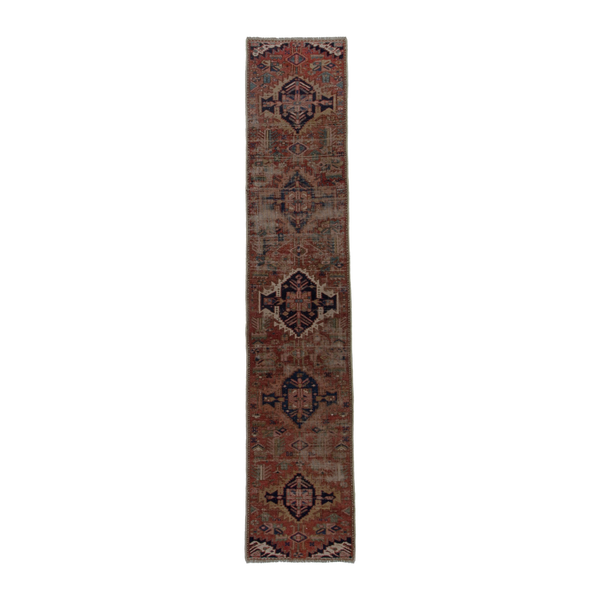
Nothing, and everything. Our rugs are fifty years old, not two thousand four hundred, and we would be lying if we suggested otherwise. But the method has not changed: knots tied one at a time onto a warp, no glue in the structure, wool that was on a sheep in the same region. That construction is why the Pazyryk carpet is still legible after twenty-four centuries in the ground, and it is the same reason a 1970s village rug is still worth putting on a floor now.
If you want to see what that looks like in practice, the Persian and Turkish collections are where the two lines of that tradition ended up.