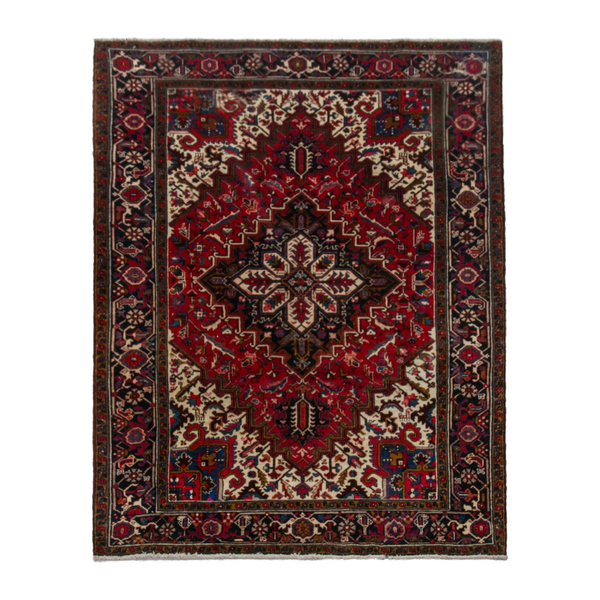
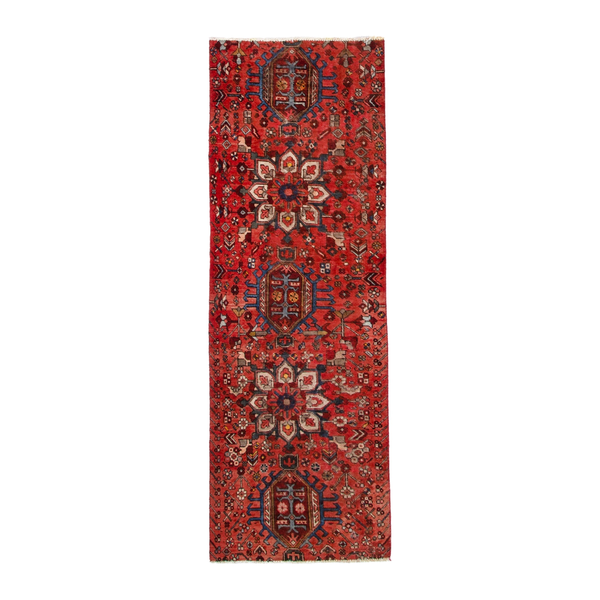
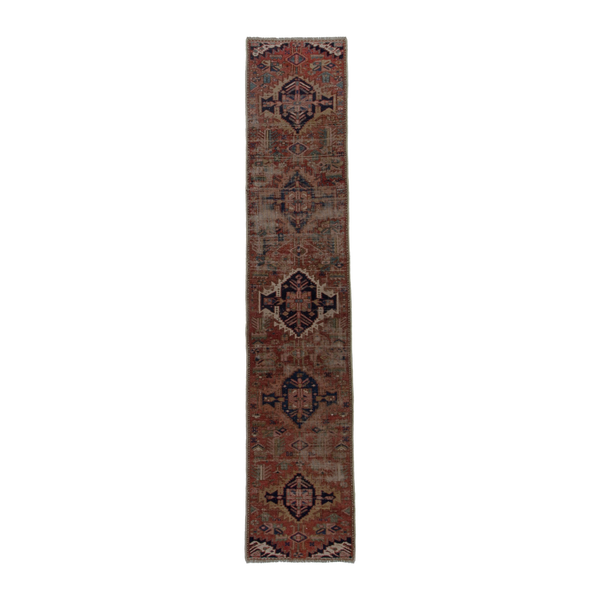
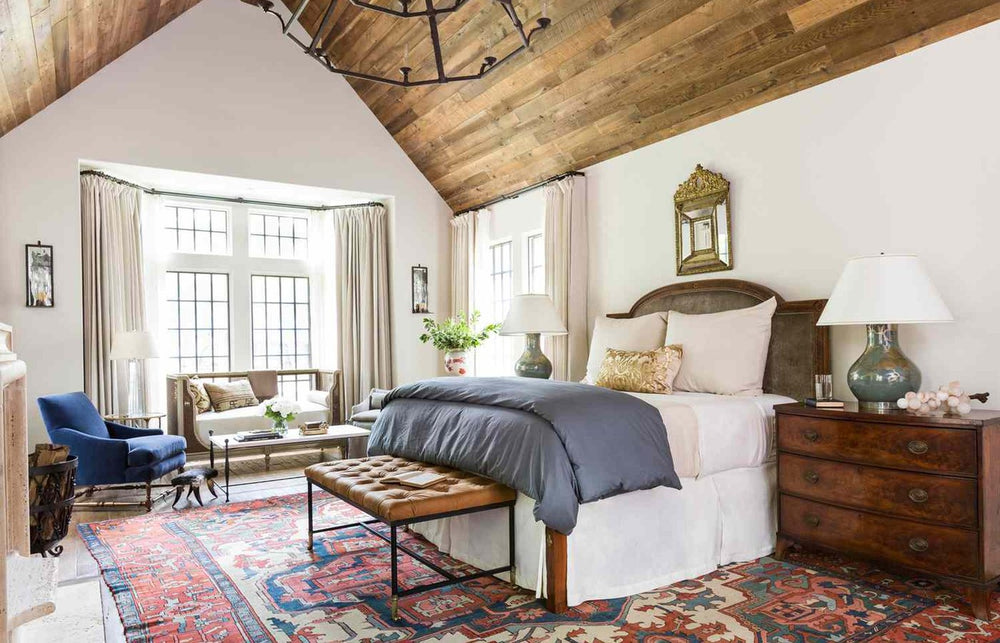
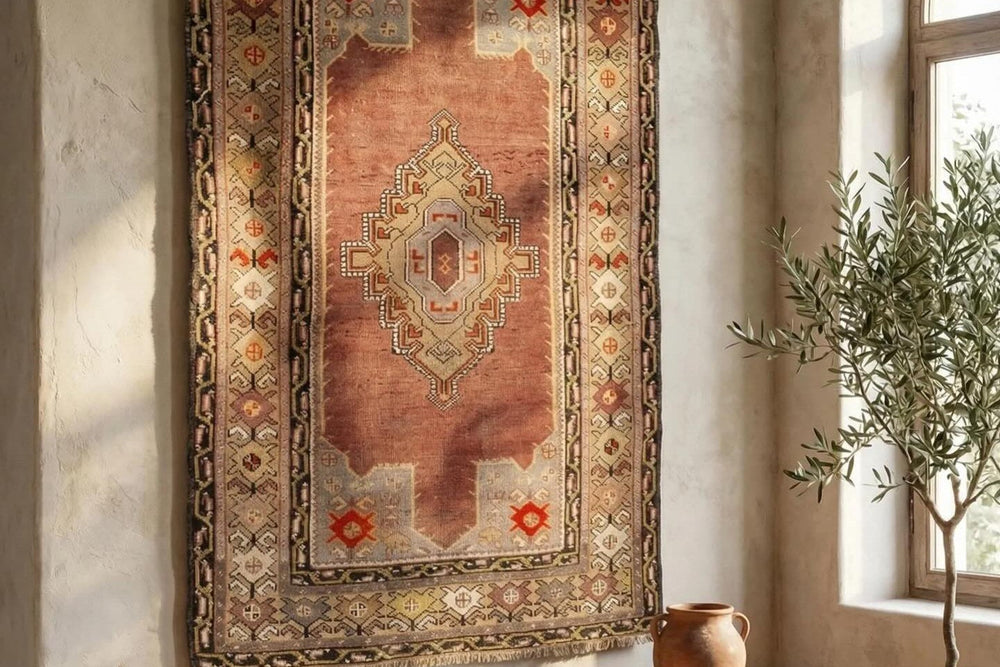
Few rugs make a first impression like a Heriz. A fine city carpet whispers, with curling vines and delicate blooms. A Heriz speaks up. It shows one big, bold medallion, a large shape at the center of the rug, with warm colors that fill a room the moment you unroll it. If you love Heriz rugs, you love a certain honesty: grand ideas made by village hands, and full of character because of it.
This is the story of where these rugs come from, why they look the way they do, and how you might live with one today.

Where Heriz is: villages near Tabriz
Heriz is not one place. It is a group of villages in north-west Persia, in the mountains east of the city of Tabriz. Over time the name came to mean a whole family of weaving villages, Heriz itself, plus its neighbors that share the same look and roots.
The land shapes the rug. This is high, rugged country. The wool from its sheep is strong and springy. That wool, as much as any design choice, gives these rugs their nature. When you handle a Heriz, you are handling tough mountain wool, spun and knotted for a hard life.
Being near Tabriz matters too. Tabriz was, and still is, one of the great centers of Persian weaving. Its workshops made refined, curved carpets, that is, rugs full of soft, flowing lines, for wealthy buyers. The Heriz villages sat close enough to borrow those grand ideas. But they were rural enough to retell them in their own plain voice. To see the polished city cousin, browse our Tabriz rugs. Set next to a Heriz, you can read both the family likeness and the change in mood.
The signature look: geometry over florals
The heart of a Heriz is almost always a large, bold medallion. Its edges are often stepped or jagged, like a staircase. It sits on an open field, held in place by strong corner shapes called spandrels. A wide, confident border runs around the whole rug.
What you will not usually see is the soft, lifelike flower work of a fine city rug. City rugs are curvilinear, their lines curve and flow. A Heriz is geometric instead. It builds its patterns from straight lines and angles. Where a Tabriz might paint a rose as a round, gentle bloom, a Heriz draws the same flower as an angular motif, a shape or emblem cut down to its bones. A motif is just a repeated design element. The result feels graphic and architectural, not delicate.
The colors stand out just as much. A palette is the set of colors a rug uses. The classic Heriz palette runs on:
- Terracotta and copper-red fields, warm, earthy, rust-toned, not a bright post-box red
- Deep indigo, a rich dark blue, for medallions, borders and contrast
- Ivory and cream to open up the corners and lift the whole rug
- Touches of soft gold, sky blue and pale green in the small details
That warm, rusty ground is so central to the type that many buyers hunt for the color first and the origin second. If the tone is what draws you, our red rugs collection is a good place to see how these earthy reds look across different pieces.

Why village weavers drew grand designs in simple geometry
Here is the part that gives Heriz rugs their soul. The medallion-and-corner layout began as a formal city design. It was the kind of pattern worked out on paper by trained designers for refined city workshops.
The village weavers of Heriz took that grand idea and made it their own. Village weaving works from memory and family patterns, not from a detailed plan for every knot. That is how it differs from city weaving. The weavers turned the flowing curves into bold, straight-edged shapes. A sweeping curved vine became a set of firm steps. A soft spray of flowers became a crisp, angular badge.
Do not read this as a shortcut or a failure. The simple shapes are exactly what give a Heriz its power. Freed from fussy detail, the design grows stronger, clearer and bolder, folk architecture in wool. You are looking at plain rural weavers reaching for something grand, and finding their own language to say it.
That is why no two are quite alike. So much lived in the weaver’s hand and eye that small shifts creep in. A border may end a little differently at each side. A color may change partway up, where one batch of wool ran out and another began. On a one-of-a-kind vintage or antique piece, these are not faults. They are the maker’s fingerprints.
Built to be lived on
Heriz rugs earned their name for toughness as well as looks. Strong highland wool, firm knotting and a sturdy foundation, the base of threads the pile is tied onto, made rugs that could take years of footsteps. The pile is the soft, upright surface you walk on.
This is a floor covering made to be used, not tiptoed around. That toughness is a big reason so many old Heriz rugs have survived. It is also why they remain a sensible choice for the rooms you truly live in.
Furnishing a busy space, a family sitting room, a hallway, anywhere with real traffic? A Heriz is one of the most forgiving handsome rugs you can pick. Our living room rugs selection is full of pieces chosen with that kind of daily life in mind.

How to spot and style a Heriz today
A few signs give a Heriz away. Look for the large stepped or jagged medallion, the angular shapes throughout, the generous corner spandrels, and above all that warm terracotta-and-indigo palette. The geometry should feel firm and architectural, not soft and flowing.
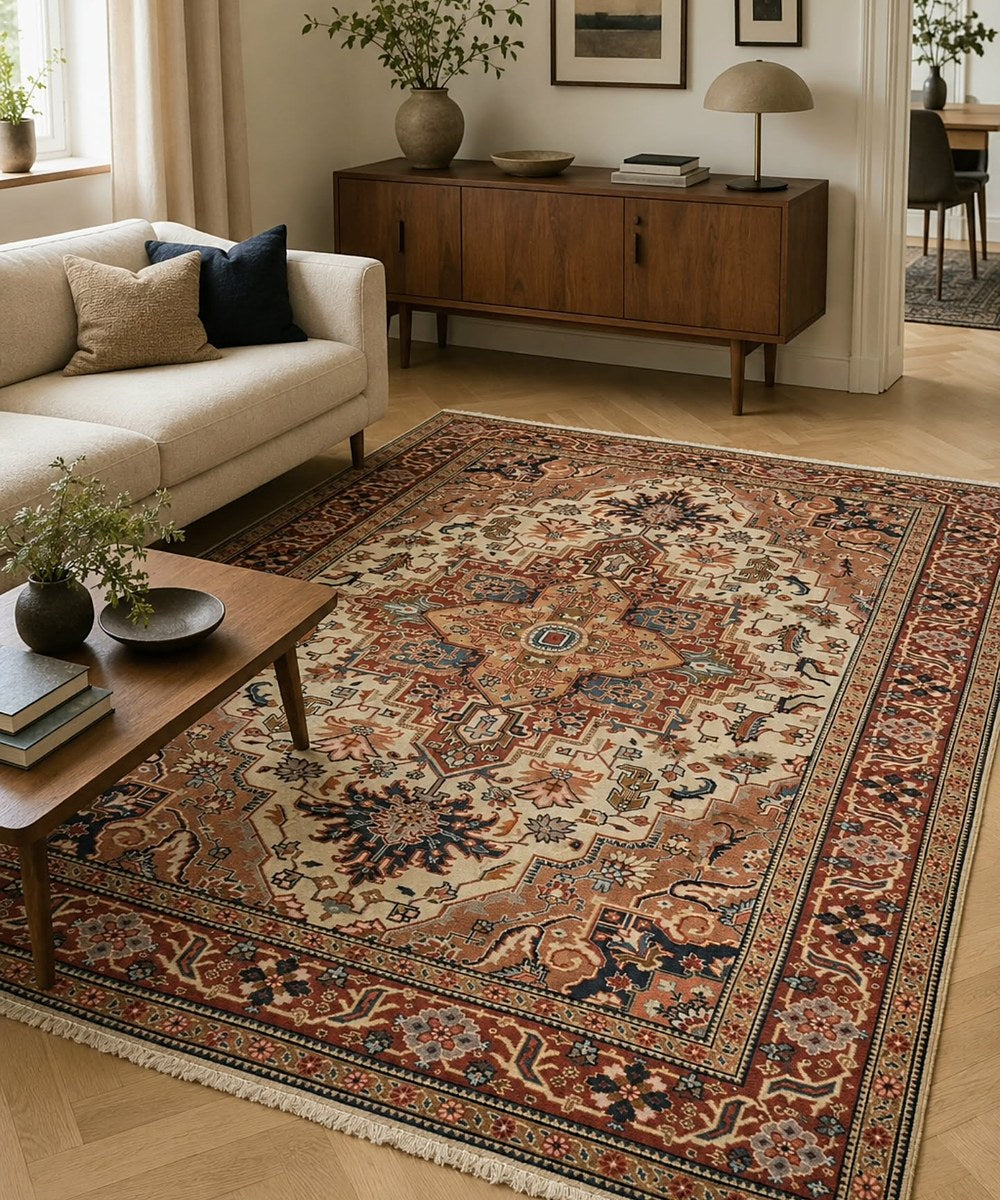
Styling one is refreshingly easy. The design is bold and the colors are earthy, so a Heriz suits both traditional and simple modern rooms. Against plain walls and simple furniture, that big medallion becomes a real focal point. In a busier, antique-filled room, it holds its own without shouting.
Let the rug lead and keep the other colors quiet, creams, warm grays, soft blues that echo the indigo. After all, it was made to be the most confident thing in the room.
Living with a piece of north-west Persia
To choose a Heriz is to choose a rug with a clear point of view. Village weavers took a grand design and made it bolder, warmer and more human in the making. Every genuine antique example carries that story in its geometry and its gentle quirks.
You can explore more of this weaving tradition, including Heriz and its neighbors, in our Persian rugs collection. If a particular piece catches your eye, we are always glad to tell you what we know about it. Take your time. The right rug tends to make itself known.
If you are choosing between weaves, Heriz vs Tabriz compared puts the two next to each other, and Persian and Turkish rugs: how to tell them apart widens the frame.