Heriz Rugs: Three Names, One Corner of Persia

A Heriz is a hand-knotted Persian rug from the villages around the town of Heris, in the mountains east of Tabriz in northwest Persia.[1] It is the rug most people picture when they picture a Persian carpet: one big angular medallion, a deep red field and ivory corners. The name covers more than one village, though. Our Heriz collection holds three weaving names from the same corner of northwest Persia: Heriz, Gharajeh and Gorevan. They share a look, but they differ in size and price, and that is what this guide sorts out.

Three names, one weaving area
Heriz sits in the mountains east of Tabriz, and the villages around it wove to the same idea for generations. We group three of those names together because the rugs belong together on a floor:
- Heriz. The name itself and the classic medallion layout, mostly at room size.
- Gharajeh. The largest group, and mostly runners and small mats. It is also the least expensive way into the look.
- Gorevan. Coarser knotting and bolder drawing, split between long runners and room-size carpets.
If you want the history rather than the buying guide, we wrote that separately in the story of Heriz. It covers where the villages are, and why weavers there drew grand designs in simple geometry.
What is the difference between Heriz and Serapi?
A Serapi is a Heriz under a trade name. Heriz rugs have been sold in the West under several village names, and Serapi is the one used for pieces in light, fairly bright colors.[1] Gorevan is another of those names, used for darker pieces.[1] So the word describes a look within Heriz weaving, not a separate place you can find on a map. Because it is a sales name, ask a seller what age and colors they mean by it. Our Heriz rugs are sold as Heriz, Gharajeh or Gorevan, and none is sold as a Serapi.
How to identify a Heriz rug
Five things identify a Heriz: one big stepped medallion, straight lines everywhere, ivory corners, heavy wool and a coarse knot on the back.
- The medallion. One large medallion with stepped, pointed edges, often with a smaller shape inside it. On a runner, several medallions line up in a row.
- The lines. Everything is straight. Vines turn at sharp angles, flowers become diamonds and stars, and nothing curves.[2]
- The corners. Large ivory or cream spandrels fill the corners around the medallion.
- The feel. Heavy, thick wool, with a coarse knot you can count from the back.
- The knot. Heriz rugs are tied with the symmetric knot on a cotton foundation.[1] On the back, each knot shows as two small bumps sitting side by side.
In effect a Heriz is a country version of the Tabriz city carpet, with the smooth curves of the Tabriz medallion turned into hard angles and broken outlines.[1] A Tabriz is finer and curves; a Heriz is coarser and steps, and Heriz vs Tabriz sets the two side by side. Heriz is a village rug woven at the size of a city carpet, which makes it unusual. Tribal, village and city rugs explains why most village rugs stay small and why Heriz is the exception.

Red is the default here
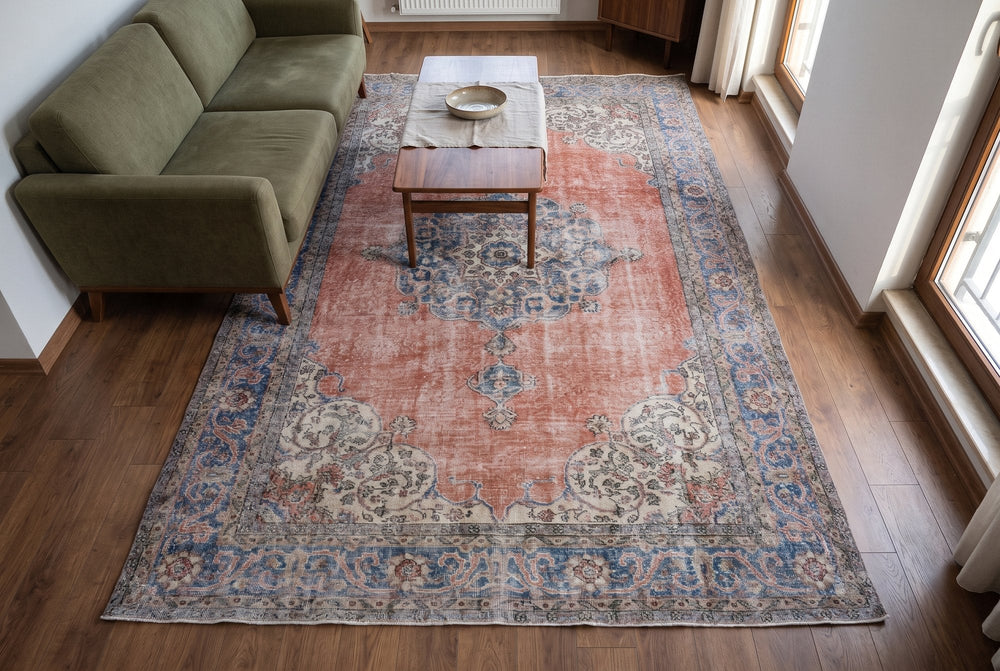
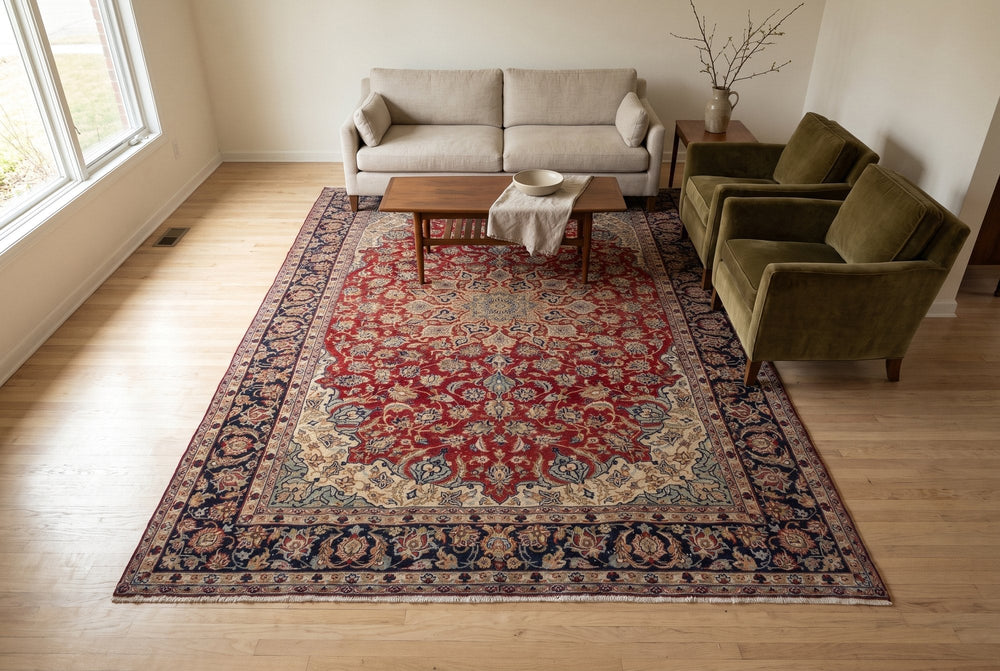
Most of these rugs have a deep red or burgundy ground. Rust, terracotta, cream and navy make up the rest. It is a warm group of rugs, and it is warm on purpose. The deep red field is the whole point of a Heriz, and the ivory corners give the eye somewhere to rest.
A Heriz in a cool room full of grays and steel will fight it. In a room that already has wood, brass or terracotta, it settles in right away. Our post on decorating with a deep red rug goes further into what to pair with it. The Heriz is also our first pick in vintage rugs in a farmhouse.

Sizes, and the surprise in them
Heriz has a reputation as a big rug, and the reputation is only half right. About half of the rugs in this group are runners, most of them Gharajeh. A good number are small mats. The room-size carpets are fewer, and most carry the Heriz or Gorevan name.
So the choice splits in two: a long hallway runner at one end, a room-size carpet at the other, and not much in between. The room sizes run from 6 by 9 up to roughly 9 by 13, and most are 7 or 8 feet wide. If you are torn between two living room sizes, 8x10 vs 9x12 helps you measure.
With a room-size Heriz, plan the furniture so the medallion stays in view. A low coffee table over the middle is fine. A big upholstered ottoman on top of the medallion hides the best part of the rug.

Are Heriz rugs valuable?
How much a Heriz is worth depends on four things: its age, its condition, its colors and its size.
Age comes first. Heriz rugs as a type go back to the middle of the 1800s, so a rug from those early decades is a very different object from one woven a century later.[1] Condition comes next. Appraisers check that the border runs all the way around the rug, ends included, because a rug that has lost its end borders is worth less.[3] The ends and sides are the first parts of any rug to wear, so look there first.[4] Color matters too. Some rugs from the late 1800s used early synthetic dyes that faded, so a field you see as soft red may once have been much deeper.[5]
Most of ours were woven between the 1940s and the 1980s, so they are vintage rather than antique, and antique vs vintage rugs explains what the labels mean. Our prices follow the size split above. The small mats cost a few hundred dollars. Most runners cost between $600 and $1,300. The room-size Heriz and Gorevan carpets mostly run from $2,000 to $2,850. If you are judging a Persian rug from any seller, what determines the cost of a rug explains what a fair price rests on.
Which of the three to look for
Start with the size you need, because it narrows the choice fast. If you want the classic look in a room-size piece, look at Heriz or Gorevan. If you want the same palette and geometry in a hall or a kitchen, look at Gharajeh, where most of the runners are. If you want it bolder and less refined, Gorevan again, where the knotting is coarser and the drawing bigger.
Caring for a Heriz
A Heriz is tough, but thick wool holds water, so do not soak it at home.[6] A thick Heriz can take days to dry after a proper wash, which is a job for a rug washer.[7] At home, vacuum it with suction only and blot spills with a dry cloth.[7] A big rug lies flat under its own weight, but on hardwood a thin pad still protects the floor and stops it creeping. Our rug care page covers the rest.
All three names are in the Heriz collection.


Sources
- Heriz carpet. Encyclopaedia Britannica.
- Carpet (possibly Heriz, 1850-1875). Victoria and Albert Museum.
- Persian Laver Kirman Rug, ca. 1900. Antiques Roadshow, PBS, 2006.
- Silk Persian Tabriz Rug, ca. 1890. Antiques Roadshow, PBS, 2011.
- Late 19th C. Heriz Silk Rug. Antiques Roadshow, PBS.
- Caring for textiles and costumes. Canadian Conservation Institute.
- Cleaning and Maintenance. The Carpet and Rug Institute.