Gharajeh Rugs
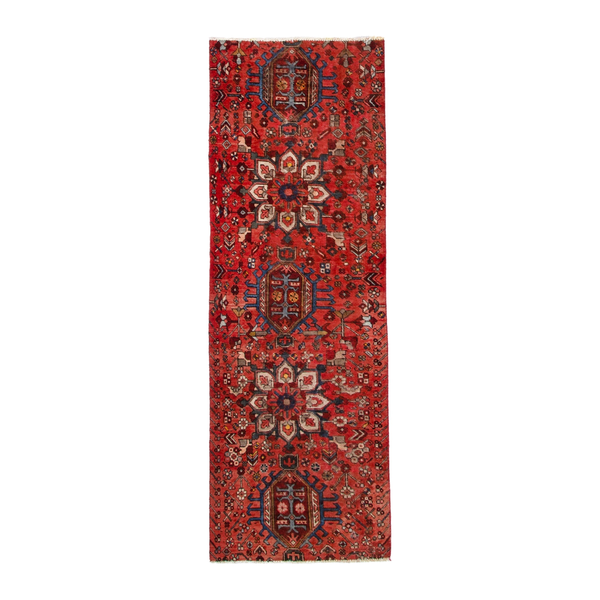
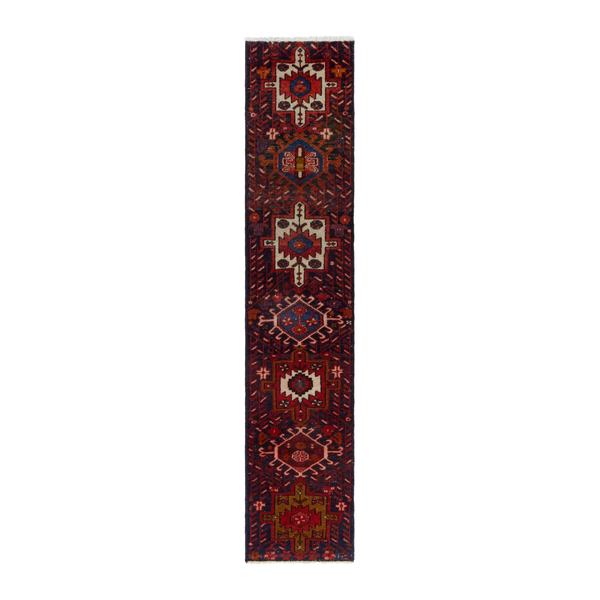
Gharajeh (Karaja) lies near Heriz in north-west Persia and is best known for its geometric runners and stacked-medallion designs in terracotta, indigo and ivory.
The weave is sturdy and made for daily traffic. These are vintage pieces, each one different, ready for a hallway or a well-used room.
Gharajeh sits inside the wider Heriz weaving district. To see the whole district in one place, including Heriz and Gorevan, browse Heriz rugs.





Gharajeh: stacked medallions from the Heriz country
Gharajeh, sometimes written Karaja, is a village weaving tradition in the Heriz region of north west Iran. Its signature is immediately recognizable: a column of two or three different medallions stacked one above the other down a long narrow field, each drawn geometrically and separated by clear ground.
The construction is typical of the region, robust and firm, in hard wearing local wool.
What to look for
- Field: stacked medallions in a vertical column, alternating in form.
- Color: madder red, indigo, ivory and camel, often with a rust ground.
- Weave: firm, hard wearing village construction.
- Sizes: particularly strong in runners and long narrow formats.
Where they work
The stacked medallion structure was made for long narrow spaces, which makes Gharajeh one of the best origins to look at for a hallway or a landing. The repeating vertical rhythm draws the eye down a corridor in a way a single medallion never can.
How they age
Robustly. These are working carpets and they take traffic well, softening in color rather than wearing thin. The geometry stays clear.
Gharajeh rug questions, answered
Is Gharajeh the same as Heriz?
They come from the same region and share construction. Heriz is usually a single large geometric medallion; Gharajeh is the stacked multiple medallion format, and tends to appear in narrower pieces.
Why is it spelled several ways?
Gharajeh, Karaja and Qaradja all describe the same village weaving.
Measuring for a hallway
Runners are the most commonly mismeasured rugs in a house. Measure the full length you want covered, then subtract a little at each end so the runner stops short of doorways rather than running under them. Leave a few inches of floor visible on each side; a runner that touches both skirting boards reads as fitted carpet and loses the effect entirely. If your hallway is longer than any single rug, two runners of the same origin laid end to end with a small gap looks deliberate and works well.
Care in a high traffic space
A hallway rug earns its keep and needs a little help. An underlay is essential; it stops creeping, adds comfort and takes a surprising amount of wear that would otherwise reach the rug. Rotate the runner end for end every six months or so in a busy corridor, since the wear is concentrated rather than spread. Vacuum without a beater bar.
What to check before you buy
On a runner, the ends take the most punishment, so look at those photographs carefully. Every rug here has been washed, inspected and where necessary repaired before it was listed.
Choosing your Gharajeh
Measure your hallway before anything else, then look at how clearly the stacked medallions are drawn. Each rug is a single piece.