Getting the rug runner length right is the difference between a hallway that feels finished and one that feels slightly off. Too long, and a runner skids up against the skirting board at one end. Too short, and it floats away from the doorway at the other. The good news is that there is no mystery to it. All you need is a tape measure and a couple of simple guidelines. You can work out the runner size for a hallway or galley kitchen in a few minutes, and shop with confidence rather than crossed fingers.
Our runners are vintage and antique one-of-a-kind pieces. Each has its own true size rather than a mass-produced “standard” one. That makes measuring your space first all the more worthwhile.
How to measure a hallway or galley kitchen
Start by clearing the walkway. Then measure the full length of the floor you want to cover, in centimeters. Measure the width at the narrowest point too. Halls often pinch in around a radiator, a console table or a door frame.
Then note where you actually want the runner to begin and end. You rarely want a runner to run wall to wall. Instead, aim to leave a margin of bare floor at each end. The piece then reads as a deliberate runner rather than fitted carpet.
- Leave roughly 10–20 cm (4–8 in) of bare floor at each end.
- Leave a few centimeters of floor showing on each long side, ideally the same margin left and right.
- Keep the runner clear of any door that swings inward across the floor.
So say your hallway floor is 300 cm long. Subtract a margin of around 15 cm at each end. You are then looking for a runner of roughly 270 cm. Do the same on the width. If the hall is 100 cm wide, a runner of about 80–90 cm leaves a balanced border on each side.

Standard runner widths and lengths
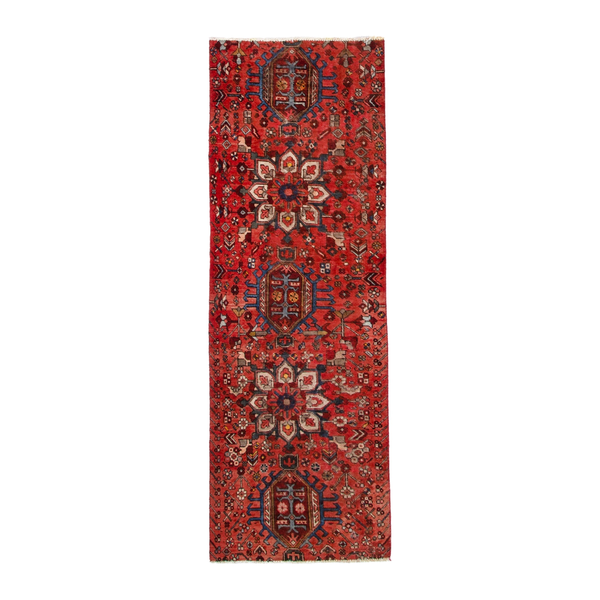
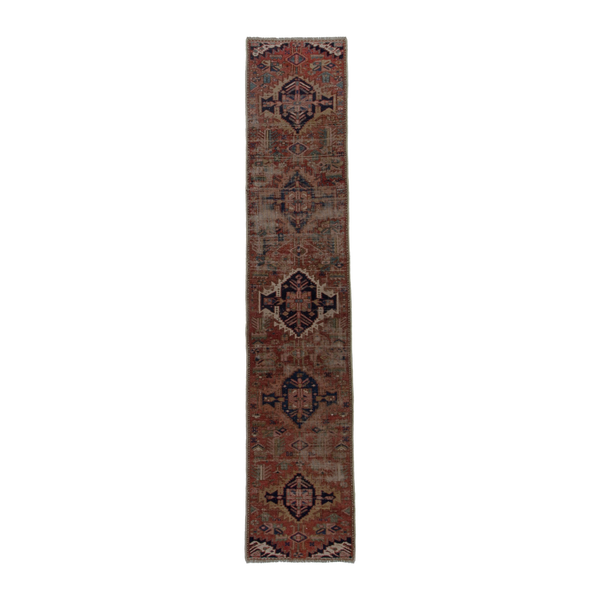
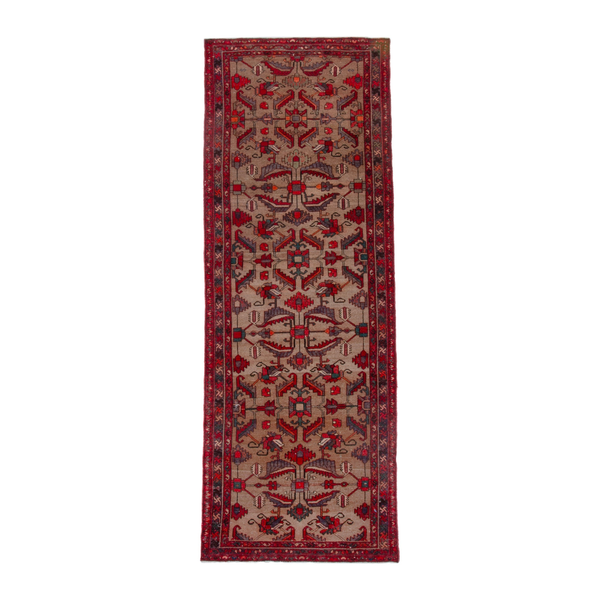
Most runners fall between about 70 cm and 100 cm wide. Lengths commonly run from around 200 cm up to 400 cm and beyond. Antique runners in particular can be gloriously long. They were often woven for the corridors of large houses.
Here is a helpful rule for width. Your runner should be narrow enough to leave floor showing on both sides. It should also be wide enough that both feet land on it as you walk. In a narrow hall, choose a slimmer runner so the borders do not disappear against the skirting.
When your hall is between sizes
Real corridors rarely match a rug to the centimeter, and one-of-a-kind pieces come as they come. When you are caught between two lengths, size down slightly rather than crowd the ends. A little extra bare floor looks calm and intentional. A runner jammed hard against the walls at both ends looks squeezed, and it draws the eye to the mismatch.
The same logic applies to width. A runner that leaves a slim, even margin on each side will always sit more gracefully. One that all but touches the walls will not.
Using more than one runner in a very long hall
Some halls are simply longer than any single runner you will reasonably find. They may be longer than any one antique piece happens to measure. In that case, two runners laid end to end can work beautifully.
Leave a small, consistent gap of bare floor between them, and treat it like the margin at each end. Choose pieces that share a palette or mood rather than trying to match them exactly. With vintage rugs, a considered pair of two different weaves often looks richer than one continuous stretch. Our hallway & entry rugs and runners are a good place to hunt for a complementary pair.

Runners in a galley kitchen
A galley kitchen is one of the best homes for a runner. It softens a hard floor exactly where you stand most. The trick is placement as much as length.
Center the runner on the walkway, the strip of floor you actually pace between the units. Don’t center it on the room as a whole. Keep it clear of the cabinet toe-kicks too. Then the runner lies flat against open floor. It won’t ride up under the units or catch a cupboard door.
For length, apply the same end margins as a hall. Stop a comfortable distance short of the walls or the doorway at each end. In a kitchen, a slightly shorter, well-centered runner nearly always beats one stretched to the limits of the space. You’ll find pieces suited to this in our kitchen rugs collection, chosen with busy floors in mind.
A brief note on stair runners
Stairs are their own project. A stair runner has to cover the tread and the riser of every step. So the length you need is much more than the straight-line height of the staircase. Turns or winder steps complicate things further. If you are considering a runner for stairs, measure each step. Treat it as a bespoke fitting job rather than a simple hallway sum. It is usually worth a professional’s eye.
Bringing it together
Measure your floor. Leave roughly 10–20 cm bare at each end and a few centimeters on each side. When you’re between sizes, size down rather than crowd. Those few habits cover almost every hall and kitchen you’ll meet.
When you’re ready to match a number to a rug, our size guide walks through the measurements again. You can also browse the full range of one-of-a-kind pieces across our runners collection. Take your measurements with you, and let the right length lead you to the right rug.
For the rest of the house, how to choose the right rug size works through the usual room shapes, and placing a rug in an open-plan living space deals with rooms that have no walls to help you.