Botteh Rugs
The boteh, the little teardrop the West renamed paisley, is one of the oldest figures in Persian weaving, scattered in neat rows across a field or worked into a border.
Rugs built around it come from many regions and read as lively but orderly. Each one here is a genuine vintage piece, hand-restored and unique.

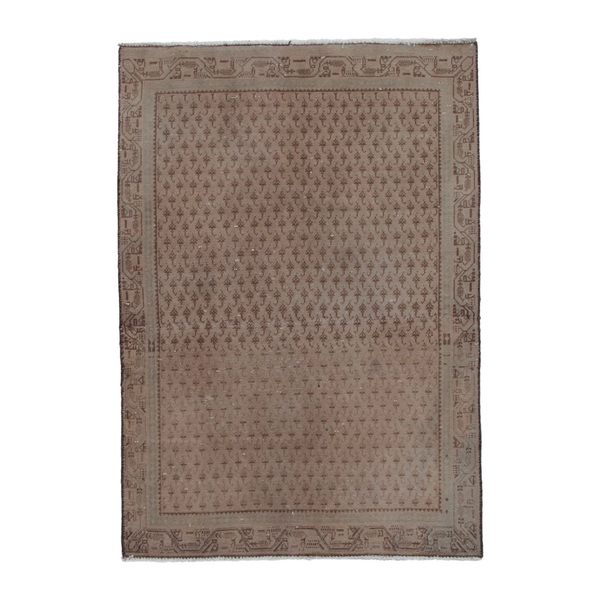


Botteh: the paisley motif, repeated across the field
The botteh is one of the oldest and most widespread motifs in Persian weaving: a teardrop with a curved tip, the ancestor of what the West calls paisley. It appears across many origins, from fine city carpets to tribal village weaves, and this collection gathers the rugs where it is the organizing idea rather than an incidental detail.
Most botteh rugs set the motif in ordered rows across an open ground, sometimes alternating direction row by row, sometimes all facing the same way. The effect is somewhere between pattern and texture.
What to look for
- Field: repeating botteh in rows, on an open ground.
- Origin: drawn from several weaving regions, so construction and palette vary.
- Color: madder red, indigo and camel grounds are the most common.
- Sizes: particularly strong in runners, where the repeat suits a long field.
Where they work
A repeating field is the easiest kind of pattern to live with. There is no medallion to center, so a botteh rug can go under furniture, run down a corridor, or turn a corner into another room without the design breaking. For hallways and dining rooms in particular, this is a real practical advantage.
The motif itself
Botteh has been read as a cypress bent by the wind, a flame, a leaf and a droplet. Weavers used it freely and drew it differently from region to region: crisp and upright in city work, loose and curled in tribal weaving. Comparing how two rugs handle the same motif is one of the pleasures of this group.
Botteh rug questions, answered
Is botteh the same as paisley?
Paisley is the Western name, taken from the Scottish town that mass produced shawls copying the Persian motif. Botteh is the original.
Do all botteh rugs come from one place?
No. The motif is used across Persia and beyond, so this collection draws from several origins. That variety is intentional.
Is the repeat monotonous?
Rarely, because hand drawn botteh vary slightly from one to the next. At a distance it reads as texture; up close every one is a little different.
Choosing your botteh rug
Decide on the ground color, then look at how the motif is drawn and how regularly it repeats. Each rug is one of a kind.