Mut is a small town in the Taurus Mountains, on the banks of the Goksu River, inland from the Mediterranean coast of Mersin.[1] Its hills and summer pastures are home to the Yoruks, the herding families of southern Turkey, and its kilims carry their colors. Turkey’s culture ministry describes the Mersin region simply as a Yoruk land.[2]
Every Mut piece we carry is a flat-woven kilim with no pile. This guide explains who wove them, how, and what their patterns mean, so you can tell a Mut kilim when you see one.

A town of the Taurus Yoruks
Mut has a long history of changing hands. In the eleventh century the Yoruk beys, a branch of the Seljuk Turks, took over the government of Mut and its district.[1] The region later passed to the Karamanids and in 1466 to the Ottomans.[1]
The herding life outlasted every ruler. Most Yoruk families have settled on the land, but moving up to the high summer pastures is a custom many still keep.[2] A researcher who studied the villages around Mut found that many people in the mountains there still lived a nomadic life.[3] In the Taurus, families did not travel great distances. They migrated vertically, from the lowlands to higher ground as spring reached each height.[4] The Textile Museum’s kilim catalog notes that this was the usual pattern in the Taurus Mountains.[4]
Kilims for the tent
A household on the move needed weavings that were light and could be packed onto animals. Families lived in black goat-hair tents or in felt-covered tents, and filled them with woven sacks, bags and floor covers.[4] Around Mut, women wove saddlebags, sacks, pouches and girths for carrying, as well as kilims.[3] The kilim was the showpiece. Mersin’s culture office describes the region’s kilims as its finest weaving, made beautiful by their motifs.[2]

Motifs with names
A 2020 study of old weavings in Mut and nearby Silifke found that geometric motifs dominate.[5] The researchers carried out fieldwork in 66 neighborhoods of the two districts where weaving is still done.[5] Among the motifs they recorded are the ram’s horn, the triangle, the zigzag, the hook, the crow’s foot and the diamond.[5]
In the region these motifs are called yanis. Rows of them were meant to protect: a row against the evil eye, a row against magic, one for strength and one for being reunited with the person you love.[2] You do not need to know the names to enjoy a Mut kilim, but they explain why so many small figures are packed between the big shapes.

How the weave works
In Turkish such weavings are called kirkitli, after the kirkit, the heavy comb used to beat each row of weft into place. Most of the pattern is slit weave. The design is built up of small blocks of solid color, each woven with its own weft yarn, and where two colors meet a short slit opens between them.[4] Hold one up to a window and the slits show as thin lines of light along the edges of the diamonds.
Slit weave is only one of the region’s techniques. Mersin weavers make shuttle-woven cloth, tablet-woven bands and weavings beaten in with the kirkit, and the Mut area is known for the last kind.[2]
The Mut kilims we carry
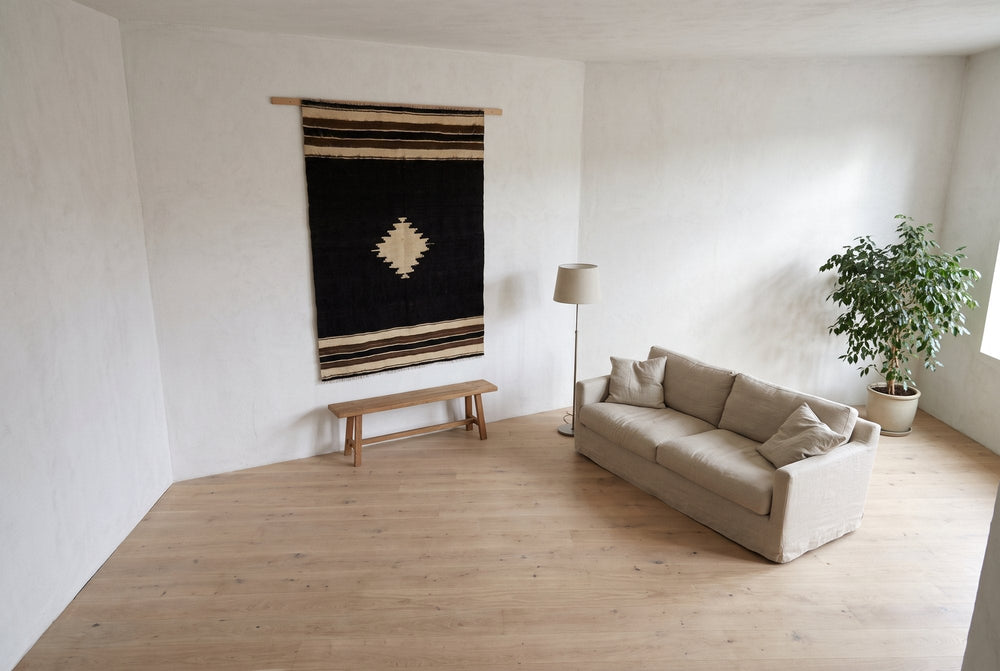
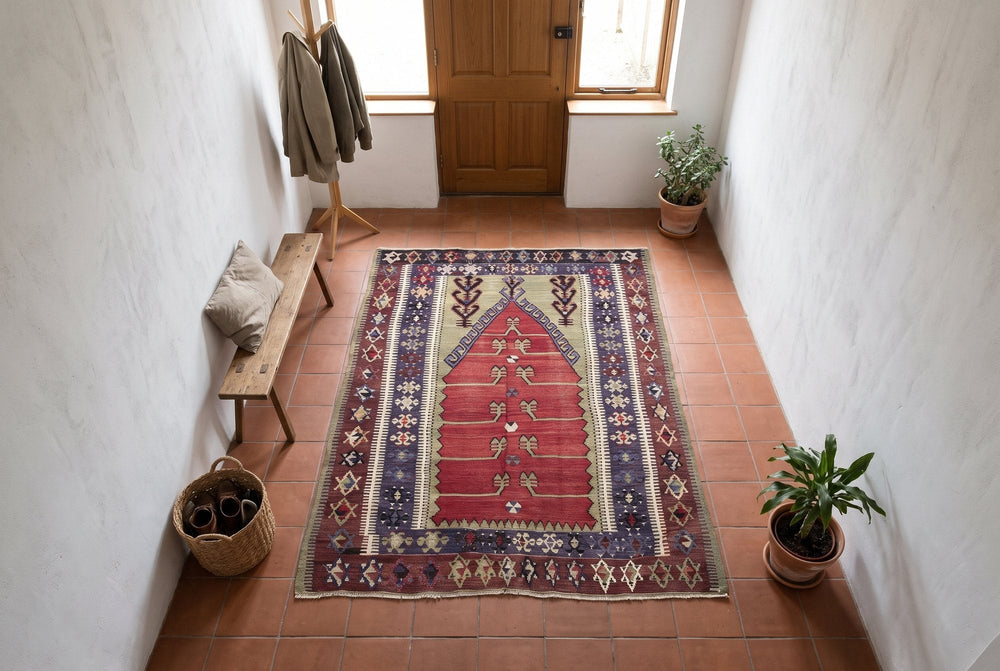
Our Mut kilims are deep and warm. Many have mahogany or burgundy fields with stepped diamonds or paired hexagons stacked down the middle, scattered with small stars and hooked figures. Others are banded from end to end in brick, walnut and camel. Most are about 5 by 8 to 5½ by 9 feet, a few are long runners of about 3 by 10 feet, and prices run from about $640 to $1,510. They are flat-woven wool, about 40 to 60 years old, and each listing gives the exact size in feet and centimeters.
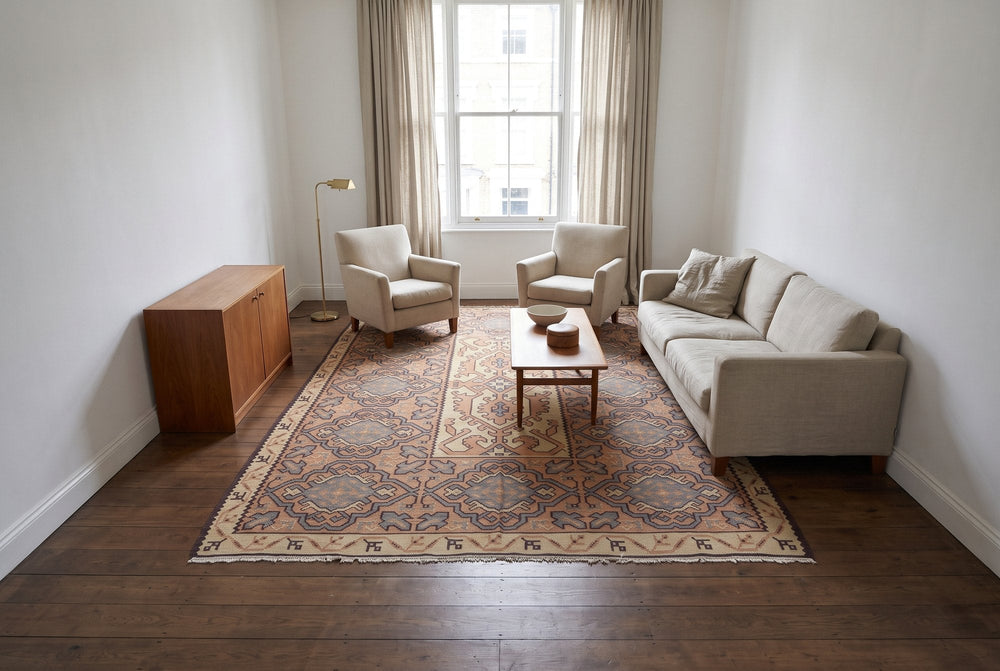
A 5 by 9 kilim is a useful size. It fits in front of a sofa with the front legs of the furniture on it, beside a queen bed, or under a small table for four. The longer piece works in a hallway or along a kitchen island, and a deep red Mut kilim warms a pale floor more than almost anything else you can put on it.

Living with a Mut kilim
A kilim is thin, so it lies flat under a door, slides easily under dining chairs and can be layered over a larger rug. Use a thin non-slip pad on a hard floor, vacuum without the beater bar and turn it every few months so it fades evenly. Our guide to kilim rugs covers kilim care in more detail.
Where to go next
The kilims themselves are in the Mut collection, and every flat weave we carry is in the kilim collection. North over the Taurus lies Konya, whose guide covers the kilims of the plain. For the whole of Turkish weaving, read the ultimate guide to Turkish rugs or browse the Turkish rug collection.


Sources
- Mut. Mersin Provincial Directorate of Culture and Tourism.
- Dokumacilik, Kece, Oruculuk: Mersin (Weaving, Felt and Plaiting). Kultur Portali, Republic of Turkiye Ministry of Culture and Tourism.
- Weavings Used for Carrying among the Yoruks (M. Akan). Ataturk Supreme Council for Culture, Language and History.
- A Nomad’s Art: Kilims of Anatolia. The George Washington University Museum and The Textile Museum, 2018.
- Design Features of Some Traditional Weavings Found in Silifke and Mut (D. Konuk and N. Dursun). Kalemname, vol. 5, no. 10, 2020.