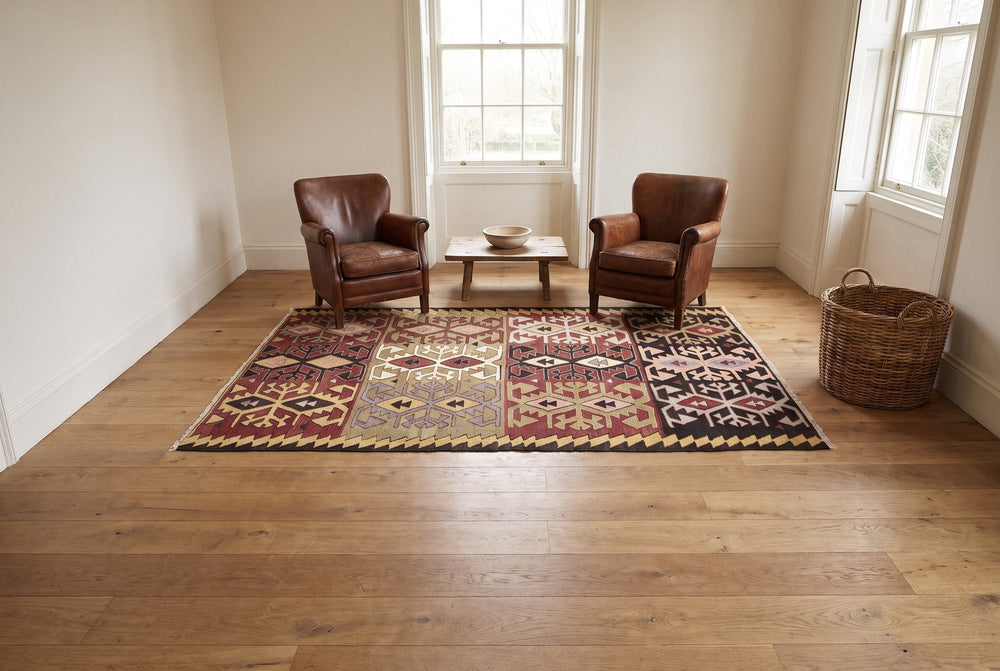
In Kandira, a woman did not only weave kilims for her wedding. Older women also wove one for their own funeral, a kilim to be laid over the coffin and then given to the mosque, to those who washed the body, or to an orphaned girl with no dowry of her own.[1] A kilim from this corner of Turkey can carry that kind of weight.
Kandira is a district of Kocaeli province on the Black Sea side of the peninsula east of Istanbul. This guide covers the people who wove its kilims, the linen and wool they used, the named types, and how to use one at home.

The Manav weavers
The art historian Tulin Coruhlu, who recorded weaving in Kandira and neighboring Kaynarca from 2004 on, traces weaving there to the arrival of the Turks in the thirteenth century.[1] The people of the area are known as Manav, a term for settled Turks of Oghuz descent rather than a separate ethnic group.[1] Kaynarca belonged to Kandira until 1959.[1] When Kandira cloth reached the Istanbul market in the nineteenth century, Kaynarca’s weaving was sold under the Kandira name.[1]
Two crafts ran side by side: linen cloth and wool kilims.[1] Growing flax and keeping flocks were, until recently, the base of the local economy.[1] Coruhlu found the proof in the chests of the women she interviewed, every one of them full of cloth and kilims.[1]

Linen and wool
Kandira is best known for its linen cloth, registered as a geographical indication.[2] The Ministry of Culture notes that it was woven on home looms in village houses until about thirty years ago.[3] The same linen shows up in the kilims. Coruhlu found that the warp of Kaynarca and Kandira kilims is generally linen, sometimes with cotton or silk added.[1]
The registration for Kandira cloth explains the trick. Heavy linen yarn was used for trousers, sacks and kilims.[2] In a kilim, it says, the linen serves as the warp for the wool and hides itself, showing only at the fringes.[2] Local weavers have their own words: linen yarn is simply ip, yarn, and wool is yun.[1]

The wool came from local flocks, shorn two or three times a year.[1] The long, dirty wool of the spring shearing went into coarse kilims, and the shorter, cleaner wool of the summer and autumn shearings into fine patterned ones.[1] Women did most of their kilim weaving in winter, once the work in the fields had eased.[1] A Manav girl’s skill, Coruhlu writes, was once measured by how much flax she pulled and how much cloth she wove.[1]
How a Kandira kilim is woven
Two kinds of loom were used. A narrow horizontal loom, the same one used for linen cloth, made runners, bench covers and sacks about 60 centimeters wide.[1] An upright loom called the kilim tree made wide floor kilims and pieces with borders and center medallions.[1] Kilims from that loom are on average about 200 centimeters wide and 300 centimeters long, woven in one piece.[1]
Patterned kilims are slit-woven.[1] Where two colors meet, each weft turns back at the edge of its own motif and leaves a vertical slit about a centimeter long.[1] Because the slits climb in steps, long lines in a Kandira kilim break into stairs, which local weavers call kayma.[1] You can see the effect in the kilim in the pictures here, where every zigzag is built of small stepped blocks.
Natural colors
Dyes came from plants. Mulberry bark gave yellow and brown, onion skin gave camel and light brown, and fresh walnut husk gave a green black.[1] Acorn cups from the oak were added to every dye to keep the color bright and fast.[1] Yarn boiled a second or third time in the leftover dye came out darker and softer.[1]
In the kilims, borders usually run in black, white and red, and the center is red.[1] Motifs add light and dark green, a light red called rabbit’s blood, a deep pomegranate red, orange, camel, dark brown, pink, yellow and blue.[1]
The named kilims

Weavers name their kilims by use and by pattern. By use there are floor kilims, runners, prayer rugs, sacks, saddlebags and cushions, and they are also grouped as dowry, everyday and funeral kilims.[1] By pattern the names include striped, tree, lamp, finger, bridge, New World, mirrored, steelyard and plow kilims.[1]
Two were almost required in a bride’s dowry: the New World and the mirrored kilim.[1] Funeral kilims were usually of the lamp or finger types.[1] Coruhlu notes that weaving has now stopped in the area and the old looms have been taken apart, which makes surviving pieces all the more worth keeping.[1]
How to recognize a Kandira kilim
Look at the fringe first: a pale, smooth linen warp is a strong clue. Then look for red in the field, black, white and red in the borders, and outlines that step rather than run straight. Sizes run large for a village kilim, with the classic floor piece close to 6 by 10 feet.
Living with a Kandira kilim
A long kilim like the one here fits a living room in front of a sofa, a bedroom along the bed, or a dining room under a long table where chairs slide easily over a flat weave. Use a non-slip pad and turn it now and then so the light falls evenly. Our guide to kilim rugs explains the flat weave, and the Ordu guide covers another Black Sea kilim tradition.
You can see the kilim from this guide on its product page, and more in the Kandira collection and the kilim collection. For the wider picture, read our ultimate guide to Turkish rugs and browse the Turkish rugs collection.
Sources
- Kaynarca and Kandira weavings. Tulin Coruhlu, Paradigma Akademi, 2022.
- Kandira cloth, geographical indication no. 396. Turkish Patent and Trademark Office, 2018.
- Kandira cloth. Kultur Portali, Ministry of Culture and Tourism of Turkey.