Yahyali Rugs and Kilims: Weaving at the Foot of the Taurus

In Yahyali, rugs were woven in winter. Women wove from November to April, and spent the summer shearing, washing, spinning and dyeing the wool for the next winter.[1] Sheep in the town are shorn in June.[1] The rhythm of the year, more than any pattern book, made the rugs of this small town at the foot of the Taurus.
Yahyali is the district of Kayseri province farthest from the city, in central Turkey.[1] This guide covers its pile rugs and kilims, how they are made and dyed, the motifs and what they mean, and how to recognize one.

A town of weavers
Yahyali weaving has a registered history of about 250 years, and carpet making was once the most important work in the district.[2] Families took their flocks to summer pastures and prepared warp, weft and pile yarn from their own animals’ wool.[2] The registration credits the high Taurus pastures with wool that is both lustrous and strong.[2]
Ersoy Inci dates its registration as a geographical indication to 1997.[1] It became known worldwide largely through visitors to nearby Cappadocia.[2]

Woven for the dowry
Petek Ersoy Inci, who interviewed Yahyali weavers for a 2024 study, found that the Yahyali carpet took its place in daily life first as part of a bride’s dowry.[1] Its first change came when it began to be sold at the town market held every Wednesday and Friday.[1] One woman she spoke with remembered that every winter carpets were woven in every village without a break.[1] The weavers she interviewed also told her that weaving had declined over the previous fifteen years.[1]
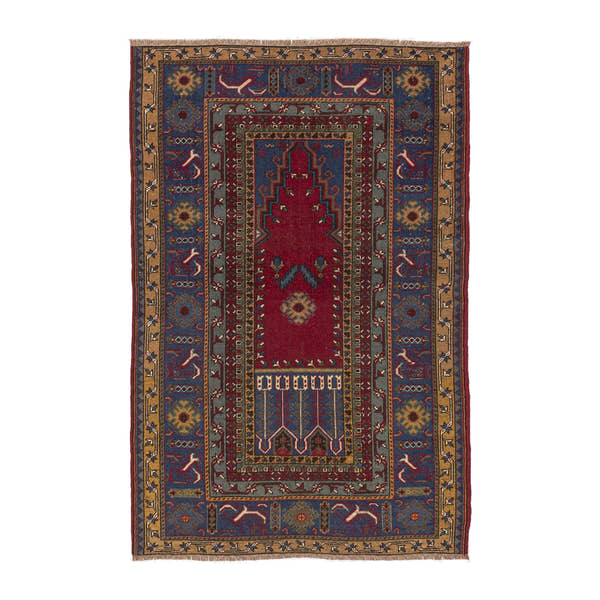
The same source recalls that a Yahyali carpet was woven mostly to lay on the sedir, the low built-in bench of a traditional room.[1] A 2023 study by Zeynep Sahin and Mehmet Genc lists the uses: on the floor and the bench, as cushions and pillows, as prayer rugs, and as saddlebags and bags.[3]
Pile and kilim
Yahyali is known for pile carpets, but the district weaves much more. Sahin and Genc describe it as a region where many kinds of pile, flat and warp-faced weaving are practiced.[3] The Ministry of Culture names Yahyali kilims, along with those of Sariz, as the best known of the Kayseri area.[4] The flat-weaving technique, it notes, turns every motif into an angular, geometric shape.[4]
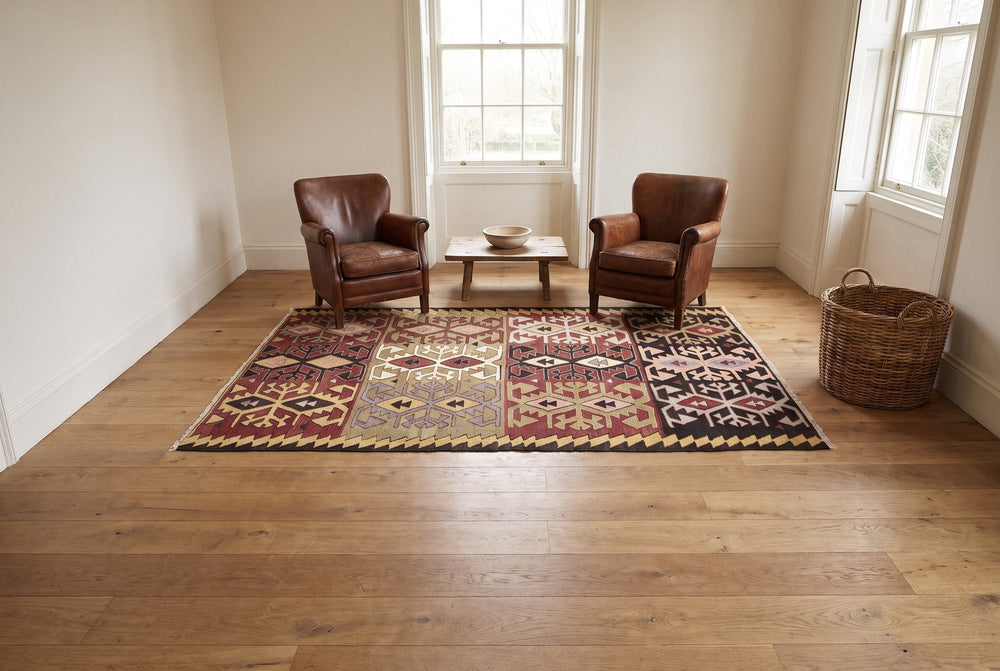
The piece in the pictures here is a kilim, flat and thin, with three linked medallions down a burgundy field and wide ochre and smoke gray borders of small hourglass shapes. If you want the thicker pile carpet the town is registered for, look for the details below.
How the pile carpet is made

Every part of a Yahyali carpet is wool: warp, weft and pile.[2] The Ministry of Culture calls that the main thing that sets it apart from the Bunyan carpets of the same province, which have a cotton warp.[4] The registered standard uses the Turkish double knot and a pile of 5 to 7 millimeters.[2] Local weavers describe each knot as built from eight strands of yarn, with weft and warp both doubled, and call it a locking knot.[1] A dealer in the town told Ersoy Inci that this is what sets Yahyali apart from other carpets of the province.[1]
The wool is washed in a stream, beaten with wooden paddles on the stones, carded and spun on a drop spindle or wheel.[2] The dyes are natural, most of them from plants and fruit peels grown in the district.[2] Only blue comes from outside: indigo does not grow there, so it is brought in and made into dye in the town’s dyehouse.[2]
Colors and motifs

Navy, a brown close to burgundy, dark green and red are the main colors, with camel, white and yellow used sparingly.[2] The registration reads the cool, dark palette as a reflection of the district’s harsh continental climate.[2] Weavers there have their own color words: brown is ger, khaki is yesen and gray is sircani.[1] A burgundy known locally as elmai, apple color, is so typical that Sahin and Genc call it the signature color of Yahyali carpets.[3]
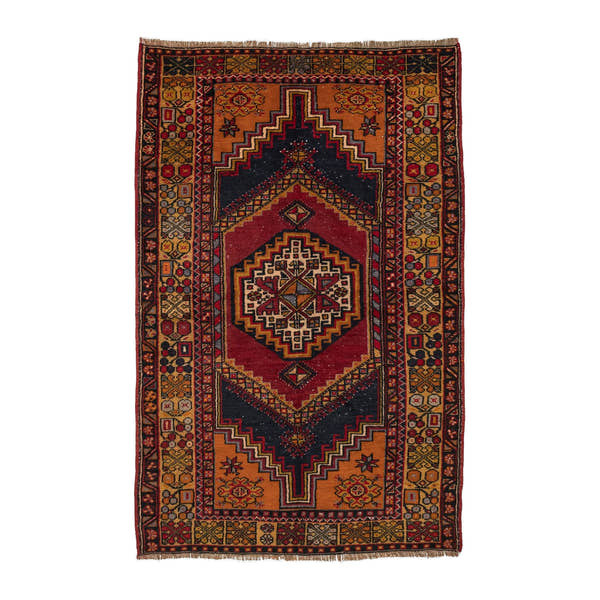
Stylized plants and geometric shapes are spread across the field to form corners and a central medallion.[2] Among the motifs you will meet are the hand on hip, tree of life, amulet, burr, hobble, comb, earring, eye and ram’s horn.[2] Each has a meaning. The hand on hip stands for fertility and plenty.[2] The tree of life tells of the weaver’s wish for a long life.[2] The hobble, a tie once put on a horse’s legs to keep it from straying, stands for a family that stays together.[2] Comb, earring and hair tie motifs speak of a young woman’s wish to marry.[2]
How to recognize a Yahyali rug
A Yahyali pile carpet is all wool, short in pile and dark in color, with navy, deep red and brown leading and only a little white or camel. Look for a center medallion with matching corners, and borders that are busy and framed. A Yahyali kilim is flat and thin, with angular medallions, often linked in a column, on a strong red or navy field.
Living with one
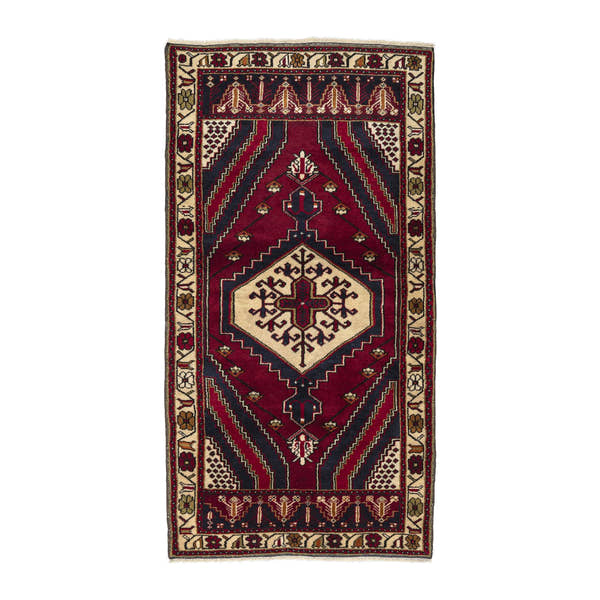
A long, narrow piece like the one here suits a hallway, the side of a bed or a spot in front of a bench. Use a thin non-slip pad, vacuum gently without the beater bar, and turn it once or twice a year. Our guide to kilim rugs explains the flat weave, and how to clean a wool rug at home covers spills.
You can see the kilim from this guide on its product page, and more in the kilim collection and the Turkish rugs collection. For the wider picture, read our ultimate guide to Turkish rugs and the Konya rugs guide.

Sources
- A tradition of labor and change: Yahyali carpet making. Petek Ersoy Inci, International Journal of Folklore Research (UHAD) 7, no. 1, 2024.
- Yahyali hand-woven carpet, geographical indication no. 18. Turkish Patent and Trademark Office.
- Design features of Yahyali cushion and pillow rugs. Zeynep Sahin and Mehmet Genc, Korkut Ata Turkiyat Arastirmalari Dergisi, 2023.
- Carpets and kilims, Kayseri. Kultur Portali, Ministry of Culture and Tourism of Turkey.