In 1888 the governor of Maras sent Sultan Abdulhamid II gifts made in the town, among them a prayer rug that Maras weavers had worked in gold thread.[1] Researchers Aysen Soysaldi and Oguzhan Kabalci read it as a sign of how well known the town’s weaving had become.[1] Maras, officially Kahramanmaras, lies in southern Turkey where the Mediterranean, the east and the southeast of the country meet.[2]
This guide covers the rugs and kilims the Ottoman yearbooks record in the Maras districts, the carpet workshop that wove for export, the village weaving of Elbistan and Pazarcik, a set of dowry flat weaves from 1955, and what to look for in a Maras piece.

A weaving and dyeing town

Under Suleyman the Magnificent, Maras was known as a home of weaving with 95,000 spindles.[1] Dyeing grew up beside it: one source counts 29 dyehouses in the town in 1868.[1] By 1878 the number had reached 32.[1]
Among the Turkmen tribes of the region, weaving was the liveliest folk art, and its products were rugs, kilims, cul covers and saddlebags.[1] All the women of a tribe knew how to weave them.[1] The Dulkadir Turkmen of Maras and its surroundings numbered about 40,000 when they came under Ottoman rule.[1] The tribes of Maras wove their rugs and kilims on upright looms called istar.[1] In the eighteenth century, Armenians in Maras were especially skilled in weaving, dyeing and other crafts.[1]
What the Ottoman yearbooks record
Soysaldi and Kabalci went through the provincial yearbooks for 1867 to 1908 to see which districts wove what. In Pazarcik, rugs, kilims, cushion covers and prayer rugs were made from wool and sold to Aleppo, Maras and Gaziantep.[1] Andirin wove kilims and sold them to Maras, Adana and Elbistan.[1] Kilims are also recorded in Goksun.[1]
In the same years the fine rugs and kilims woven by the Derguzinli and Sinemenli tribes of Pazarcik became well known.[1] The authors call the nineteenth century the brightest time for rug and kilim weaving in the region.[1]
A carpet workshop for export
Around the turn of the twentieth century, the Oriental Carpet Manufacturers of Izmir had a branch in Maras with about 100 carpet looms.[3] The carpets were woven by children, Christian girls.[3] The yarn came already dyed from Izmir.[3] The finished carpets went back to Izmir and from there to Europe and America.[3] A worker earned 2 kurus and 60 para a day.[3] Workers had to put in at least eight hours a day at the looms.[3]
Village rugs of Elbistan and Pazarcik
Andirin, Afsin, Goksun and Pazarcik are the parts of Maras best known for their weavings.[2] Many villagers there kept a nomadic life, and the Varsak, Afsar, Sinemilli and Mahkeni Yoruks carry on the weaving tradition.[2]
In the twentieth century carpet weaving was a living in Elbistan, and every house had a loom.[1] Weavers there used wool and goat hair.[1] Their looms were mostly of the rolling type, on which they wove long runners above all.[1] They also made prayer rugs, Quran covers, cushion rugs and small rugs.[1] Priced by the square meter, the rugs were sold to nearby provinces, Malatya above all, and to Istanbul.[1]
Near Pazarcik, the Mahkeni and Sinemili Yoruks spun wool from their own sheep on a long spindle they call oreke.[1] Black sheep’s wool shows up often in their weavings, mostly in the warp.[1]

Four dowry weavings from 1955

Textile scholar Filiz Nurhan Olmez studied four flat weaves made in 1955 in Kirikkilise, a village 35 kilometers from Goksun, for a dowry.[2] They were ordered by Ismail Olmez, who worked as a mounted postman in Saimbeyli from 1947 to 1977.[2] The pieces were woven in the kilim, zili and cicim techniques.[2] In the kilims the wefts sit closer together than the warps, and in the zili and cicim pieces it is the other way around.[2] Wool and goat hair were the materials, and synthetic dyes were used alongside plant dyes.[2]
The first kilim has a red field with black, indigo, yellow, beige, pale green and brown.[2] One kilim carries the inscription 1955 and F.250, which Olmez reads as its year and a price of 250 lira.[2] Pink in the second kilim may come from a synthetic dye.[2] A wolf’s mouth motif on the first kilim has the same form as one on the saddlebags of the Karakecili Yoruks of Kula, in Manisa.[2] A warp-faced cicim floor cover in the set has motifs that resemble letters of the Old Turkic runic alphabet.[2] In its material and its lack of fringe, that cover is close to the warp-faced cicims of the Savak tribe of Tunceli.[2] The zili piece begins with a butterfly motif.[2]
Olmez concludes that weaving in the village then served both the family’s own needs and income, and that pieces were made to order for dowries.[2] Red, yellow, green and blue are the common colors.[2]
What to look for in a Maras piece
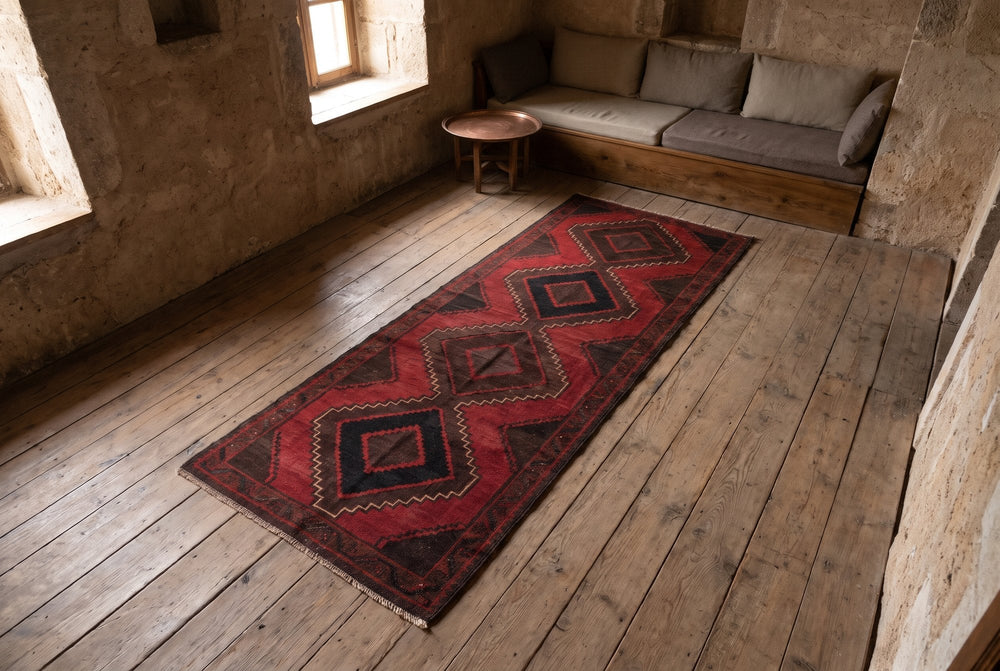
Maras kilims, like the rugs of the region, are marked by red, black and brown.[2] Narrow, long kilims are common.[1] Besides kilims with a row of lozenge medallions, you see designs split into square and rectangular compartments that local people call sandik, the chest.[1]
Hand-woven rugs and kilims could not keep up with mass production in the twentieth century.[1] Weaving for sale stopped because costs were high and prices low.[1] Today few people still know the craft, and rugs and kilims are woven only for use or for dowries.[1] Public education centers in Pazarcik, central Maras and Elbistan are trying to revive it.[1] So most Maras pieces you meet will be older village work, often with dark wool in the warp.
Where to go next
Elbistan sold many of its runners to Malatya, so the Malatya rugs guide is the natural next read, and the ultimate guide to kilim rugs explains the flat weave techniques. For the wider picture, read the ultimate guide to Turkish rugs and browse our kilims and all Turkish rugs.
For a piece from Malatya itself, see this Malatya kilim, with wide bands of indigo, orange and gray on a black cherry field.
Or see this Gaziantep kilim, with wide seal brown stripes between pale gray panels of small black diamonds. Neither it nor the Malatya kilim is a Maras piece.


Sources
- Osmanli Salnamelerinde Kahramanmaras Hali-Kilim Dokumaciligi (Rug and Kilim Weaving of Kahramanmaras in the Ottoman Yearbooks), in Kahramanmaras Arastirmalari. Aysen Soysaldi and Oguzhan Kabalci, 2021.
- Kirikkilise Koyunden 4 Duz Dokuma Uzerine Gozlemler (Observations on Four Flat Weaves from Kirikkilise Village). Filiz Nurhan Olmez, Erdem, 2009.
- Osmanli Doneminde Maras’ta Iktisadi Faaliyetler (Economic Activities of Maras in the Ottoman Period). H. Sahin, Gaziantep University Journal of Social Sciences, 2011.