
In 1907 the town of Corum had about 2,000 looms, according to the yearbook of the Ankara province quoted by textile researcher Hilal Bozkurt.[1] Among the things woven on them were cloth, cloaks, kilims and prayer rugs.[1] Corum is a province in north central Turkey, home to the Bronze Age sites of Alaca Hoyuk and Bogazkoy.
Today the rug and kilim weaving that was once common in the province survives in small amounts in Mecitozu, Ortakoy and Alaca, mostly for dowries.[2] This guide covers how weaving worked in Corum homes, the plain goat hair weavings of its northern villages, the plant dyes of the province, and the motifs weavers used and what they mean.

Weaving at home
Weaving was one of the main trades of Corum, and in the early nineteenth century it was done mostly in homes rather than in workshops.[1] The same yearbook records that a master weaver of alaca, a striped cloth, was brought from Burdur to teach it at a girls’ school to anyone who wanted to learn.[1] The cloth the schoolgirls wove was said to be of very good quality, with fast colors.[1]
In the villages of Osmancik, nearly every house had a loom called a duzen, on which people wove socks, headscarves and kilims.[2] Carpets were also woven in Osmancik in the past, and the craft goes on there in occasional courses.[2] Ortakoy runs courses in rug, kilim and wall cushion weaving.[2] Researchers at Hitit University name Mecitozu as the district of Corum known for kilim weaving.[3]
Goat hair weavings of the north
The Kizilirmak river, which runs through the province, makes its land and its herds rich.[4] In 2017 and 2018, Begul Ozkoca studied goat hair weavings in villages of Osmancik, Dodurga and Lacin, in the north of the province.[4] These districts are colder and more mountainous than the rest of Corum, and the weavings made there for daily use are plainer.[4] Such weavings are no longer made in the villages, but the ones families still have are in use.[4]
The pieces she recorded served as grain sacks, saddlebags, floor spreads, aprons, tent covers and the cloth laid over flatbread.[4] Most were left in the natural color of the hair, with a bar motif dividing the field at intervals and braided or fringed ends.[4] Floor spreads kept out the cold indoors in winter and were laid outside at harvest to dry pulses.[4] The colors are brown, cream, white and a milky brown.[4]
All the pieces were woven in the kilim technique, and 8 of the 10 had a goat hair warp.[4] Bags for food used more wool, so that hair would not shed into what they held.[4] Goat hair strips for a tent were woven about 2 to 3 meters long and 50 centimeters wide.[4] The smallest tent took five of them sewn side by side.[4] Locally, weavings made in the cicim and zili techniques are called cul.[4]
Ozkoca found a spindle, a wool comb and a spinning wheel in the villages, but no loom.[4] As people moved from the villages to the cities, many old weavings were left unused in a corner.[4]
Plant dyes of Corum
For her doctoral thesis, Bozkurt gathered dye plants that grow wild in Corum, among them vine, quince, buckthorn, madder, elder, walnut, linden, sumac, cornelian cherry, rosehip and black mulberry.[1] She used them in 100 dyeings of wool kilim yarn.[1] The results ranged through cream and beige, yellow, green, brown and red.[1] Her fieldwork also found that rug, kilim and cloth weaving had once been very common in the province but is no longer actively practiced.[1]


Motifs and what they mean
Nuran Kayabasi, Hilal Bozkurt and Begul Ozkoca recorded the motifs used in Corum’s crafts, and many of them appear in its rugs and kilims. The tree of life is a symbol of immortality, and birds perched on it in many weavings are souls that will fly when their time comes.[3] In Corum the tree of life appears in rugs and kilims.[3] In Anatolian weaving, the hands on hips motif stands for happiness, motherhood, fertility and marriage.[3] The ram’s horn stands for courage, honesty, plenty, strength and manhood.[3]
The fetter, a hobble that keeps a horse from wandering off, stands for a family that should stay bound together.[3] The burr, a thorny weed, was believed to keep away the evil eye and to stand for plenty, so it was woven often into flour sacks and the cicim cloths laid over bread.[3] The water path stands for the water that Anatolian women lived with all day.[3]
The eye is woven into the plain band at the start and end of a rug or flat weave, so that the weaving and its weaver are kept from the evil eye.[3] The wolf’s mouth, usually woven in the border, stands for fear and protection.[3] A girl who wove the earring motif was telling her family she wished to marry.[3] The star, one of the oldest motifs known in Anatolia, appears in Corum rugs.[3] So does the scorpion, a sign of fear and the wish for protection.[3] The researchers also include the sun disk, which they describe as a religious standard of the Hittites, among the motifs of Corum’s crafts.[3]
What to look for in a Corum piece

A plain goat hair spread or sack in brown and cream, with bars across the field and braided ends, fits the weavings of the northern villages. A wool kilim with eyes in its end bands or earrings and fetters in the field speaks the motif language described above. Because so little is woven in the province today, most Corum pieces you meet will be older work kept by families.
Where to go next
The ultimate guide to kilim rugs explains how flat weaves like cicim and kilim are made, and the Sivas rugs guide covers a rug center to the east. For the wider picture, read the ultimate guide to Turkish rugs and browse our kilims and all Turkish rugs.
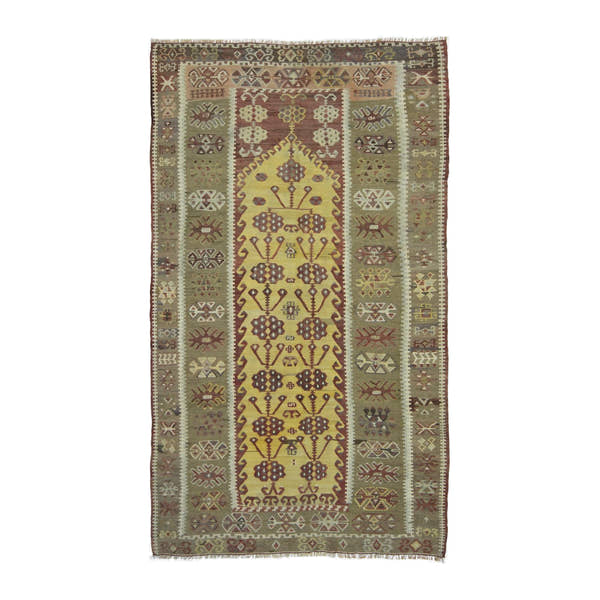
For a village kilim from Sivas, to the east, see this Sivas kilim, with bands of deep red and charcoal and small hooked stars in gold, pink and cream.
Or see this Konya kilim with a lattice of hooked diamonds, also from central Anatolia. Neither is a Corum piece.


Sources
- Corum’da Yetisen Bazi Bitkilerden Elde Edilen Renkler (Colors Obtained from Some Plants Growing in Corum), PhD thesis. Hilal Bozkurt, Ankara University, 2016.
- Corum ve Kultur (Corum and Culture). Corum Provincial Directorate of Culture and Tourism.
- Corum El Sanatlarinda Kullanilan Motifler ve Anlamlari (The Motifs Used in Corum’s Handicrafts and Their Meanings). Nuran Kayabasi, Hilal Bozkurt and Begul Ozkoca, Hitit University Journal of Social Sciences, 2016.
- Corum’un Bazi Koylerinde Uretilen Kil Dokuma Ornekleri (Goat Hair Weavings from Some Villages of Corum). Begul Ozkoca, Aris Journal, 2019.


