Gaziantep Kilims: The Shuttle-Woven Antep Kilim

At its busiest, Gaziantep in southeast Turkey kept around 7,000 hand looms at work.[2] Kilims from the town’s workshops traveled all over Turkey, and some were given to mosques as far away as Yozgat, Denizli and Ankara.[1] This is the Antep kilim, as Gaziantep kilims are often called. Unlike most Anatolian kilims, it was woven by craftsmen in the town on a shuttle loom, which makes it thinner and finer than a kilim beaten down by hand.[1] Look for bands of stepped diamond medallions in red, black, white and brown, separated by stripes.

Where Gaziantep kilims come from
Kilim weaving in Gaziantep has a long history, but nobody knows exactly when it began. Turkey’s Ministry of Culture and Tourism says the date and the stages the craft went through are not known for certain.[2] One recent study traces it back to the 16th century.[3]
Two traditions met here. Textile researcher Aysen Soysaldi describes village kilims that local families wove for their own homes on upright looms, long single pieces mostly in black, red, brown and white. She also describes the kilim of the bazaar, woven by craftsmen for sale and found across Turkey.[1] In her reading, the Antep kilim maker took the village tradition to the market, simplified its motifs and moved to production on the shuttle loom.[1]
The bazaar trade did not last. The Ministry records that by the 1960s the number of hand looms in Gaziantep had fallen to 100 to 150.[2] Soysaldi links the decline to machine-made flat weaves that appeared in the 1960s, after which the hand weavers could no longer sell their kilims.[1]
How an Antep kilim is made
The classic Antep kilim is a slit-weave kilim. Each motif is woven with its own shuttle, which leaves small slits along the warp between one color and the next.[1] In kilims 70 to 100 years old, Soysaldi gives slits between 3 millimeters and 1 centimeter long.[1]
The materials are unusual too. Older Antep kilims have a warp of black-dyed cotton and a weft of fine, single-ply wool colored with natural dyes.[1] Madder root gave shades from melon orange to red, and indigo imported from India gave navy and blue.[1] Synthetic dyes arrived in the 1940s, and acrylic yarns after the 1970s.[1]
Large floor kilims were woven in two halves. Each half carries the same half of the design, and when the two are sewn together the halves meet to form whole medallions, in a floor kilim of about 150 by 250 centimeters. Runners and prayer kilims are woven in one piece.[1]

How to recognize an Antep kilim
Start with the layout. A classic Antep kilim has three bands of medallions across it: a wide one in the middle, called the orta gobek, and a narrower one near each short end. Between them run soy, plain stripes in an ordered color sequence.[1] Down the middle of those stripes, black and white or red and white wefts often form a row of small comb teeth.[1]
Then check the colors. Soysaldi lists red, black, white, brown, orange, yellow, purple and khaki green as the characteristic weft colors of the traditional Antep kilim.[1] Bright grass green, chick yellow and pink belong to newer pieces.
Finally, feel it. Because it was woven on a shuttle loom with fine warp and weft, an Antep kilim is thinner than a hand-beaten village kilim, and a two-panel piece has a seam running down its length.
The medallions you will see
Antep kilim makers gave their medallions names, and Soysaldi recorded them with a kilim maker in Gaziantep:[1]
- Pence gobek, the claw: a diamond of stepped triangles whose steps bend at 45 degrees like an elbow. One of the most loved designs of old Antep kilims, named for the strong talons of a bird of prey.
- Habbap ayagi, the clog: the local word for a wooden bath clog, a diamond built from stepped triangles nested back to back.
- Zincir gobek, the chain: flat steps that grow from the center outward, one, three, five, seven, nine and eleven, like waves of light spreading from a point.
- Kus kanadi, the bird’s wing: diamond-shaped wings stacked around the center line, like a bird in flight.
- Atomlu, the atom: an oval core with shapes spreading to either side. It is said to have been inspired by the atomic bomb dropped on Japan in the Second World War.[1]

The Gaziantep kilims we carry
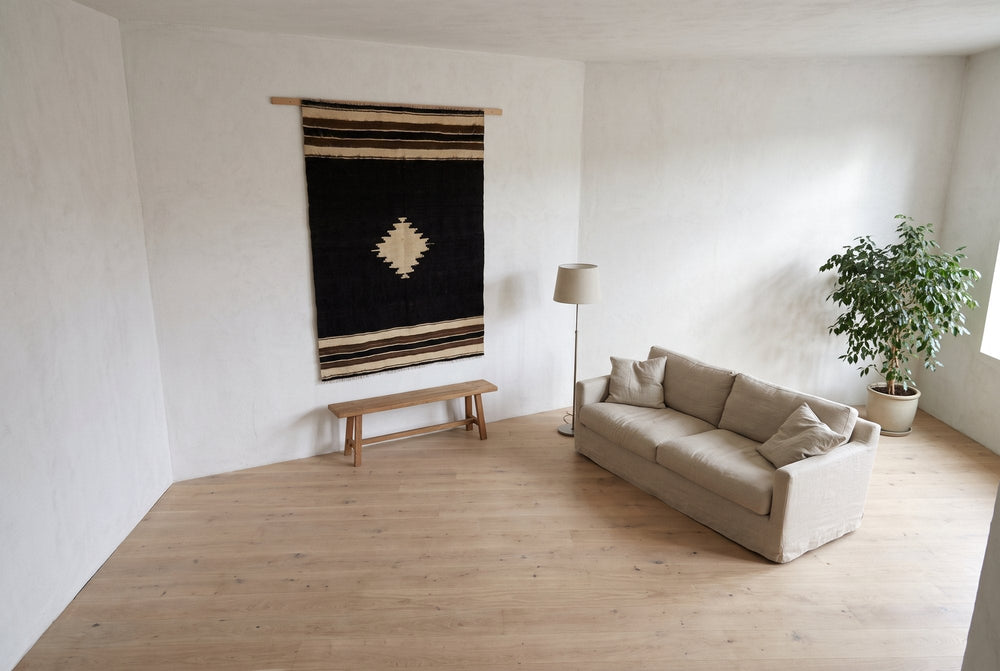
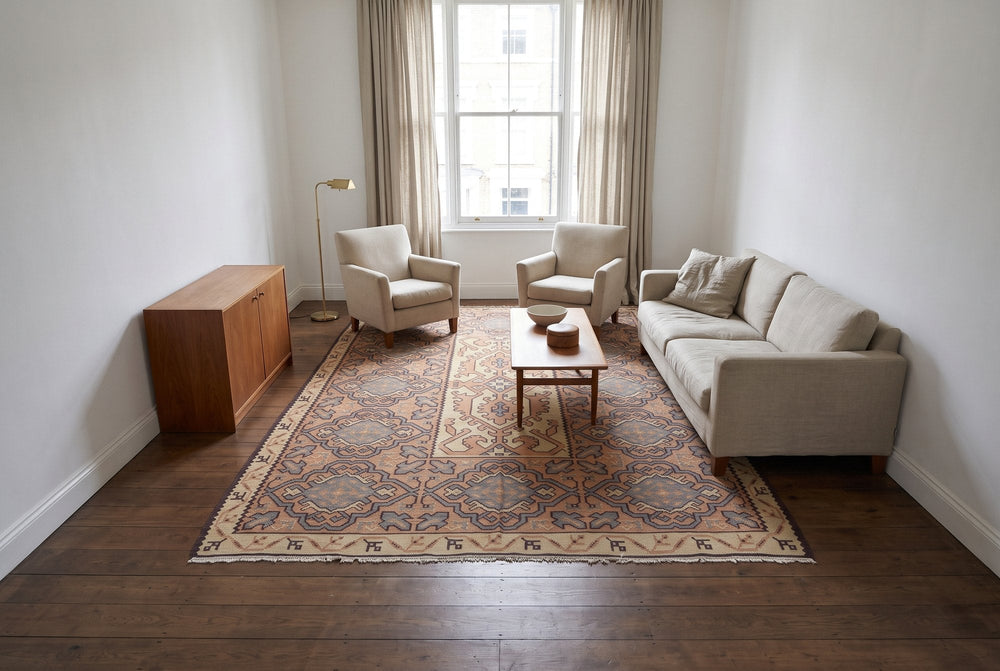
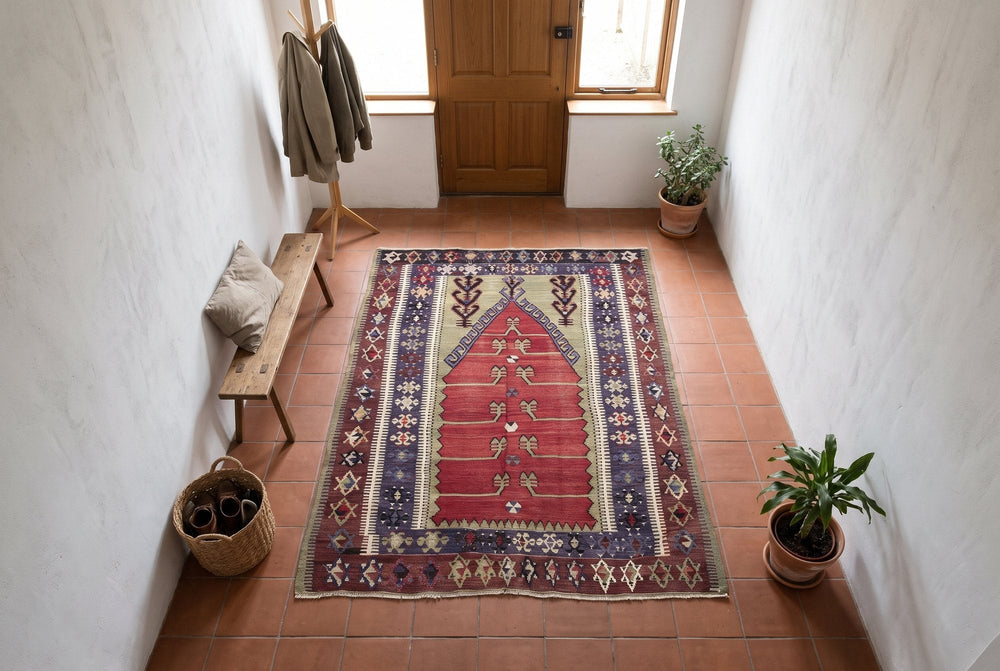
The Gaziantep kilims we carry now are the plainer, striped side of the tradition, without the big medallion bands. All are flat-woven wool, most about 40 to 60 years old. One has wide seal brown stripes between gray panels of tiny black diamonds, and another runs narrow stripes of ivory motifs over deep mahogany. A third is striped in red, cream, gray and black with rows of small pink and purple checks, and a long runner of about 2½ by 10 feet carries a bright broken line of red, green, ivory, yellow and blue down its center. Sizes run from about 4½ by 7 feet to about 6 by 7 feet, plus the runner, and prices from about $785 to $1,110. Each listing gives the exact size in feet and centimeters.
Living with a Gaziantep kilim
An Antep kilim lies very flat and light, which makes it easy to move, hang or lay over a bench. Its bands of medallions read from across the room, and the stripes between them give a quieter rhythm close up. Red, black and white sit well with plain walls, dark wood and leather.
Care is simple. Vacuum it without a beater bar, turn it every few months so light and wear reach every side, and use a thin pad on a hard floor so it stays put. If your kilim has a center seam, check it now and then and have any loose stitches closed before they spread. Our guide to cleaning a wool rug at home covers spills and stains.
Where to go next
For flat weaves in general, start with our guide to kilim rugs. Stepped diamonds and comb motifs turn up all over Anatolia, and reading a rug: motifs and what they mean explains the common ones. To see how a bazaar weaving differs from village and tribal work, read tribal, village and city rugs, and for the Turkish side of our catalog, the guide to Turkish rugs and the Anatolian rugs guide. You can browse all Turkish rugs and Anatolian rugs, or see every piece from this region in the Gaziantep collection.


Sources
- Antep Kilimleri (Antep Kilims). Aysen Soysaldi, Turkish Ministry of Culture and Tourism e-book library.
- Gaziantep: Kilimcilik (Kilim Weaving). Turkish Ministry of Culture and Tourism, Kultur Portali.
- Gaziantep Province Nurdagi District Komurler Village Palas Weaving. Oguzhan Kabalci, Motif Akademi Halkbilimi Dergisi, 2026.