Rug No. has found its new home.
Every rug we sell is one of a kind, so that piece is gone. Here are others in the same spirit, or tell Rug Finder what you are looking for.
Corum Rugs
Corum rugs on this page are kilims from Corum Province in north central Turkey. A study of old kilims kept in a village shrine found white and black the colors used most. Each piece in this collection is one of a kind.


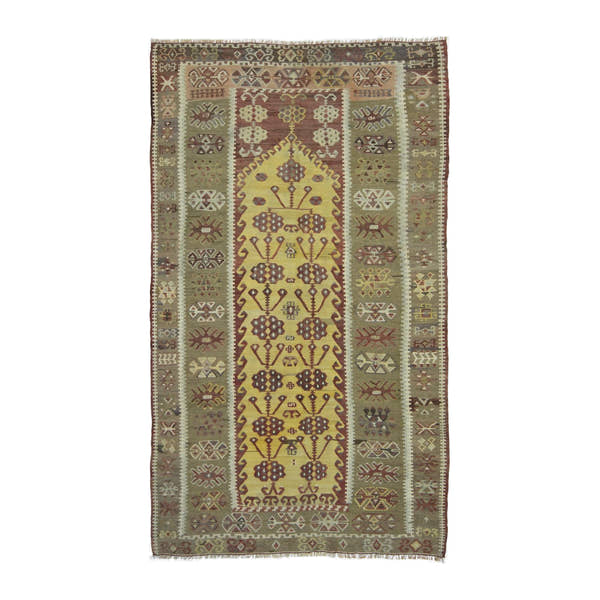

Corum rugs: kilims of north central Anatolia
In a 2017 study, Begul Ozkoca and H. Sinem Sanli recorded the kilims kept in the shrine and dervish lodge of Mehmetdedetekke, a village in the Dodurga district of Corum. They note that old kilims now survive in limited numbers in village lodges, shrines, mosques and cemevis, where their worth is known and they are looked after.
How they are made
The Mehmetdedetekke kilims are worked in the kilim technique: in each area of the design a colored weft passes over and under the warps up to the edge of the next color, then turns back, so each color builds its own motif. The warps were wool and cotton, and the wefts and patterning yarns wool, with some synthetic yarn. The pieces measured from 84 to 193 centimeters long and from 40 to 130 centimeters wide.
Reading a Corum kilim
- Layout: the field is laid out geometrically, often in thin and thick bands, or divided into two or three equal parts, with diamonds, hexagons or a single unit repeated across or down the rug.
- Motifs: finger, eye and swallow motifs appear most, beside ram’s horn, shepherd’s buttonhole, hands on hips, the running water line, the Turkmen rose and the bird.
- Color: white and black come first, followed by blue, green, orange and red, with navy, purple and mustard among the rest. The authors tie the range of colors to the plants of the area, which women learned to use over time.
What to look for in a flat weave
In a flat weave the colored wool runs through the weave itself, so motifs are built from straight edges and small steps. Diamonds, stars and bands come out bold, the back usually shows the same design as the front, and with no pile the piece lies thin and light on the floor.
Corum among the Turkish weaves
Corum sits between the Black Sea coast and the central plateau. Compare it with our Sivas rugs further east and the village weaving in our Anatolian collection.
For flat weaves in general, browse our kilim rugs and read the guide to kilim rugs, and for the names and meanings of the common shapes, see reading a rug: motifs and what they mean.
Choosing a size
- Runners: a hall or a galley kitchen. See choosing a runner length.
- Small rugs: an entry, a bedside or a bathroom. See where to put a small rug.
- Room sizes: a living room seating group or a dining table. See choosing the right rug size.
What each listing shows
Every rug page gives the exact size in feet and centimeters, the main colors and a set of photos, including close views. Read the size against the space before you choose, and look at the close views for the small marks of use that come with a handmade rug. If a question is left, we answer by email or phone.
Caring for it
Vacuum gently, turn the rug every few months so sun and traffic reach every side, and blot spills straight away rather than rubbing them. A thin rug pad keeps a rug in place on a hard floor. Our guide to cleaning a wool rug at home has the details.
More on where these rugs come from and how they are made: the Corum guide.
Related collections
Browse all Turkish rugs, kilim rugs and Anatolian rugs.