Diyarbakir Kilims: Karacadag and the Museum Collection
When art historian Evindar Yesilbas went back to the Karacadag villages of Diyarbakir after a 2004 survey, she found that by 2008 the women there had stopped weaving altogether.[1] Families were selling the kilims they still had to shopkeepers in the old Hasan Pasha Han, a caravanserai in the city.[1]
Diyarbakir is a city on the Tigris in southeastern Turkey. This guide covers the Karacadag kilims, how they were made and what they look like, the kilims kept in the Diyarbakir Archaeology Museum, the motifs that recur in both, and what to look for in a Diyarbakir kilim.
Karacadag and its kilims

Karacadag is an old volcano southwest of the Diyarbakir basin, built from dark lava on the border with Sanliurfa.[1] The small villages on its slopes are what people mean by Karacadag.[1] Yesilbas counts it among the old centers where fine Turkish kilims were made.[1] The kilims were woven by the people there for their own daily needs.[1]
Yesilbas notes that wool flat weaves of the Diyarbakir area were once very rich and varied, but lost their place over time and began to disappear.[1] Workshops for Karacadag kilims existed until 2008.[1] Weak demand and a preference for factory rugs and kilims led weavers to give up the work.[1]
Wool, dye and loom

Families who kept animals in the Karacadag villages sheared wool twice a year, in spring and autumn.[1] Older people combed the wool, picking out dirt and thorns, and spun it on a hand spindle called tesi.[1] Hand-spun yarn, loosely twisted, gives the kilim surface a soft sheen that brightens its colors.[1]
The warps were often left undyed, while the weft yarn was dyed in skeins.[1] Dyes came from the leaves, fruit, bark and roots of local plants.[1] In later years weavers turned to synthetic dyes because they were cheaper and easier, and to factory-spun wool from other provinces.[1] Some colors came from the natural shades of sheep’s wool.[1] Kilims were once woven on ground looms; later the upright istar loom and modern looms came in.[1]
What a Karacadag kilim looks like
Most pieces are in the kilim technique, cicim, or both together.[1] In the kilim technique, each weft color turns back at the edge of its own motif, and the vertical gap left where two colors meet is called an ilik, a slit.[1]
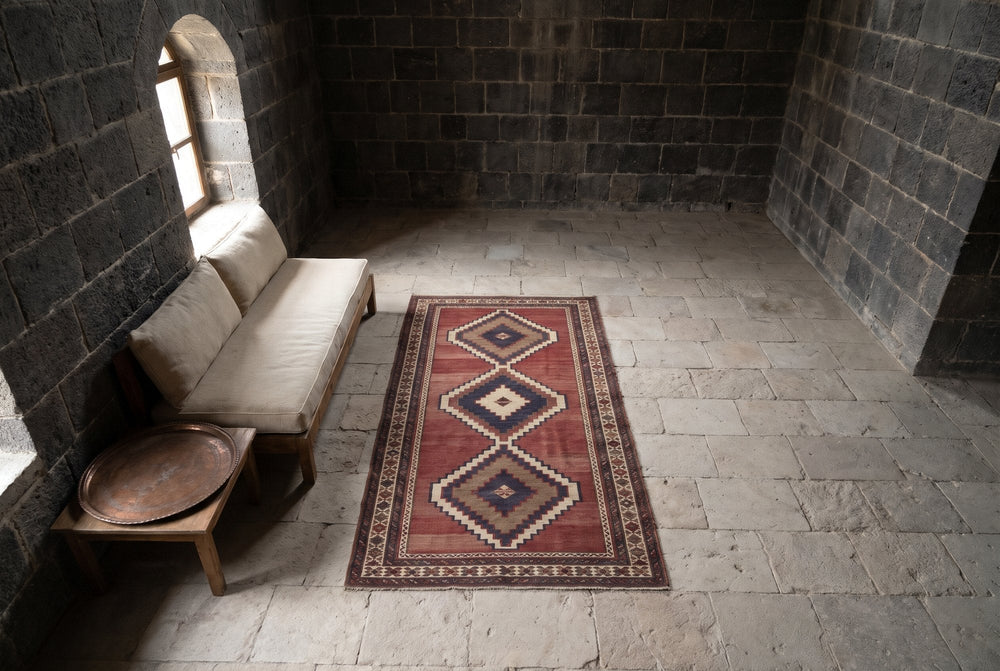
By use, Karacadag kilims include floor kilims, runners, prayer rugs, divan covers, wall hangings and cushion and mattress covers.[1] Most have three or five medallions down the center, though some carry motifs only at the ends and middle.[1] Others are built from rows of horizontal bands, plain stripes alternating with patterned ones.[1]
Larger pieces were sometimes woven in two halves and sewn together.[1] Borders, when there are any, use zigzags, meanders with hexagons, the camel’s foot and the small frog.[1] Red and its shades come first, then yellow, white, black, blue, green, purple, gray and brown.[1]

Kilims in the Diyarbakir Archaeology Museum
Diyarbakir’s first museum was founded in 1934 in the Zinciriye Madrasa near the Great Mosque.[2] Its ethnographic collection holds carved doors, chests inlaid with mother of pearl and ivory, and rugs and kilims.[2] Today the Archaeology Museum keeps 91 kilims in storage.[2] Gizem Gem and Sema Tagi chose ten that differ in motif, color and layout for a closer study.[2]
Where the material is recorded, warp and weft are wool.[2] Two of the ten were woven in two pieces.[2] Several are long runners: one measures 118 by 418 centimeters, another 100 by 485.[2] One red-ground kilim of 188 by 310 centimeters has hands on hips, wolf’s mouth, ram’s horn and hook motifs, with water paths, hexagons and hair ties in its outer border.[2] A brown-ground kilim of 140 by 295 centimeters carries human figures and mountain goats among its hands on hips, eyes and hooks.[2] Across the ten, brown, black, pink, green, blue and orange are the usual colors.[2]
Motifs and what they mean

In Karacadag kilims the most frequent motifs are hands on hips, ram’s horn, wolf’s mouth, burr, amulet, eye, lozenges, water path, fertility cross, hexagons and stars.[1] Hands on hips appears in the center, in the borders and in bands at the ends.[1] The ram’s horn stands for plenty, heroism, strength and manhood.[1] The eye, which local people call by names such as four eyes and calf’s eye, is used very often.[1]
The tree of life stands for eternity, and the crab and scorpion for evil.[1] Motifs left open at one end stress endlessness, a way for the weaver to tie her work to the sacred.[1] Weavers taught patterns by having learners memorize them.[1] Yesilbas writes that the Karacadag weaver put her feelings, hopes, joys, sorrows and fears into the motifs of her kilim.[1]
In the museum kilims, the most common symbolic motifs are water paths, amulets and hooks, followed by fetters, hourglasses, crosses, earrings, eyes and fertility signs.[2] Among figures, the wolf’s mouth, ram’s horn and hands on hips lead, while human figures and mountain goats are rare.[2] Of the geometric shapes, triangles come first, then stars and hexagons.[2] The hair tie is the most common motif drawn from an object.[2]
To bring the craft back, Yesilbas proposed finding the women who once wove kilims and bringing them together in a social support project.[1]
What to look for in a Diyarbakir kilim
A red kilim with three or five medallions down the center, undyed warps and hands on hips at the ends fits the Karacadag type. Long, narrow runners in brown, orange and pink with wolf’s mouth and ram’s horn motifs match many of the museum pieces. A center seam often means a kilim woven in two halves.
Where to go next
The ultimate guide to kilim rugs explains slit-woven kilims and the other flat weave techniques, and the Malatya rugs guide covers another weaving area of eastern Anatolia. For the wider picture, read the ultimate guide to Turkish rugs and browse our kilims.
For an eastern Anatolian flat weave in stock, see this Hakkari kilim, or this Malatya kilim. Neither is a Diyarbakir piece.


Sources
- Diyarbakir Karacadag Kilimlerinin Desen ve Motif Ozellikleri (The Design and Motif Features of the Kilims Produced in Karacadag, Diyarbakir). Evindar Yesilbas, Aris, 2011.
- Diyarbakir Arkeoloji Muzesi Icin Tekstil Urunu Hediyelik Turistik Esya Onerileri (Textile Souvenir Proposals for the Diyarbakir Archaeology Museum). Gizem Gem and Sema Tagi, Akademik Sanat, 2025.


