
Between 1925 and 1945, carpet weavers in western Turkey could be paid in a currency of their own.[1] It was issued by a Simav carpet company and accepted in the workshops of Simav, Gediz, Emet, Demirci, Kula, Usak and Selendi, where weavers spent it in the local shops.[1] Simav is a district of Kutahya province, and its story says a lot about carpet weaving in this part of Turkey.
This guide covers the carpets of Simav, the village rugs and flat weaves of Kutahya, the motifs weavers use and what they mean, and what to look for in a Kutahya piece.

Simav, a carpet town
Textile researchers Sema Tagi and Mustafa Arili trace carpet weaving in Simav to the nineteenth century, when demand for carpets rose and new weaving centers opened across Anatolia.[1] It was started by merchants from outside, and merchants have guided it ever since.[1] From the nineteenth century on, English carpet companies had carpets woven in Simav, Demirci and Selendi and opened agencies there.[1] The first local carpet company was set up in the early 1900s by a Simav entrepreneur named Suleyman Sami, and it closed in a crisis during the Second World War.[1]
Weaving stayed central to the district. The researchers note that it matters to family budgets and lets women put the time they have outside farm work to use.[1] When the study was made, Simav and its villages had about 3,000 carpet looms, three yarn mills, two dyehouses and many carpet washing workshops.[1] Merchants in the district alone had 100,000 to 120,000 square meters of carpet woven a year.[1]
What a Simav carpet looks like

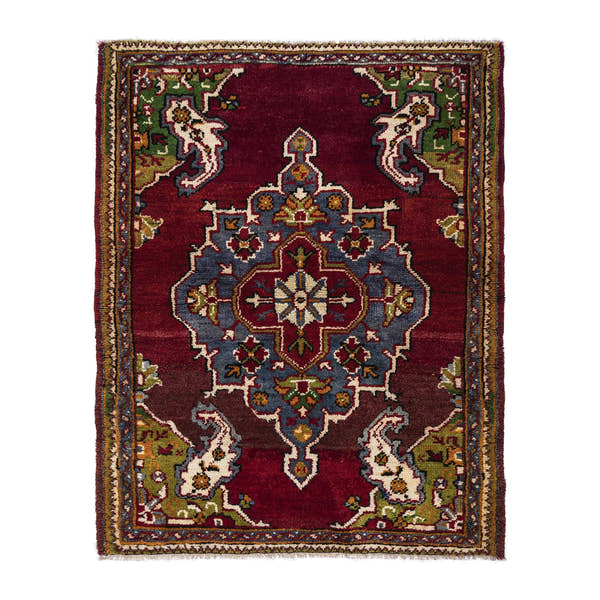
The Ministry of Culture describes the old Simav carpets, known as palace carpets, as decorated mostly with leaves and flowers.[2] Field and border carry curling veined leaves, rosettes, pomegranate flowers, hyacinths and carnations.[2] Because they were colored with root dye, they were also called root dye carpets.[2]
The most common motifs are leaves, flowers and rosettes, and old Simav carpets went by design names such as leblebi seker, a sugared chickpea sweet, empirme and the angular medallion.[1] These names describe the design, not the number of knots.[1]
Under the Turkish standard for hand-knotted carpets, a Simav carpet is a coarse-class rug with a cotton warp and weft and a wool pile.[1] It has 18 knots across and 24 knots down in each 10 centimeters, and a pile 12 to 16 millimeters high.[1]
How the look changed
In the 1910s, Simav carpets still had their own local designs and knot counts.[1] After the 1930s, as unemployment rose, cheaper carpets were woven in larger numbers, the old designs lost their character and began to look like those of Isparta.[1] They were sold on the market as Isparta II.[1] From 1950 to 1980, tanners who had lost their trade turned to carpet making, buying designs and paying weavers to work them.[1]
In the 1980s demand for those cotton-foundation carpets fell and more carpets were woven with a wool warp and weft.[1] So an older Simav piece may look close to an Isparta rug, and the foundation can help date it.
How the trade worked
Commercial weaving reached the area when Sykes, an English merchant living in Izmir, sent master weavers from Usak who taught the craft to local people.[1] By the mid-1880s the carpet trade of the region was in the hands of six large English firms, which later formed the Oriental Carpet Manufacturers.[1] That company held the carpet trade of western Anatolia for many years and kept working until 1934.[1] In the 1940s the Second World War stopped carpet exports altogether, and carpets were made only for the home market.[1]
Simav grew again after the war. The number of carpet makers in the district rose from four in 1959 to about sixty in 1966.[1] About 250 of the looms stood in the town itself and the rest in the villages, and nearly all of them were in homes.[1]
Simav dealers told the researchers that the knot count across or down a carpet can rise or fall by 5 to 10 without trouble, and that they cared more about color and design than about knot density.[1] The study ends on a sad note: the district had stopped weaving carpets of its own design.[1]
Village rugs and flat weaves

Simav is not the whole of Kutahya. The Ministry of Culture notes that Yoruk carpets of the area are woven in Bayramsah village, in the Aslanapa district.[2] A 2026 study by A. A. Tug Kiziltoprak lists the Cakmak and Karakecili carpets, the cicim and zili flat weaves of Kutahya, and the carpets of Simav among the weavings of the province.[3] Hand weaving of rugs and kilims in village and town homes is still an important source of income.[2]
Motifs and what they mean

Kiziltoprak looks at the six motifs met most often in Kutahya carpets and flat weaves. The ram’s horn stands for strength and plenty; the hands on hips for women and fertility; the eye for protection from the evil eye; the comb for marriage and children; the bird for a free spirit and wisdom; and the tree of life for the cycle of life.[3] The same motifs still appear in the cicim and zili weavings made in the province today.[3] In those weavings, extra pattern yarns are carried through the weave to draw the motifs.[3]
What to look for in a Kutahya piece
Ask whether the warp and weft are cotton or wool; a cotton foundation with a wool pile points to the classic Simav carpet. Look for leaves, rosettes and flowers in the field and border, and for the deep reds of root dye. If a village piece shows rams’ horns, eyes, combs or birds, read them as the weaver’s wishes for the household.
Where to go next
The Isparta rugs guide explains the workshop rugs that later Simav carpets came to resemble, and the Manisa rugs guide covers the neighboring province to the west. For the wider picture, read the ultimate guide to Turkish rugs and browse all Turkish rugs.
For a western Anatolian rug in stock, see this Oushak rug from neighboring Usak, or this Esme kilim from the same province. Neither is a Kutahya piece.
Sources
- Simav Ilcesinde El Dokumasi Halicilik (Carpet Weaving in Simav County). Sema Tagi and Mustafa Arili, e-Journal of New World Sciences Academy, 2011.
- Kutahya: Geleneksel Sanatlar ve Zanaatlar (Traditional Arts and Crafts). Turkish Ministry of Culture and Tourism.
- Kutahya Yoresi Hali ve Duz Dokuma Motiflerinin Iletisimsel Islevleri (The Communicative Functions of Kutahya Carpet and Flat-Weave Motifs). A. A. Tug Kiziltoprak, Izmir Journal of Economics, 2026.


