Bayburt Rugs and Kilims: Weaving in Northeast Turkey
In the seventeenth century, the Ottoman traveler Evliya Celebi visited Bayburt and wrote that kilims and prayer rugs woven from wool colored in the town’s dyehouses were sent as far as Europe.[1] Bayburt is a province on the high ground between the Black Sea mountains and eastern Anatolia, and weaving is still part of its identity.
This guide covers what Bayburt wove, the looms and wool, the motifs and what they mean, the ehram that women wore, and what to look for in a Bayburt piece.

A town of weavers
The Governorship of Bayburt names kilims, prayer rugs and the ehram, a woven wrap, as the most important crafts still alive in the province, together with stone and copper work.[1] The town’s street names still remember the trades: there is an Ehramci Street, named for the ehram weavers, beside streets of blacksmiths, farriers and saddlers.[2] Kilims, saddlebags and the finer ehram were woven from local sheep’s wool, spun fine and even.[2] The yarn was wound on spools and colored with natural dyes before the weaving began.[2]

Looms, wool and what makes a good kilim

Bayburt weavers use a wooden upright loom set at a slight slant, known locally by names such as the tree loom, the stretching tree and the thread tree.[2] It is easy to carry and set up.[2]
Locally, the quality of a kilim is judged by the fineness of its warp, the material, the dyes and the weaving.[2] Cotton has only lately come into use for the warp, and pieces woven on a cotton warp are thought of as less valuable.[2] Wool is always counted as good, and hand-spun wool is better still.[2] Because girls wove kilims for their dowry, they preferred natural dyes.[2]
A Bayburt kilim takes its name from its use: a prayer rug, a divan cushion, a floor spread or a cover for the bedding piled in the day.[2] Kilims are woven in one piece or in two halves.[2]
A kilim for every job
Until recently the kilim was the most woven cloth in Bayburt and the one most present in daily life.[2] A wall kilim hung on the wall of a room and measured about 2 by 1.3 meters.[2] A makat kilim was spread on the raised wooden bench along the wall, for sitting.[2] A room kilim covered the floor, in whatever size the room needed.[2] A runner lay in the courtyards that led to the rooms.[2]
Some uses were tied to family life. A small prayer rug of about 130 by 80 centimeters was sent in a bundle to those who gave gold to a bride, as a gift in return.[2] Cradles hung from the ceiling were made of kilim.[2] In winter a kilim was hung behind the door to keep the cold out and the warmth in.[2]

Motifs and what they say
On prayer kilims, the borders carry stylized tulips, carnations and tree of life motifs.[2] Besides plant motifs, Bayburt weavers drew birds, deer, lions and rams’ heads, set among geometric shapes.[2] Plant motifs are used most heavily in Bayburt and around Bardiz in Erzurum.[2] To draw those rounded leaves, weavers close the slits between colors with a technique called ilistirme, which makes curved lines easier to weave.[2]
Color carries meaning too: red is love, green is a wish come true, blue is hope, white is happiness and black is mourning.[2] The star stands for happiness, goodness and light.[2] The ram’s horn stands for plenty, courage and strength.[2] A tree of life with leaves means long life, and one with flowers adds beauty.[2] The dragon, thought of as a great snake, guards treasure and the tree of life.[2] The chest stands for the wish to marry and have children.[2]
Old pieces found in Bayburt
Field work by textile researchers Keziban Selcuk and Huseyin Yurttas turned up old pieces that show these motifs in use. A floor cover found in Bayburt, woven in the eighteenth century and measuring 200 by 400 centimeters, has a row of dragon motifs along its borders.[3] A twentieth-century kilim runner, 120 by 450 centimeters, has a single snake curling in the ground outside its medallions, which the researchers think was woven for protection.[3] A kilim cushion from the Harmanozu quarter of Bayburt has a human figure woven in its center.[3] A kilim prayer rug in the Baksi Museum, in the Aydintepe district, has stylized birds in its corners and inside the niche, on a red ground.[3]
The same study warns that weaving in the region, as in most of Anatolia, is slowly dying out.[3] Old Bayburt kilims are part of a craft that has few hands left.
The ehram
Bayburt is best known in Turkey for the ehram, a wrap that women wore outdoors, woven entirely of wool on its own loom.[1] Its color told age: white for young girls, purple or gray brown for middle-aged women, and purple and black for older women.[1] Its patterns have names like the bee landed upside down on the branch, the rice grain, the snowflake, the wheel star and the flying birds.[1] The ehram is a garment, not a floor cover, but the same wool, looms and motif names run through the kilims of the province.
What to look for in a Bayburt piece
Look at the warp first: wool, ideally hand-spun, is what local weavers valued. Look for soft natural colors, rounded plant motifs in the borders, and small birds, rams’ heads or stars in the field. A seam down the middle means the kilim was woven in two halves, which is part of how it was made.
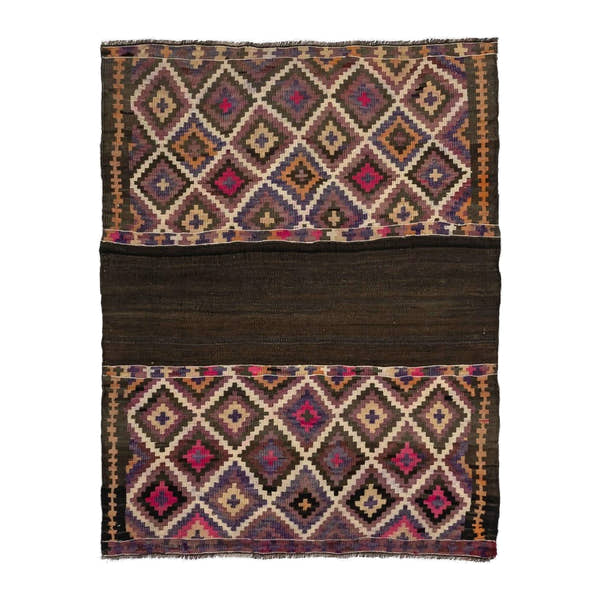
We have a Bayburt runner kilim with two patterned end panels and a long striped middle in chestnut, reddish brown and dark brown.
Where to go next
Our guide to kilim rugs explains the flat weave, and the ultimate guide to Turkish rugs gives the wider picture. For eastern neighbors, read the Kars rugs guide and the Malatya rugs guide. You can browse all Turkish rugs and the kilim collection.
For a larger flat weave from farther west in Anatolia, see this Sivas kilim, with deep red and charcoal bands and a white zigzag lattice across the middle. It is not a Bayburt piece.


Sources
- El Sanatlari (Handicrafts). Governorship of Bayburt.
- El Sanatlari: Kilim Dokumaciligi (Handicrafts: Kilim Weaving). Eastern Black Sea Culture Inventory Project.
- Dogu Karadeniz Bolgesi Dokumalarinda Tespit Edilen Figurlu Motifler (Figured Motifs in Eastern Black Sea Weavings). Keziban Selcuk and Huseyin Yurttas, Ataturk University Journal of Fine Arts, 2020.