Hamedan sits in a high plain under Mount Alvand, and the villages around it have woven rugs for the city’s market for generations. Toyserkan lies to the south of the mountain and Asadabad to the west, and both send small, sturdy village rugs into the trade under their own names.
We carry a handful from each, most of them mats and small rugs. This guide covers the two places, what they share with the wider Hamedan family, how to tell their rugs apart, and how to use and care for a small rug well.

Toyserkan, the saffron valley
Toyserkan’s name joins two old villages. The geographer Guy Le Strange, describing the district halfway between Hamedan and Nahavand, notes that the fourteenth century writer Mustawfi named among its towns Sarkan and Tuvi, both of which still exist.[1] He adds that in his own day Tuvi was the name commonly given to the district.[1] Put Tuvi and Sarkan together and you have Toyserkan.
The district was rich. Medieval writers called it the district of Rudhravar and knew it above all for saffron; Le Strange calls it the rich district so famous for its saffron.[1] Its rugs came later, a village craft that grew with the Hamedan market in the nineteenth and twentieth centuries.
Asadabad, on the road west
Asadabad lies west of Hamedan on the road toward Kermanshah, below the pass over Mount Alvand. The tenth century geographer Ibn Hawkal called it a populous city, Le Strange tells us, and it had a mosque and good markets.[1] Mustawfi counted thirty-five villages as its dependencies.[1]
Cloth came first here too. In R. B. Serjeant’s survey of medieval textile records, Asadabad and Nahavand appear among the towns of the region that produced cotton.[2] Carpet weaving became the village trade later, and today the name turns up mostly on small rugs.
What they share with Hamedan rugs
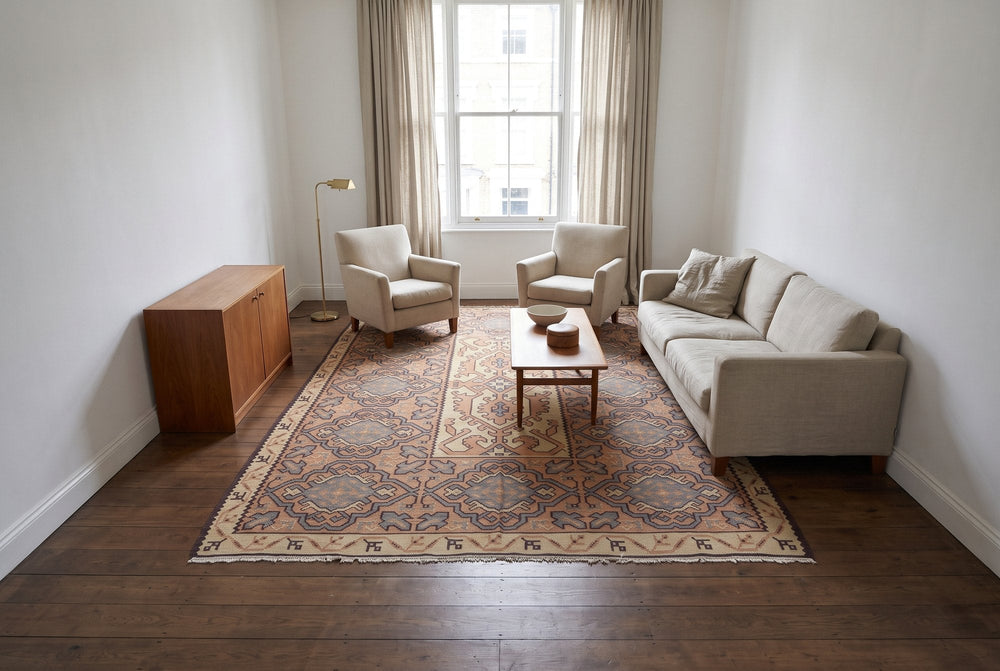
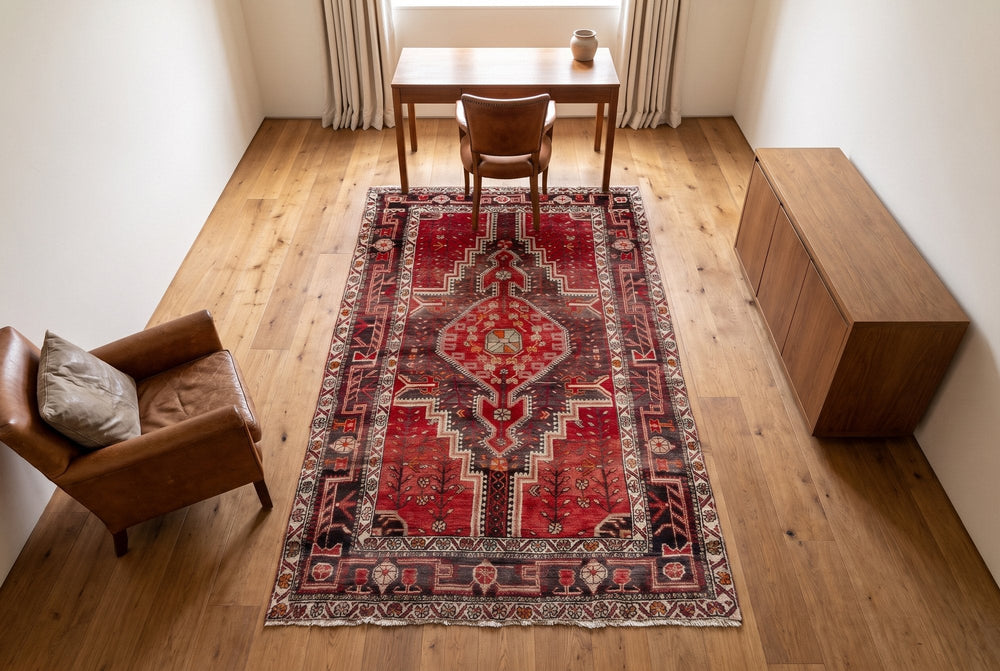
Both belong to the large family the trade calls Hamedan rugs. Walter Hawley, writing in 1913, said that Hamedan rugs come in many sizes and that some are simply mats.[3] The typical pattern of the mats and smaller pieces, he wrote, consists of a central diamond-shaped medallion, surrounded by a field of contrasting color, from which triangular corners are set off.[3]
That is almost exactly what our Toyserkan and Asadabad rugs look like. A red, dark brown or teal diamond, often with stepped pendants, sits at the center, and stepped or serrated corner pieces close the field. Hawley also noted that the medallions and corners are usually defined by serrated lines or fringed with hooks or comb-like teeth, and you can see that on most of these pieces.[3]
One old family trait you will not find here is camel hair. Hawley wrote that moderately old Hamedans contain more camel’s hair than any other class of rugs, often in the pile of the field and in a wide plain outer edging.[3] Our Toyserkan and Asadabad rugs are wool throughout, and their borders are patterned to the edge, a sign of the later village weaving that replaced those older pieces. If you see a wide band of plain tan around an old Hamedan-area rug, that is the camel hair edging he meant.
Telling them apart
The two groups are close, but each has a look. Our Toyserkan rugs lean dark: deep red, near-black or black fields with dark brown medallions, teal leaves and cream borders of small flowers. One has a row of bare trees along the bottom of the field, a small village touch.
The Asadabad pieces are lighter and brighter. Two have pink or dusty rose fields with teal, green and ivory drawing, and the third pairs two stepped diamonds on deep red with olive corners. All three are small enough to hold in your arms.

Sizes and prices
Most of these rugs are mats of about 2 by 2½ feet to about 2½ by 3 feet, priced from about $275 to $300. Toyserkan also gives us two rugs of about 4¼ by 6¾ feet at about $480 and one of about 5¼ by 9¼ feet at $750. All are hand-knotted wool on a cotton foundation and listed at about 50 years old, and each listing gives the exact size in feet and centimeters.
Using a small rug well
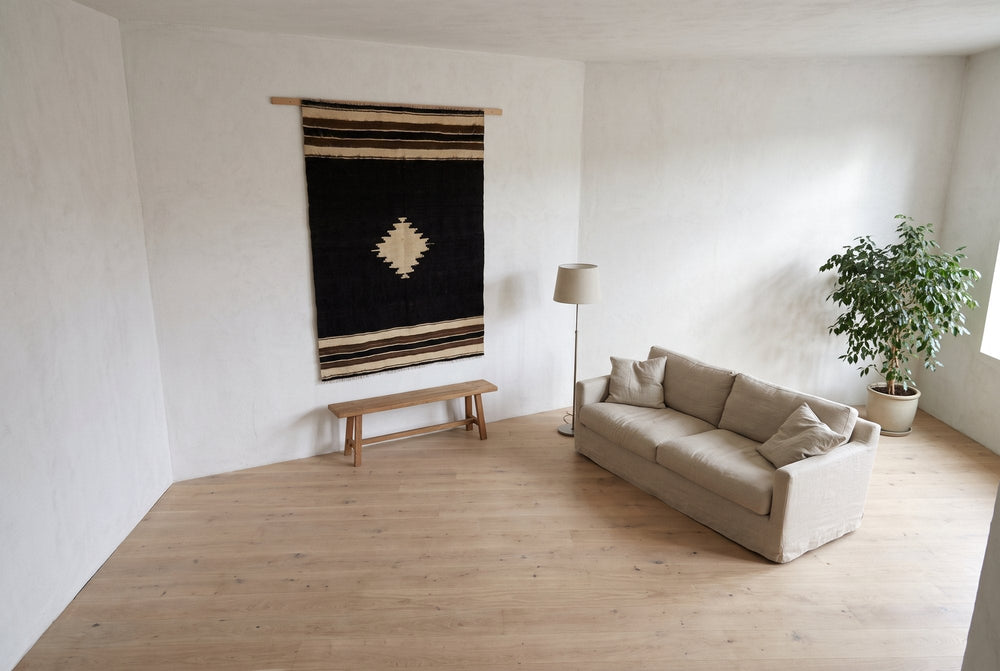
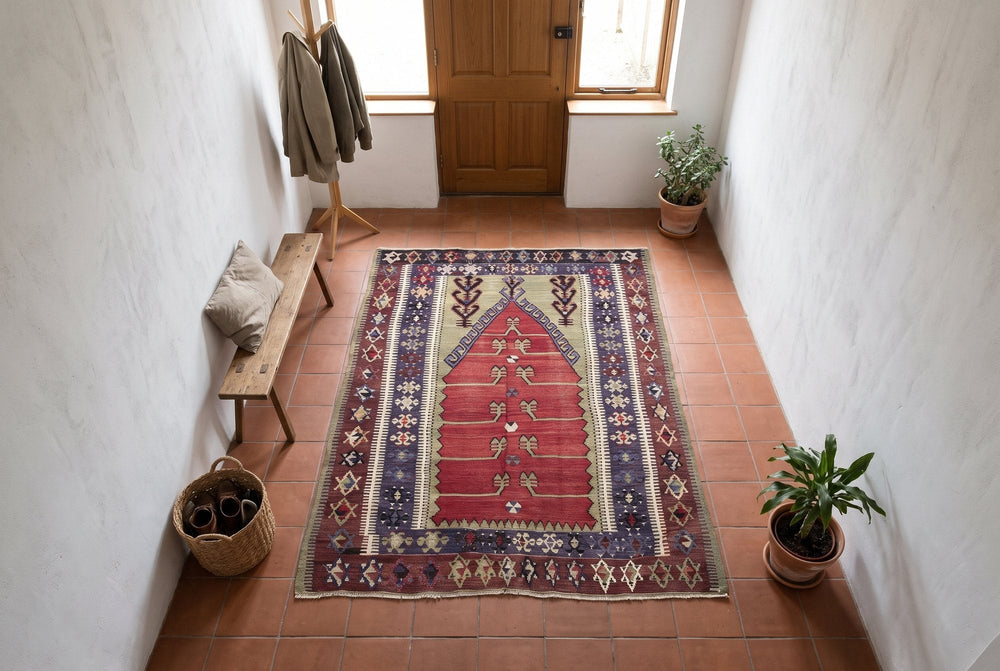
A mat is the easiest way to bring an old rug into a home. Put one inside the front door, in front of a sink, at the foot of a bed or under a small table, or hang it on a wall, where its knots can be seen up close. On a smooth floor, use a thin pad so it does not slide.
The Canadian Conservation Institute advises turning rugs from time to time so they wear evenly.[4] If you hang one, it describes sewing a strip of Velcro to a cotton sleeve and stitching that to the top of the rug, which spreads the weight.[4]
Where to go next
Browse every piece in the Toyserkan collection and the Asadabad collection, or all of our Persian rugs. For the market town itself, read our Hamedan rugs guide, and for its neighbors, the Malayer and Songhor guides.
Sources
- The Lands of the Eastern Caliphate. G. Le Strange, Cambridge University Press, via Internet Archive, 1905.
- Material for a History of Islamic Textiles up to the Mongol Conquest. R. B. Serjeant, Ars Islamica vols. 11-12, via Internet Archive, 1946.
- Oriental Rugs, Antique and Modern. Walter A. Hawley, Project Gutenberg, 1913.
- Basic care: Carpets and rugs. Canadian Conservation Institute.