Rug No. has found its new home.
Every rug we sell is one of a kind, so that piece is gone. Here are others in the same spirit, or tell Rug Finder what you are looking for.
Iraqi Rugs
Iraqi rugs on this page come from the Kurdish mountain country of northern Iraq, among them pieces woven by the Herki. Flat weaves lead the group: thin, light and close to the floor, with motifs such as birds and stepped bands built from straight edges, so they read clearly from across a room. Each piece is one of a kind.
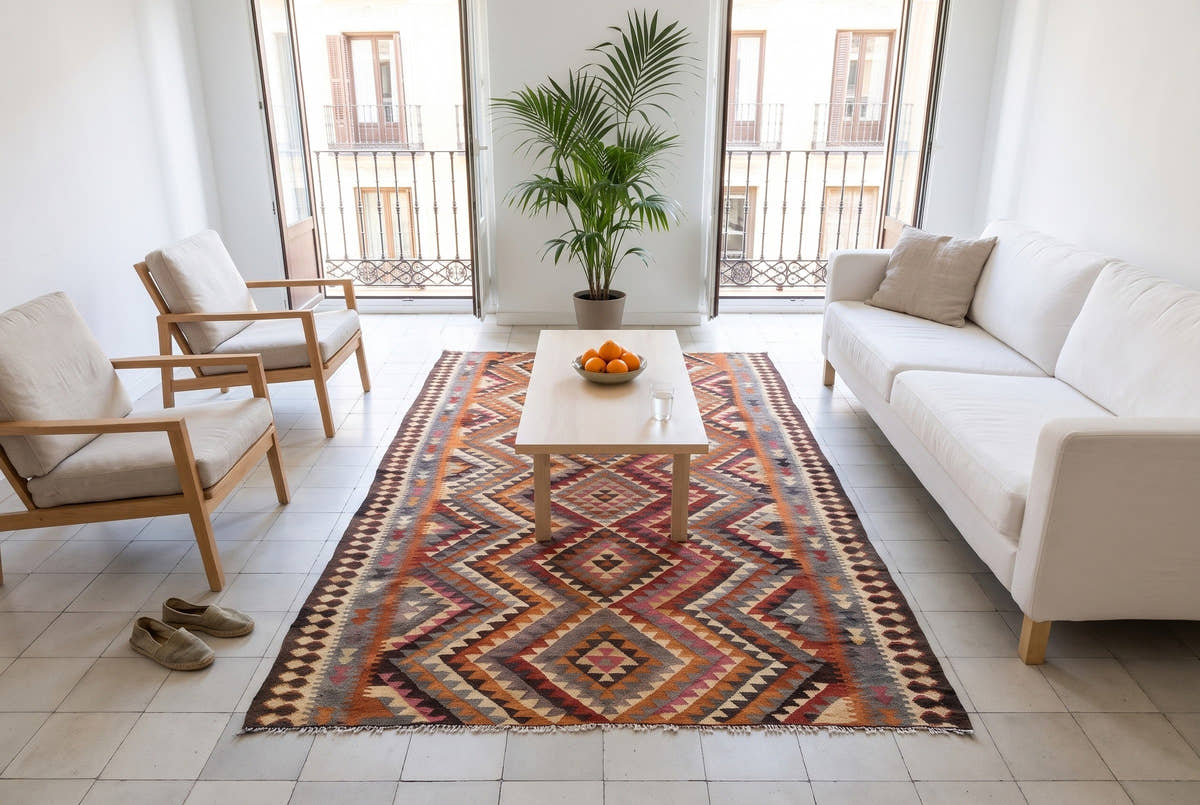


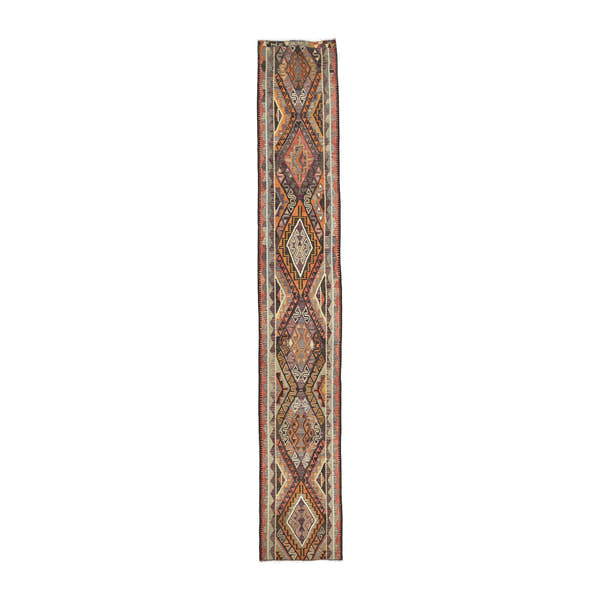
Herki weaving from the Kurdish mountains
The Herki are a Kurdish tribe whose communities live in the Kurdistan Region of Iraq and across the nearby mountain borders, including Hakkari Province in Turkey. Most Herkis traditionally lived as nomads, keeping herds, weaving textiles and carrying goods between countries. The pieces in this collection follow that tribal way of drawing: straight lines and strong outlines that read clearly from across a room.
What to look for in a flat weave
In a flat weave the colored wool runs through the weave itself, so every motif is built from straight edges and small steps. Birds, stars and bands come out blocky and bold, and the back usually shows the same design as the front. There is no pile, so the pattern is part of the structure rather than cut into a surface, and it stays crisp from one end to the other. Shades can shift down the length, which gives each piece a quiet movement of its own.
Why a flat weave suits a hall
A flat-woven runner has no pile, so it lies thin, clears the bottom of a door and stays put on a thin pad. It is easy to lift and shake out, and it can be turned end to end now and then so both ends get the same wear. Our guide to choosing a runner length shows how much floor to leave at each end, and the guide to kilim rugs explains how a flat weave is made.
Placing a flat-woven runner
A runner with a strong column of motifs reads clearly from the end of a hall, so it works well where the eye runs the length of the floor: an entry passage, a corridor between bedrooms, or the side of a long kitchen island. A pale ground keeps a narrow space light, and darker motifs give it some weight. A shorter flat weave also works at a back door or beside a bed, where a thin rug lies flat underfoot. See hallway and entry rugs for more pieces at this scale.
Caring for it
Vacuum a flat weave gently without a beater bar, blot spills rather than rubbing, and use a thin rug pad on hard floors. For more, see how to clean a wool rug at home.
Related collections
For other Kurdish weaving, read about Songhor rugs and Bijar rugs. For flat weaves from the Balkans, see Balkan kilims, and for long, narrow pieces of every kind, all runners.