In 1979 the photographer Josephine Powell stood in the village of Mustafabeyli in Adana province and photographed a Yoruk woman picking up lambs.[1] The picture now sits in a museum catalog about kilims, and that is no accident. In the hills above the Adana plain, sheep, wool and kilims have long belonged to the same life.
Adana is a city and province on the Cukurova plain of southern Turkey, with the Taurus Mountains rising to the north. This guide covers the Yoruk weavers of the area, how their kilims are made and dyed, the motifs to look for, and how to use one at home.

Herders of the Taurus
For centuries the herders of this region moved with their flocks. In the Taurus Mountains the usual pattern was vertical: families took their animals higher as each slope came into spring and returned to the lowlands when the cold set in.[1] The anthropologist Ulla Johansen, who worked among Yoruks in the Antitaurus north of Adana in the late 1950s, recorded how loose those lines were.[1] Some families lived in a black tent all year, and others kept a house in the lowlands or the mountains and lived in it for three or four months.[1]
Kilims were part of that tent life. Powell also photographed a tent interior in Adana for the same body of work.[1] The anthropologist Kimberly Hart, writing in the catalog, describes the textiles of herders as portable, beautiful and useful at once.[1] She also argues that their patterns belonged to groups rather than to single weavers, and worked as a kind of signage for who a migrating group was.[1]
Koc University’s archive of Powell’s work includes a kilim from 1981 in the tent of a family camped for a while on the road to Saimbeyli, in the Adana uplands.[2] It carries the ram’s horn motif, worked in the cicim technique. The archive describes the ram’s horn as a sign of heroism, strength and plenty.[2]

Kilims, sacks and bags
Weaving was once widespread around Adana. The provincial culture office notes that the region’s crafts began to lose their old importance in the twentieth century as technology changed daily life.[3] It lists what villagers still weave: carpets, kilims, sacks, saddlebags and bags.[3]
When the Ministry of Culture tells travelers what to bring home from Adana, its answer is a kilim from Karatepe.[4] It describes them as made entirely from natural wool and root dyes, still shaped by women’s hands in the old way.[4]
The Karatepe kilim
Karatepe lies just east of Adana, in Kadirli district of neighboring Osmaniye province. Its kilim was registered as a geographical indication in 2021, and the registration describes it in detail.[5] It is woven entirely of wool.[5] The registration traces the history of the kilim in Karatepe village back to the eighth century BC, the age of the ancient site there.[5]
Dyeing starts with plants. Pomegranate rind, onion skin, walnut leaves, pine bark, oak and oleander are among those boiled in water for a long time before the plants are lifted out.[5] The wool goes into the colored water, simmers over a low fire, then is rinsed well in clean water and hung to dry.[5]
Every color has a source. White, black and gray come straight from the sheep, with no dye at all.[5] Blue is indigo, and red comes from pine bark and madder.[5] Yellow comes from chamomile and spurge, among other plants.[5] The registration gives each color a meaning: red for wealth and joy, green for faith, blue for nobility, yellow for protection from evil, and black for release from worldly trouble.[5]
The kilims are slit-woven, with 33 to 40 warp threads in every 10 centimeters.[5] Because the warp is stretched tight and the weft beaten down hard, the registration says, they shed dirt and dust, and they can be used on both sides.[5] They were once woven on wooden upright looms called istar, fixed to the floor.[5]
Motifs to look for

A Karatepe kilim has a framed border with small motifs and large motifs in the field, most of them geometric.[5] The list of motif names reads like a short poem: diamond, star, ladder, ram’s horn, hand on hip, hair tie, wolf’s track, wolf’s mouth, and two that mean the lover sulked and the lover looked.[5] One star-like motif with an open hexagon at its center is called akil tasi, the stone of wisdom.[5] Pine trees, roses, tulips and burrs appear among the plant motifs.[5]
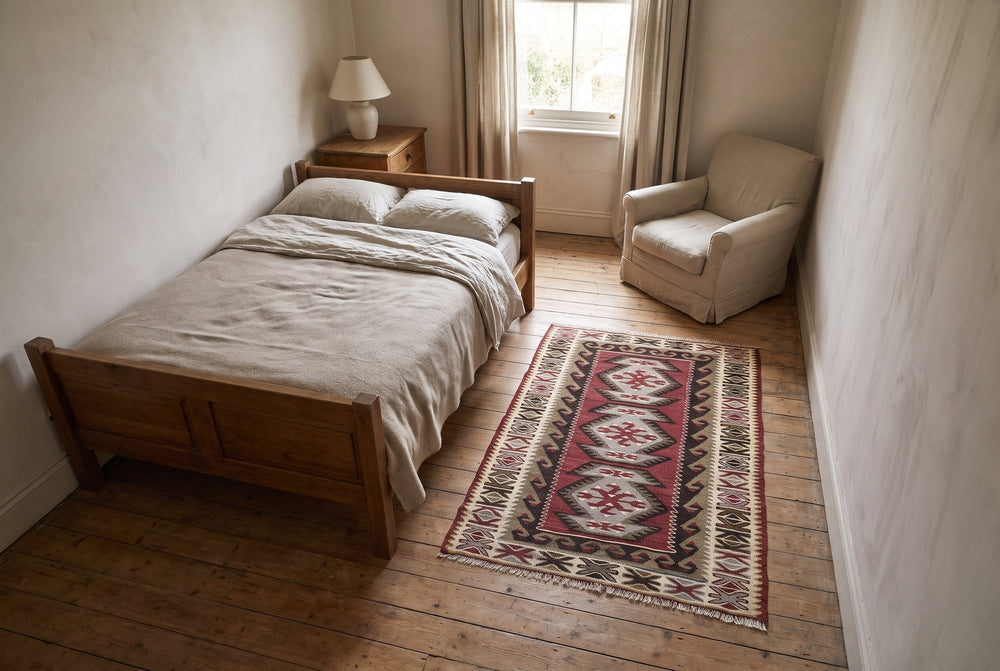
The kilim in the pictures here keeps to the same habits on a small scale. Three gray hexagonal medallions are linked end to end down a mahogany field, each holding a red branching figure, with a band of small hooks around them and a cream border of tiny stars and arrows.
How to recognize an Adana kilim

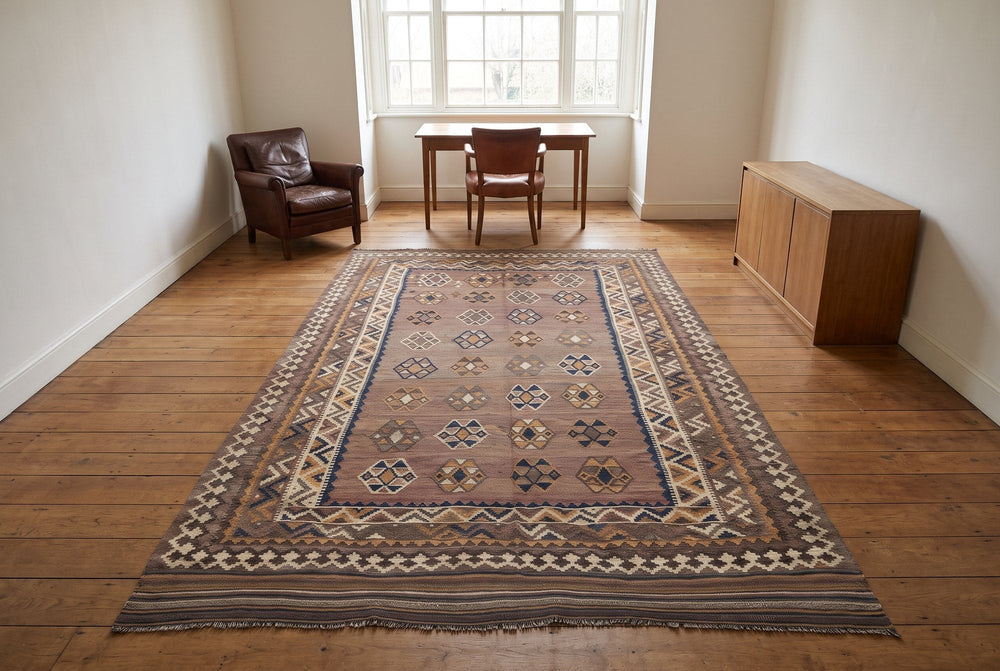
Look for a flat weave with small slits where colors meet, a strong red or brown field, and large geometric medallions or diamonds, often in a row. Natural sheep’s wool colors, white, black, gray and brown, are often left undyed. Borders are framed and busy, the field bolder and more open. Sizes run from small mats like the one here to room-sized pieces.
Living with an Adana kilim
A small kilim is ideal by a front door, beside a bed, or as a layer on a larger rug. Use a thin non-slip pad, shake it out or vacuum it gently, and turn it from time to time. Our guide to kilim rugs explains the flat weave in more detail, and the Dosemealti guide covers Yoruk weaving farther west along the Taurus.
You can see the kilim from this guide on its product page, and more in the Adana collection and the kilim collection. For the wider picture, read our ultimate guide to Turkish rugs and browse the Turkish rugs collection.


Sources
- A Nomad’s Art: Kilims of Anatolia. The George Washington University Museum and The Textile Museum, 2018.
- Nomads of Anatolia: Yoruks, digital exhibitions. Suna Kirac Library, Koc University.
- Dress and traditional arts. Adana Provincial Directorate of Culture and Tourism.
- Kilim, Adana. Kultur Portali, Ministry of Culture and Tourism of Turkey.
- Karatepe kilim, geographical indication no. 785. Turkish Patent and Trademark Office, 2021.