Dosemealti Rugs: Teke Yoruk Weaving from Antalya
Every summer, weavers in Dosemealti, north of Antalya, spread their new carpets over fields and empty land in villages across the district, and the whole area fills with them through the summer.[1] The sun and the damp soften the colors into the pastel shades buyers ask for.[1] The custom says a lot about these rugs. They are made to be lived with, on the floor, in the open, and they are expected to change.
This guide covers where Dosemealti rugs come from, who weaves them, the named designs, and how to tell one from other small Turkish rugs.

Where Dosemealti is
Dosemealti lies about 20 kilometers north of the city of Antalya, a wide area of villages that is now a district of Antalya province.[2] A study from Akdeniz University places its 23 villages on the skirts of the Taurus Mountains.[3] That geography matters. The Taurus range behind the coast was a route for herders who moved their flocks to higher pasture as each slope came into spring and came back down when the cold arrived.[4]
The rugs are named for the place, and the place gives them their name in the literature: rugs woven on the upright looms of Dosemealti are called Dosemealti rugs.[5]
Who weaves them
The weavers are Teke Yoruks, a nomadic group that came into Anatolia after the twelfth century and settled in what is now the district.[1] Their rugs carry the habits of tent weaving. The Antalya Museum describes the oldest Dosemealti carpets as nomadic in character and small in size.[6]
The Ministry of Culture sums up the look in a few words: dark colors, motifs drawn like kilim patterns, short pile, and sizes easy to carry.[5] If you know Turkish village rugs, that list is a good first test.
The oldest examples and the museum
The earliest known Dosemealti rug is a type called Halelli, and it is on display in the Antalya Museum.[1] The museum itself calls Halelli the oldest and most traditional of the Dosemealti carpets.[6] It shows them in the same hall as carpets from Usak, Ladik, Bergama and Kula, among others.[6]
The Akdeniz University study names the villages that made the best of the rugs that survive: Kovanlik, Asagioba, Killik, Eksili, Karatas and Karaveliler.[3] The same study notes that those villages had stopped making carpets some thirty years before it was written.[3]

How a Dosemealti rug is made
Both the warp and the weft are sheep’s wool.[1] The pile is tied with the Turkish knot, also called the Gordes knot, which wraps around two neighboring warps.[1] The registration notes that this knot gives cleaner shapes when the drawing is geometric and stylized, which is exactly the kind of drawing these rugs use.[1]
The local loom is called an istar, and it leans against the wall at an angle.[1] The finished part is rolled from back to front, because the weavers do not work from a paper pattern.[1] They look at the back of what they have already woven to repeat the design, and they know the old patterns by heart.[1]
The sides are finished like a kilim, in wool the color of the field.[1] Knot counts have dropped over time: older rugs reached 3 by 4 or even 4 by 4 knots per square centimeter, and newer ones can be as coarse as 2 by 2.[1] Look at the back of a vintage piece and you can often judge which end of that range it sits in.

Natural dyes
Before dyeing, the yarn is boiled with leaves of plants such as chaste tree or grapevine, or with walnut husk, until it turns yellow.[1] Blue comes from indigo and green from indigo dyed over yellow.[1] Walnut husk and acorn cups give brown.[1] Brown yarn dyed again with salt and iron oxide turns black.[1]
Older rugs used red, blue, navy, green and white, while red, burgundy, green, black, dark and light blue and natural yellow lead in more recent ones.[1] The field is usually red, blue, burgundy or navy.[2]
The named designs
Weavers name a Dosemealti rug by the layout of its field. The Ministry of Culture lists more than a dozen types, among them Halelli, Toplu, Kocasulu, Dalli, Akrepli and the mosque design called Camili.[2]
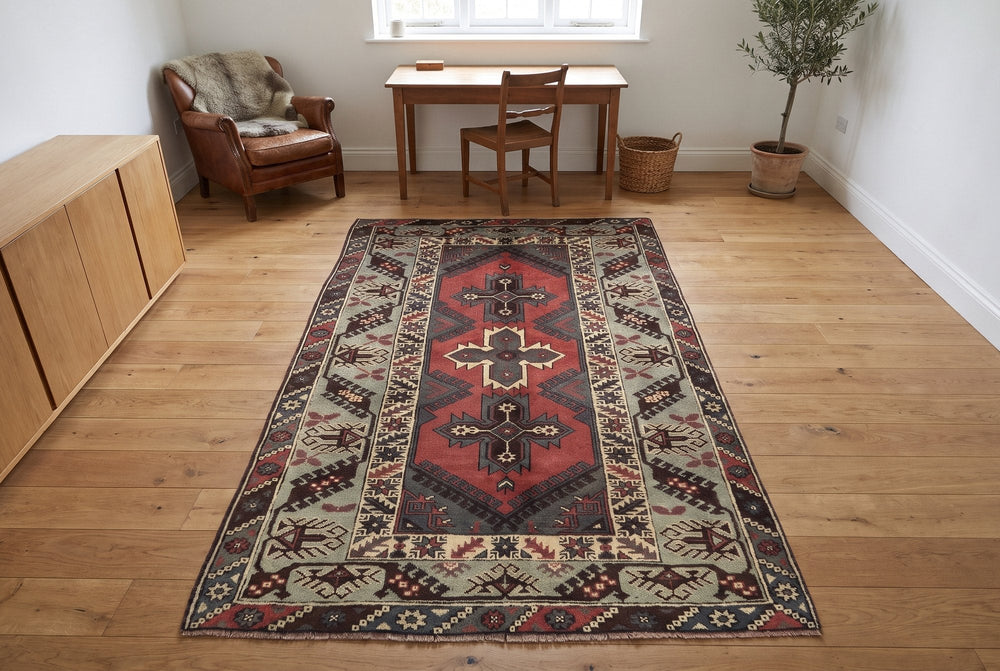
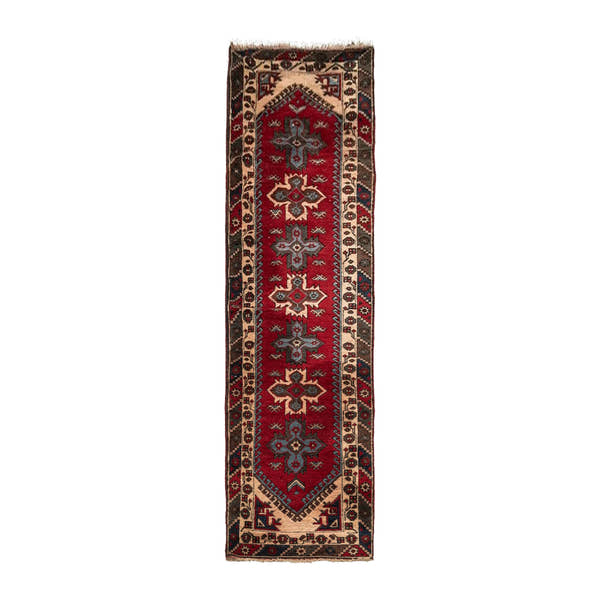
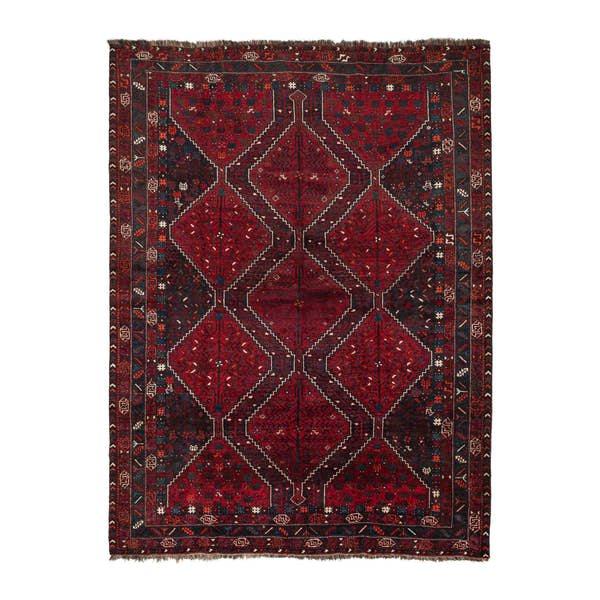
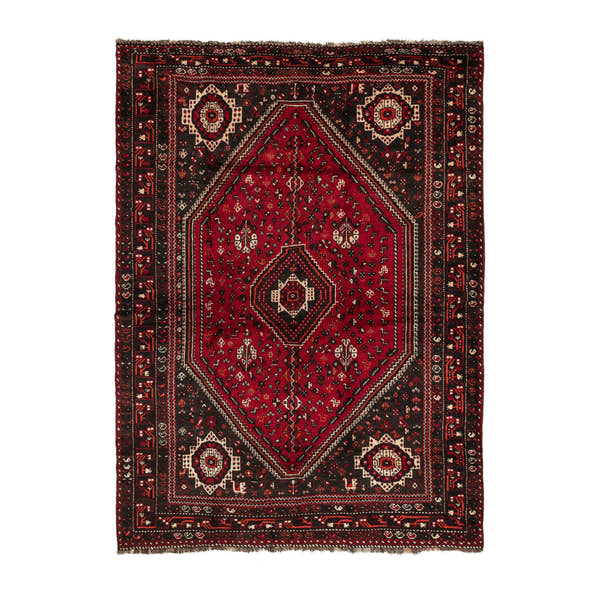
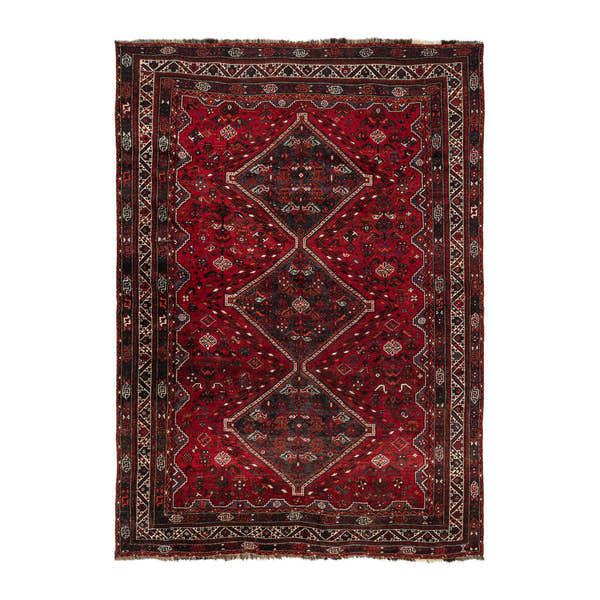
In a Toplu rug, two or three large cross-like motifs run in a line down the field.[1] The rug in the pictures here follows that plan, with three crosses stacked down a brick red panel. An Akrepli rug is woven for a bride’s dowry.[1] Its hooked diamond medallion is filled with a scorpion motif.[1] A Halelli fills the field with small local geometric and symbolic motifs set out in a symmetric plan.[1]
The registration adds that every design and every color carries its own meaning, built up over centuries.[1] Kilims, bags and wall rugs are woven in the area too.[1]

Sizes
Most Dosemealti rugs are close to prayer rug size, and the registration gives a range from 71 by 120 centimeters up to 143 by 196 centimeters.[1] Locally they are named by size as prayer rugs, runners or quarter rugs.[2] So a Dosemealti is a rug for a bedside, a study, an entry or a small sitting area, not for under a large dining table.
How to recognize a Dosemealti rug
Start with the size and the pile. A Dosemealti is small and the pile is short, so it lies close to the floor. Then look at the drawing. The motifs are built from straight lines, steps and hooks, the way a kilim pattern is built, and the medallions often stand in a column down a long panel. Last, look at the color. A deep red or navy field with sage, cream and dark brown around it is typical, and sun-softened tones are part of the local tradition rather than a flaw.
Rugs from Milas and other western Turkish towns can share the small size and the prayer rug format. Our Milas guide shows how those differ, and the Anatolian rugs guide covers village weaving across the country.
Caring for a Dosemealti rug
Wool pile this short does not hide grit, so vacuum it often without the beater bar and turn it now and then so the light falls evenly. Use a thin non-slip pad, since a small rug moves easily. For washing, how to clean a wool rug at home covers the basics.
You can see the rug from this guide on its product page, and more in the Turkish rugs collection. For the wider picture, read our ultimate guide to Turkish rugs and the Konya rugs guide on the other side of the Taurus.
Sources
- Dosemealti hand-woven carpet, geographical indication no. 796. Turkish Patent and Trademark Office, 2021.
- Dosemealti carpet. Kultur Portali, Ministry of Culture and Tourism of Turkey.
- Dosemealti carpets. Akdeniz University.
- A Nomad’s Art: Kilims of Anatolia. The George Washington University Museum and The Textile Museum, 2018.
- Dosemealti carpet weaving. Antalya Provincial Directorate of Culture and Tourism.
- Antalya Museum. Ministry of Culture and Tourism of Turkey.