Some of the best-known Turkish carpets in the world go by the names of European painters. European painters put rugs from the Bergama region into their pictures, and some of those designs came to be called after the painters.[1] The town that wove them, in the hills inland from the Aegean, still weaves rugs today, smaller and simpler, in a handful of villages.
This guide covers where Bergama rugs come from, the old groups collectors talk about, the village areas of Kozak and Yuntdag, and how to recognize a Bergama rug.

A town that wove for Europe

Bergama is a district of Izmir province on the Aegean side of Turkey. Its municipality dates the start of Bergama rug weaving to the fourteenth century, when nomadic tribes first settled in and around the town.[2] Bergama rugs were in great demand from the sixteenth to the nineteenth century.[1] Noble families, collectors and even churches in Europe owned them.[1]
The Metropolitan Museum of Art tells part of that story through a group it calls Transylvanian carpets. Large numbers of western Anatolian carpets reached Europe in the seventeenth and eighteenth centuries.[3] So many were given to churches in Romania and Hungary that the name Transylvanian stuck to them.[3]

Early and late Bergama
Scholars and collectors sort Bergama rugs into two main periods and eighteen groups.[2] The early groups carry the painters’ names, among them Holbein, Lotto, Bellini and Memling, along with the Transylvanian group.[2] The late groups carry the names of the people and places that wove them, such as the Kazdag mountain groups near Canakkale, Yuntdag, Yagcibedir, Kozak and Karadag.[2]
The Met’s own collection includes a nineteenth-century carpet cataloged as from western Anatolia, Bergama region.[4] That is the period most vintage Bergama rugs on the market belong to: village rugs of the late groups, not the court-era carpets in the paintings. Museums in Turkey keep both. The Antalya Museum, for one, shows Bergama carpets in its carpet hall beside those of Usak, Ladik and Kula.[5]
The four village areas
By place, Bergama weaving falls into four areas: Yagcibedir, Karadag, Kozak and Yuntdag.[1] The municipality lists the villages of each. Kozak takes in Gubas, Kilaz, Karaceli and Tahtacilar, among others.[2] Yuntdag takes in Derici, Yuncu, Sarikecili, Maldan and Gaylan.[2]
In the nineteenth century almost every house in Bergama had a loom.[2] The municipality puts exports in those years at an average of 19 kilometers of carpet a year.[2] A study published in 1957, cited by the municipality, records that weaving later shrank until it survived only in the villages of Kozak, Yuntdag and Yagcibedir.[2]
Yuntdag: kilims, sacks and dowry bags
Yuntdag is the hill country north of Manisa, on the southern side of the Bergama region.[6] In the village homes studied there for the Textile Museum’s kilim catalog, older women still kept bags, sacks and kilims from their dowries.[6] Those houses had little standing furniture and were furnished with textiles instead.[6]
Yuntdag weavers also use extra-weft patterning, the technique called zili in much of western Turkey. In the Manisa and Yuntdag areas those pieces are simply called kilim, with names such as cingilli kilim depending on the design.[6] If you find a vintage flat-weave sold as Yuntdag, that is the tradition it comes from. Our guide to kilim rugs explains the weaves.

How a Bergama rug is made
Bergama rugs, kilims, sacks, saddlebags and prayer rugs are woven on hand looms that local people call istar.[1] Wool from local sheep is spun and plied by hand.[1] It is colored with dyes from plants, which is why Bergama rugs keep their bright color for a very long time.[1]
The pile is tied with the Gordes, or Turkish, knot, which the Ministry of Culture credits for the rugs’ strength.[1] The registered standard for a Bergama hand-woven carpet sets the pile at 7 to 10 millimeters, deeper than many western Turkish village rugs.[7] Warp, weft and pile are all wool.[7]
The story of the Kiz Bergama
Bergama rugs come with stories, and the best known belongs to a type called Kiz Bergama, the girl’s Bergama.[1] In the legend, the son of a tribal chief between Bergama and Dikili sees a girl at a spring and falls for her.[1] The match ends in a feud between the two families.[1] Parted from him for good, the girl weaves her grief into her rug.[1]
How to recognize a Bergama rug
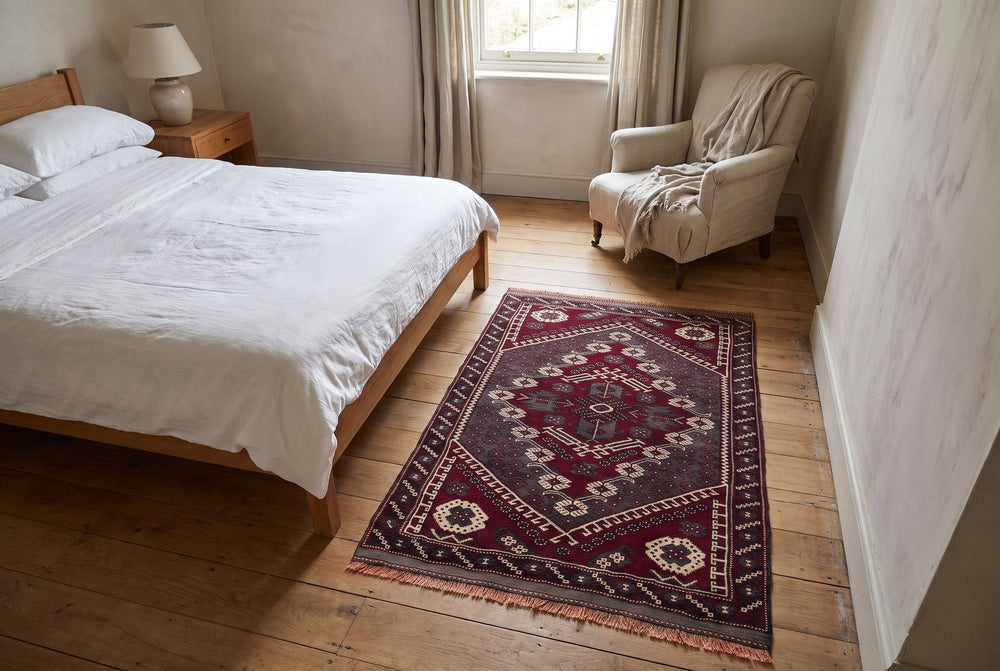
Most vintage Bergama rugs are small and close to square, sized for a prayer rug or a spot by the door. Look for a big geometric medallion, often stepped or hooked, with smaller star or rosette shapes in the corners. Red is the usual field color, set against dark blue or brown and crisp cream. The pile is fuller than on many western Turkish rugs, so the rug feels thick in the hand.
The rug in the pictures here shows the type well: a burgundy field, one large dark medallion, cream rosettes in the corners and a hooked border. Rugs from Milas farther south tend toward softer colors and prayer layouts, and our Manisa guide covers the province next door.
Living with a Bergama rug
A small, thick Bergama works best where it can lie flat and be seen: at a front door, beside a bed, or under a reading chair. Put a thin non-slip pad under it, vacuum without the beater bar, and turn it once or twice a year so it wears evenly. How to clean a wool rug at home covers spills and washing.
You can see the rug from this guide on its product page, and more in the Turkish rugs collection. For the wider picture, read our ultimate guide to Turkish rugs and the Anatolian rugs guide.
Sources
- Bergama hand-woven carpet. Kultur Portali, Ministry of Culture and Tourism of Turkey.
- Carpet and weaving. Bergama Site Management, Bergama Municipality.
- ‘Transylvanian’ Carpet. The Metropolitan Museum of Art.
- Islamic Carpets: The Joseph V. McMullan Collection. The Metropolitan Museum of Art Bulletin, 1970.
- Antalya Museum. Ministry of Culture and Tourism of Turkey.
- A Nomad’s Art: Kilims of Anatolia. The George Washington University Museum and The Textile Museum, 2018.
- Bergama hand-woven carpet, geographical indication no. 14. Turkish Patent and Trademark Office, 1997.


