Kayseri sits at the foot of Mount Erciyes, on the old trade roads of central Turkey, and it has been a carpet town for a very long time. Marco Polo, describing the Seljuk lands of Anatolia, named Casaria among their chief cities.[1] His editor identified Casaria as the ancient Caesarea of Cappadocia, the city we now call Kayseri.[1] In the same passage he wrote that the people there wove the finest and handsomest carpets in the world.[1]
A Kayseri rug comes from the city and the province around it. Most are knotted pile rugs with fine, flowing designs, and the region weaves flat kilims too. This guide covers where the tradition comes from, the two weaving districts people name first, and how to read the rugs we carry.

A Seljuk city on the trade roads
In the thirteenth century Kayseri was one of the cities where the Seljuk sultans of Anatolia built on a grand scale. The Khuand Khatun complex in Kayseri, built in 1237 and 1238, is among the important surviving monuments of that period.[2] Turkish cultural sources date the region’s carpet weaving to the same era and say it arrived from the east with the Seljuks, then grew into a style of its own in Kayseri.[3]

Bunyan and Yahyali: the two names to know
Ask about Kayseri carpets in Turkey and you will hear two district names, Bunyan and Yahyali.[4] Bunyan lies northeast of the city. Its rugs are woven on a cotton warp, with a pile of wool and floss.[4] Their grounds are usually red, blue or navy.[4] Turkey’s tourism office adds that cotton yarn and synthetic dyes came into use in Bunyan carpets from 1907.[5]
Yahyali, to the south in the Taurus foothills, kept to wool. The main difference from Bunyan is that a Yahyali rug uses wool for both the warp and the knotted yarn.[4] Its main colors are red, navy, brown, yellow and gray.[6] Stylized plant and geometric motifs are spread over the field to make a center and corners.[6] The registered description of the Yahyali carpet gives it a history of about 250 years.[6]

Fine rugs and prayer rugs
Kayseri weavers made rugs for the floor, for seating and for prayer. The Bunyan rugs were sorted by size into cushion, pillow, floor and divan pieces.[4] Kayseri also stands in the great Istanbul collection of prayer rugs: a colloquium at The Textile Museum introduced prayer carpets from the Vakiflar collection woven in Milas, Gordes, Kula, Ladik, Usak and Kayseri, among other towns.[7]
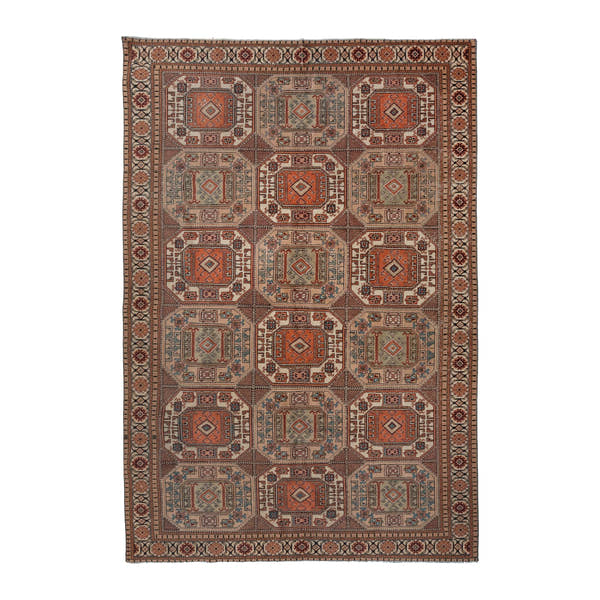
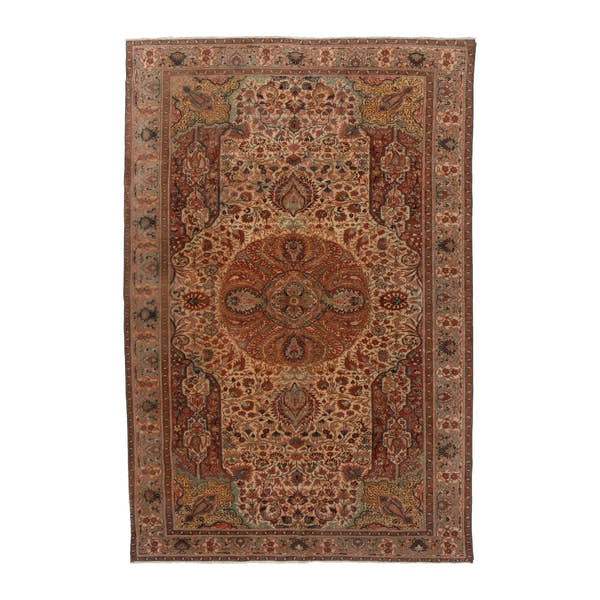
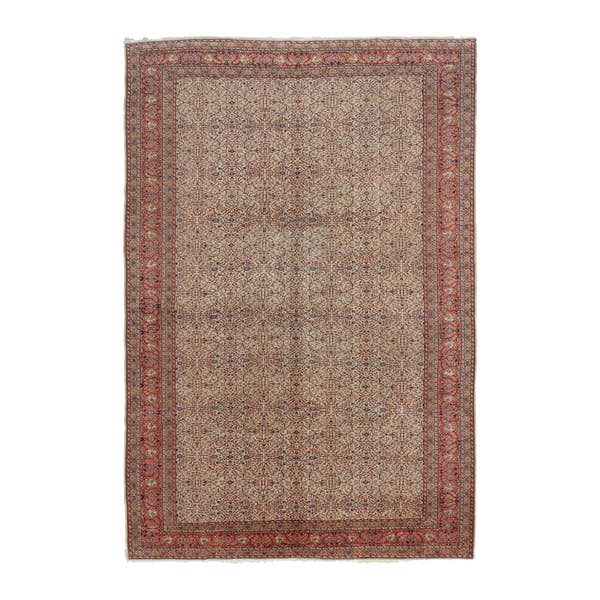
The Kayseri rugs we carry lean toward that refined side. Most are all-over designs with no medallion: rows of paisley boteh, small rosettes on curling vines, or a close lattice of tiny flowers on a beige or cream field. A few have a central medallion with pendants, in navy, walnut or steel blue. Each is hand-knotted in wool on a cotton foundation and is about fifty years old.

Kayseri kilims
Kayseri is a kilim name as well. Collectors group Anatolian kilims by market towns, tribes and broad regional names such as Konya, Karaman and Kayseri.[8] The provincial culture office notes that the weaving itself turns motifs into angular, geometric shapes.[4] It names the Sariz and Yahyali kilims of the province, with local types such as Cubuklu, Ibikli, Papatyali and Kirkbudak, as well as Yoruk and Avsar kilims.[4] Nomadic life lasted a long time here: The Textile Museum’s kilim catalog shows a row of felt-roofed nomad tents at a summer camp in Akkisla, Kayseri, photographed in 1985.[8]


How to recognize a Kayseri rug
Turn the rug over first. On a pile rug, a cotton foundation shows as pale, even warp threads at the fringe, and the knots on the back are small and regular. Look at the drawing next. Many Kayseri pile rugs, ours included, use curving floral designs, palmettes and paisley, so they can look closer to a Persian rug than to the bold geometry of a Konya or Sivas village rug. Our guide to telling Persian and Turkish rugs apart explains the knot that settles the question.
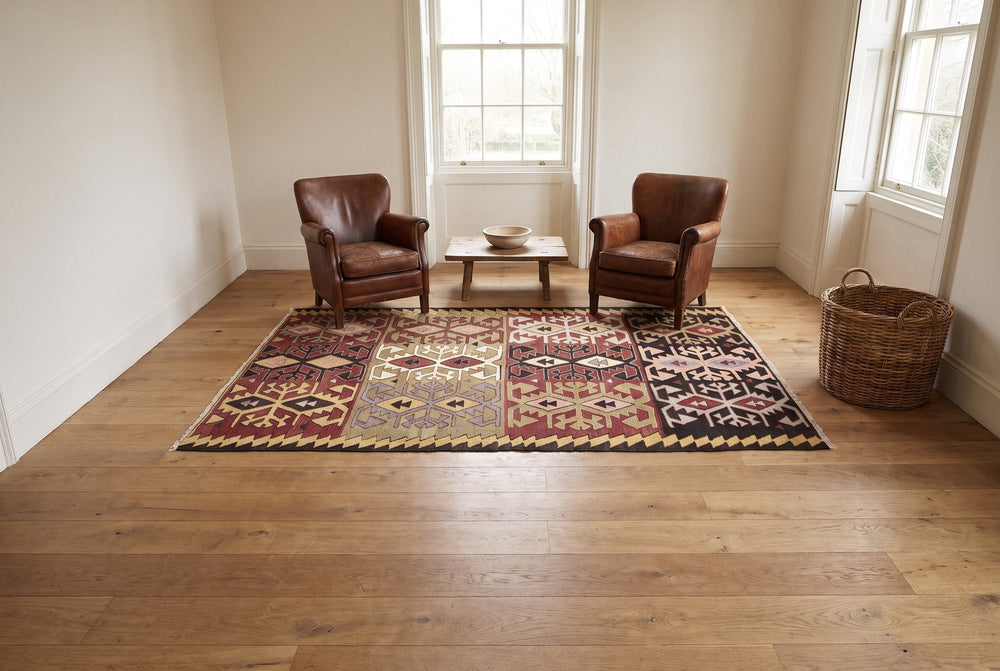
A Kayseri kilim is a different object. It has no pile, the pattern is made of stepped diamonds and hooks, and it lies thin on the floor.
Sizes, colors and price
Many of the Kayseri pile rugs we list now are close to 7 by 9 feet, a good size for a living room or under a queen bed. A few are room sizes of about 10 by 13 feet, and the kilims are small, about 3 by 5 feet. Beige and cream fields are the most common, with rust, sage, plum, navy and dusty rose in the pattern. Prices run from about $750 to $3,800, and every rug page gives the exact size in feet and centimeters.
Caring for a Kayseri rug
A fine Kayseri pile is short, so vacuum it with the beater bar off and turn the rug every few months so sun and footsteps wear it evenly. Blot spills with a clean white cloth and never rub. How to clean a wool rug at home covers the rest.
Where to go next
The rugs themselves are in the Kayseri collection, and the wider picture is in the ultimate guide to Turkish rugs and the Turkish rug collection. Two Seljuk neighbors have guides of their own: Konya, the old capital, and Sivas, farther east on the same roads. For the flat weave, read our guide to kilim rugs or browse the kilim collection.

Sources
- The Travels of Marco Polo, Volume 1 (Yule-Cordier edition). Project Gutenberg, 1903.
- The Art of the Seljuq Period in Anatolia (1081-1307). The Metropolitan Museum of Art, 2001.
- Halicilik ve Kilim: Kayseri (Carpets and Kilims). Kultur Portali, Republic of Turkiye Ministry of Culture and Tourism.
- Geleneksel El Sanatlari (Traditional Handicrafts). Kayseri Provincial Directorate of Culture and Tourism.
- Feel the Culture and Touch of Kayseri. Go Turkiye, Turkish Culture and Tourism Office.
- Yahyali El Halisi (Yahyali Handmade Carpet, geographical indication). Kultur Portali, Republic of Turkiye Ministry of Culture and Tourism.
- Prayer Carpets Colloquium. The George Washington University Museum and The Textile Museum.
- A Nomad’s Art: Kilims of Anatolia. The George Washington University Museum and The Textile Museum, 2018.