Yagcibedir Rugs: Navy, Red and the Stepped Niche
Ask a weaver in the hills of Sindirgi when her family started making these rugs and she will tell you she does not know. Weavers there say they learned the craft from their ancestors and cannot say when or how it began.[1] What they can tell you is what every motif means, because the rugs are woven from memory, the same way their mothers wove them.
Yagcibedir rugs come from the Yoruk villages of Balikesir province in western Turkey. This guide covers who weaves them, the dark blue and red palette, the stepped niche at the center, and how to recognize one.

Where the name comes from
The rug takes its name from the Yagcibedir Yoruks, a group living in the Sindirgi district of Balikesir province.[2] The provincial culture atlas dates their presence around Balikesir to the seventeenth century.[3] Their villages include Karakaya, Egridere, Alakir, Cakilli, Esmedere and Golcuk in Sindirgi, Kayalidere in Bigadic and Ahmetolen in Kepsut.[3]
Bekir Deniz of Ege University, writing on the Sindirgi rugs, records that the group is said to have been settled in the area in the years around 1864.[1] He also notes that the name covers rugs woven across Balikesir and its districts and around Bergama, wherever they share the same character.[1] The oldest rugs that have come down to us are about 100 to 150 years old.[1]
For most of that time the rugs were not made to sell. They were woven for a girl’s dowry, which in Sindirgi is called sepi.[1] Deniz found that a young woman still received at least ten rugs when her dowry was prepared, and fifteen or twenty in a family that could afford it.[1] Many families still keep their old rugs at home.[1]

How a Yagcibedir rug is made
Both warp and weft are wool, and the yarn is very fine.[2] The pile is tied with the Turkish, or Gordes, knot, which the district office says is tied so firmly that the rugs last a very long time.[2] The registered standard sets the pile at 5 to 7 millimeters, a short, dense pile.[4]

Weavers work on upright looms, and the knot is called the Yoruk knot as well as the Turkish knot.[3] Weavers count the work in rows of knots, which they call siyirdim.[1] Two weavers working together finish 50 to 60 rows a day.[1] A prayer rug of 120 by 200 centimeters holds about 1,000 to 1,050 rows, so it takes a pair of weavers several weeks.[1] No paper pattern is used.[1] The design is woven from memory, and its parts are placed a little differently on each rug.[1]
Navy, red and a little white
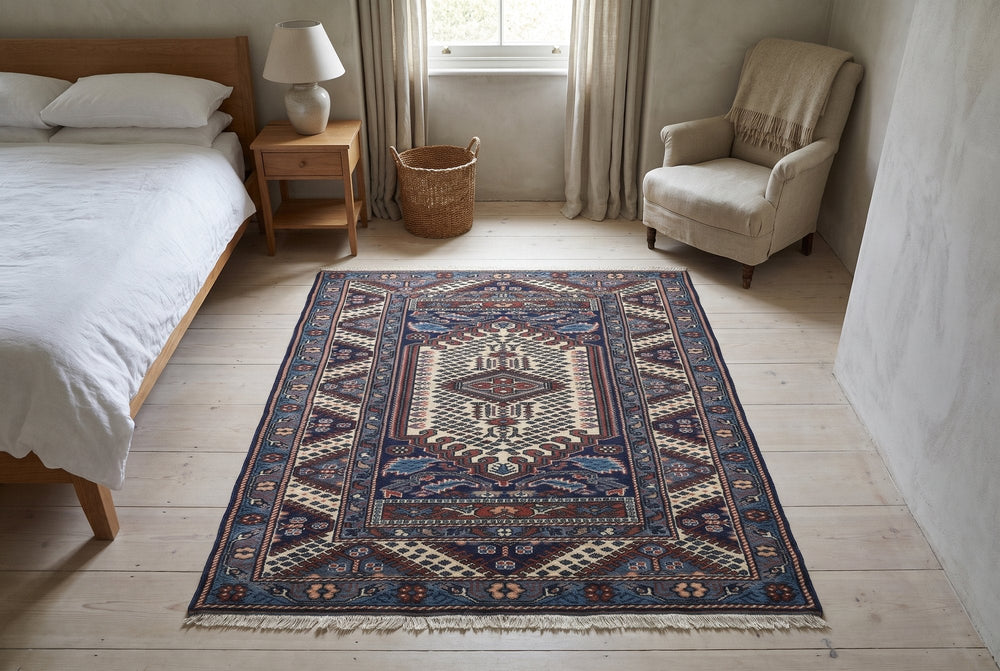
The palette is small. The district office names four main colors: navy, which weavers call gok, or sky, a bright red, a dark red and white.[2] Navy is the most used, and it comes from the root of a local plant.[2] The old blue was slow work. Dyers soaked a sour, unsalted dough in hot water for fifteen days, boiled the crushed root in a second pot, then combined the two and added a little indigo before the yarn went in.[1]
Each color has its place. Navy fills the field and the borders, red goes to the borders, corners and central motifs, and white is kept for the borders and the lines of the niche.[3] The registration calls a white line running through the middle of a navy field, and white in the border, the most important mark of the type.[4]
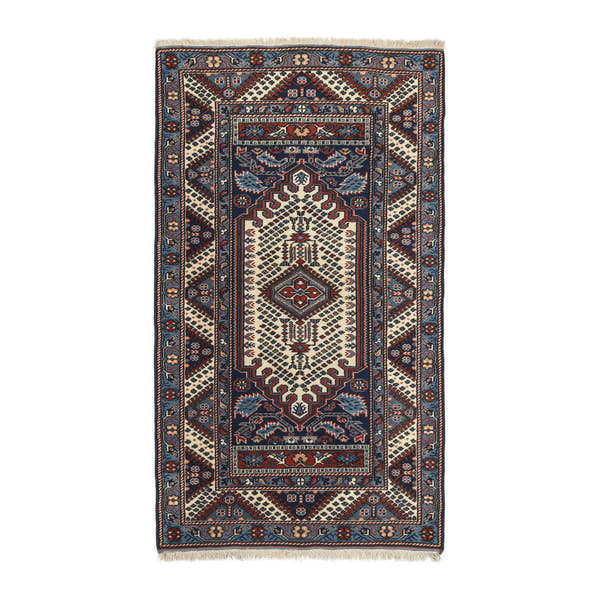
Two villages, Egridere and Alakir, make rugs with a white field instead and leave out black.[2] The rug in the pictures here, with its cream center inside a navy frame, sits closer to that lighter side of the family.

The niche at the center
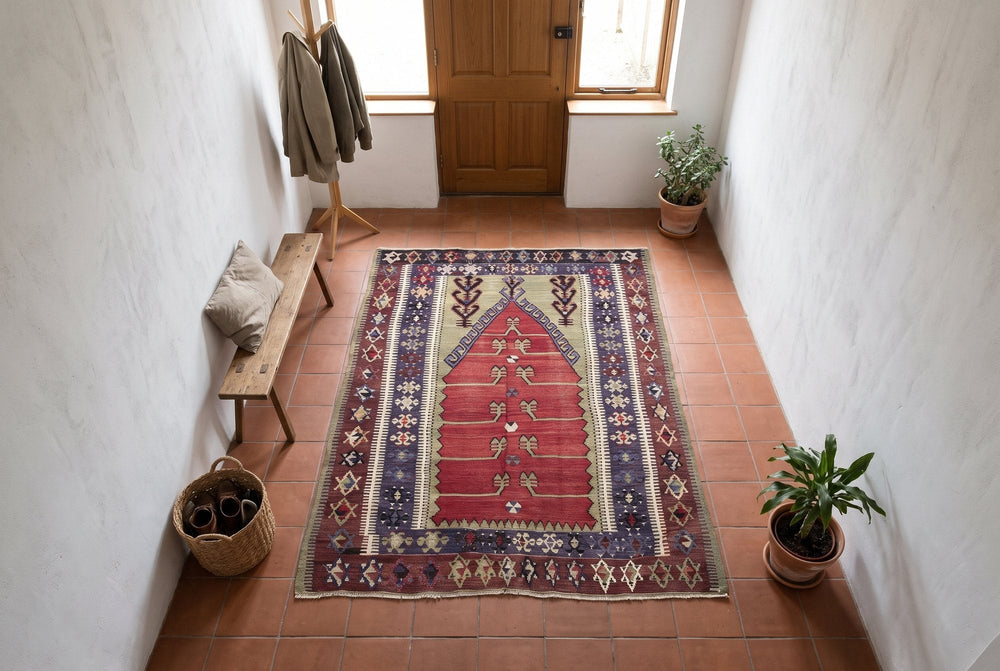
The registration describes a double-ended niche: stylized plant and geometric motifs spread over the surface so that a prayer niche points both ways, with its inside filled with geometric shapes.[4] The niche rises in steps, narrowing as it climbs, and meets in a point that looks like a hook.[1] Local weavers read the steps, usually thirteen of them, as a climb toward heaven.[2] The district office calls the niche the one motif no Yagcibedir rug goes without.[2]
Inside the field you will often find three stars.[2] The middle one stands for the sun and the other two for the moon.[2] Under the niche, three ram’s head motifs stand for the ram that leads the flock, and for strength.[2]
Borders have names too. The culture atlas sorts the rugs by motif into three groups: Karagoz, Heybe Sulu and Yedi Elli.[3] The Heybe Sulu border copies the pattern on the saddlebags the Yoruks’ horses carried.[2]
Sizes
Weavers make floor rugs, prayer rugs, runners, quarter rugs and saddlebags.[1] A prayer rug of this type measures about 120 by 215 centimeters.[1] A small prayer mat is about 50 by 90 centimeters.[1] Most pieces are small enough for a bedside, an entry or a study.
How to recognize a Yagcibedir rug
Look for a deep navy field, or sometimes a white one, with red and a little white and almost nothing else. Look for the stepped niche, often pointing both ways, and small stars in the field. Feel the pile: it is short and tight, so the drawing stays sharp. And look at the back. Fine wool and a dense knot show as small, even squares.
Rugs from Bergama, a short drive west, also lean on red and navy. Our Bergama guide shows how they differ, and the Manisa guide covers the neighboring province to the south.
Living with one
The district office says the colors of these rugs grow more beautiful with use.[2] It gives them a life of 150 to 200 years.[2] Short pile is easy to keep clean: vacuum without the beater bar, rotate the rug once or twice a year, and keep it out of hard afternoon sun. Our guide to cleaning a wool rug at home covers the rest.
You can see the rug from this guide on its product page, and more in the Turkish rugs collection. For the wider picture, read our ultimate guide to Turkish rugs and the Anatolian rugs guide.


Sources
- Yagcibedir carpets of the Sindirgi (Balikesir) area. Bekir Deniz, Erdem journal, Ataturk Culture Center.
- Culture: Yagcibedir. District Governorship of Sindirgi.
- Traditional folk arts of Balikesir. Kultur Portali, Ministry of Culture and Tourism of Turkey.
- Yagcibedir hand-woven carpet, geographical indication no. 17. Turkish Patent and Trademark Office, 1997.