Rug No. has found its new home.
Every rug we sell is one of a kind, so that piece is gone. Here are others in the same spirit, or tell Rug Finder what you are looking for.
Sanandaj Rugs
Sanandaj, historically Senneh, is the capital of Kurdistan province in western Persia and gives its name to one of the two main Persian knots. The rugs are fine, thin and precisely drawn.
They are usually small, and ours are mostly mats, with a few runners. Each one was knotted in the 1970s and exists in a single example.


Sanandaj: the town that named a knot
Sanandaj, historically Senneh, is the capital of Kurdistan province in western Persia, and it is the town that gave its name to the Senneh knot, the asymmetric knot used across much of Persia. That is a reasonable clue to what the rugs are like: precise, fine and thin, with drawing that stays crisp because the knots are small.
Sanandaj rugs are almost always small. The town wove for local use and for gifts rather than for European reception rooms, and the pieces that survive are mats, small rugs and short runners.
Signs of a Sanandaj
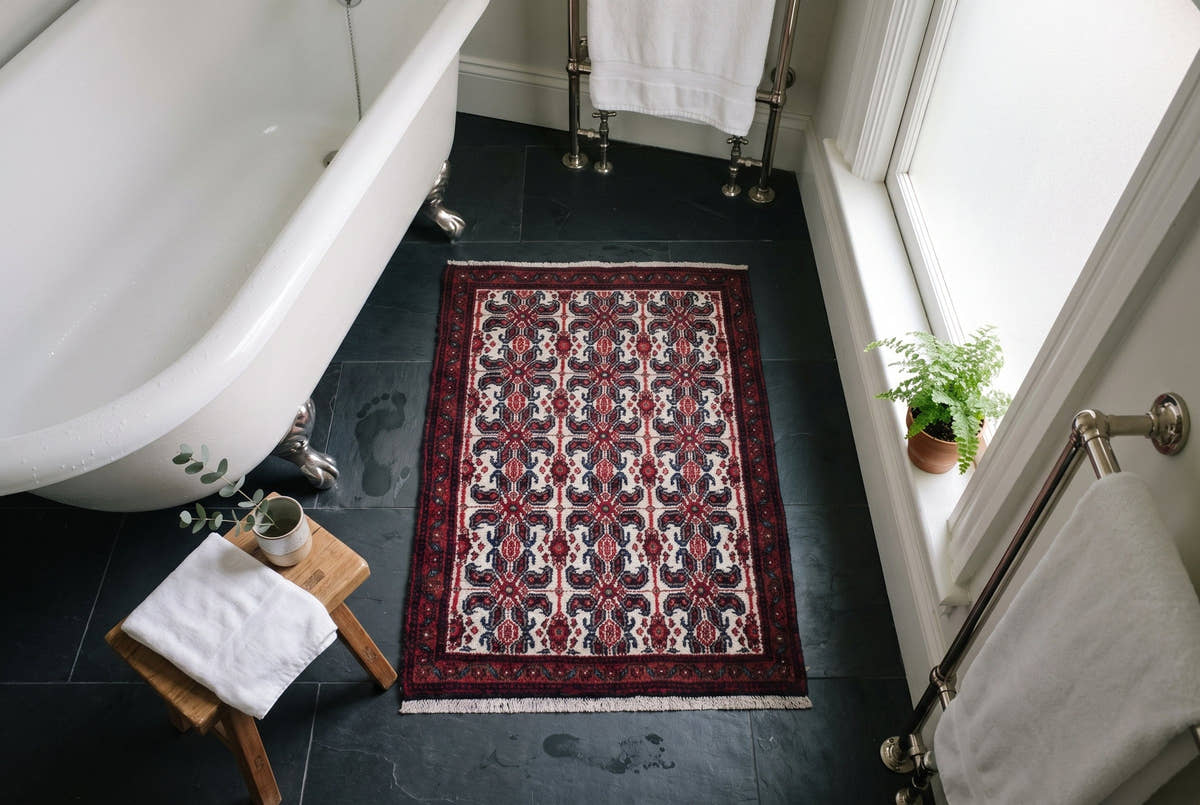
- Drawing: tight Herati fields, small repeating boteh, and finely drawn diamond medallions.
- Color: burgundy and dark brown or near-black grounds most often, with ivory and soft rose in the detail.
- Construction: fine knotting on a thin foundation; the back is smooth and the handle is flat like cloth.
- Sizes: accent sizes and runners in this collection.
Rugs to see up close
These are rugs for places where you look closely: a bedside, a study, a landing, a bathroom door. The drawing rewards being seen from a few feet away rather than across a room.
Their thinness also makes them easy to place under furniture legs and in tight doorways.
Senneh, Sanandaj, and the confusion
You will see both names. Senneh is the older name and remains the trade term for the rugs; Sanandaj is the modern name of the city. They are the same place, and neither is more correct than the other.
Sanandaj questions
Are all Persian rugs woven with a Senneh knot?
No. The Senneh knot is one of two main knots and is used across much of Persia, but by no means everywhere. Confusingly, Sanandaj rugs themselves are not always woven with it.
Why are they so small?
The town wove for domestic and ceremonial use rather than for large-scale export. Large Sanandaj pieces exist but they are uncommon.
Can they take daily traffic?
Reasonably, though the pile is short. They suit lighter traffic than a Heriz or a Bijar.
Choosing among them
Look at the fineness of the drawing and the ground color. These are pieces to live with closely, so choose the one you want to look at. All are vintage, roughly fifty years old, and not repeated. Our Sanandaj guide goes deeper into the Senneh name and the town’s weaving.