Eskisehir Kilims: Red Wool Kilims from Sivrihisar
In Sivrihisar, a town of Eskisehir province in central Turkey, the roof of the Great Mosque rests on 67 wooden columns.[6] The mosque dates from 1274, and the provincial culture office says fine examples of Sivrihisar kilim weaving can be seen inside.[7] In 2023 it joined the UNESCO World Heritage List as one of five medieval wooden mosques of Anatolia.[6] The kilims of Sivrihisar are mostly red, woven in wool and full of motifs with local names.[2] Some of those names come with a story, like the motif said to have cost a weaver her marriage.

Where Eskisehir kilims come from
Eskisehir has long been home to nomadic groups. Textile researchers Dilara Karayel and Servet Senem Ugurlu write that the province became home to the Karakecili, a nomadic group, after the 13th century, and that the Karakecili spread through the villages of Mihaliccik, Sivrihisar and Cifteler.[4] Weaving and other handwork in the region were made for the dowry chest.[4]

The tradition is old. A study of wolf’s mouth motifs in central Anatolian kilims includes a Sivrihisar kilim dated to the 18th century and several from the 19th.[3] Today Sivrihisar kilim is a registered geographical indication in Turkey, registered by the Sivrihisar Municipality in 2022 for kilims woven inside the district.[1]


How a Sivrihisar kilim is made
The registration describes kilims woven from sheep’s wool colored entirely with natural dyes, on upright wooden looms of hornbeam or pine about 250 by 190 centimeters.[1] In a survey of 44 Sivrihisar flat weaves, Ikbal Darcin and Fatma Nur Basaran found the weft yarns were all wool, with mostly wool warps and a little cotton in a few.[2]
Three kinds of flat weave come from Sivrihisar. The kilim proper is the largest, on average 156 by 315 centimeters with fringe about 6 centimeters long. Zili and cicim pieces, both woven with extra pattern yarns, are smaller, on average about 103 by 140 and 110 by 146 centimeters.[1] Within the kilims, Darcin and Basaran recorded curved wefts, outlined motifs and a weave without slits.[2]


How to recognize one
Start with the color. Red carries most of a Sivrihisar kilim, and shades of the same color often sit side by side.[2] The registration says red is the color used most for the geometric designs.[1]
Then look at the center and the borders. The registration names the kayik, the boat, as a motif used in every Sivrihisar kilim, in the center field.[1] Along the borders, look for a comb-like motif. A museum catalog from George Washington University calls it parmakli, fingered, and names Sivrihisar among the places where it turns up most.[5]
The motifs you will see
The geographical indication lists more than thirty motifs, and many carry a meaning or a story. These readings come from the registration; weavers did not leave a written key.[1]
- Gul budagi, the rose branch: a kilim with this motif was given to a new bride with the wish that her family would branch out wide, with many healthy children.
- Kavak, the poplar: its side arms are called fingers, the space in the middle the lake and the top the cap. It appears in both the borders and the center.
- Ayna, the mirror: read as unity, friendship and solidarity in the family, and woven in the center in outlined kilim technique.
- Kari bosatan, the wife divorcer: the story says it comes from Sivrihisar. A young weaver tried for days to weave it and failed, and her husband divorced her, saying he had no use for a woman who could not make so simple a motif. It looks like a slingshot or a letter Y and borders almost every zili kilim in the region.
- Ejderha, the dragon: stands for enmity. In the border it says the enemy is harmless; in the center, that the enemy is dangerous.
- Merdivenli, the ladder: read as reaching toward God and people helping each other toward goodness, and woven after the border, before the center begins.
- Coban iligi, the shepherd’s buttonhole: drawn in sharp lines from the letter S, and used in both borders and center.[1]
The five-chimney kilim
One Sivrihisar design has a name of its own. Darcin and Basaran call the bes bacali, five-chimney, kilim the most typical and best known weaving of Sivrihisar, past and present.[2] Karayel and Ugurlu describe it as a well-known prayer kilim particular to Sivrihisar.[4] They quote an earlier study by Altin, which reads it as the five stages of the Sufi path and the cleansing of the soul. It is also rare: of the 44 weavings Darcin and Basaran studied, only two were five-chimney kilims.[2]
The Eskisehir kilims we carry
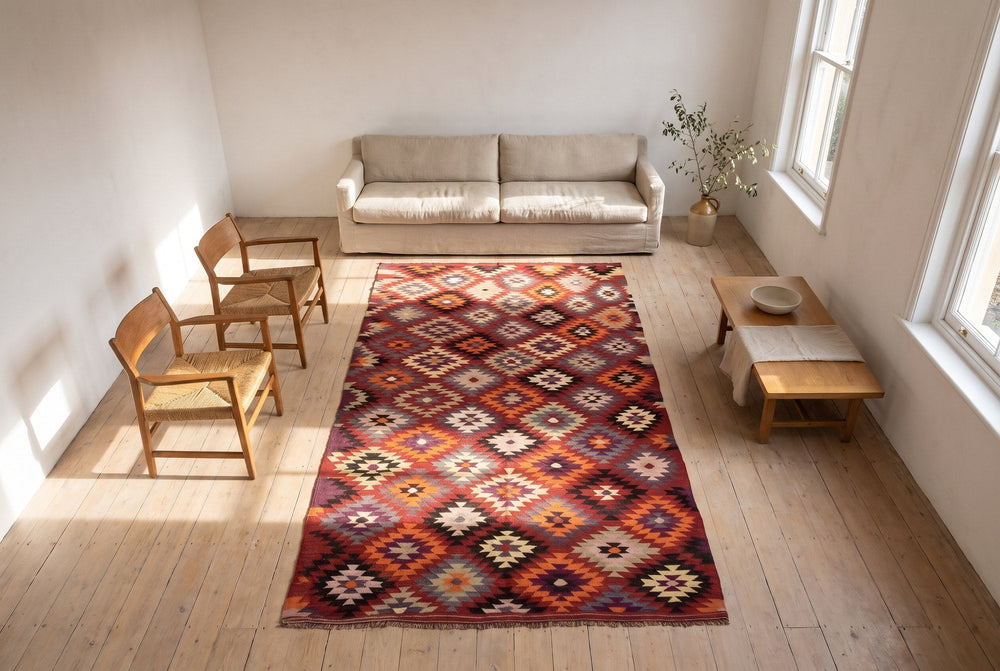
The Eskisehir kilims we carry are red-ground kilims of the kind described above. One is a brick red lattice of stepped diamonds in orange, cream, black, purple and gray; the other has yellow, sage and pink diamonds on a faded red field inside a wide gray blue border. They are flat-woven wool, about 40 to 60 years old, roughly 5 by 8½ and 6 by 8 feet, and priced from about $1,230 to $1,410. Each listing gives the exact size in feet and centimeters.
Living with an Eskisehir kilim
A red kilim brings warmth to a plain room without the height of a pile rug. Large pieces in the kilim proper’s long, generous proportions sit well under a dining table or in front of a sofa, and the smaller zili and cicim pieces suit a bedside or an entry. Because a kilim lies thin and close to the floor, it works under a door that swings or a chair that slides.
Care is simple. Vacuum it without a beater bar, turn it every few months so light and wear reach every side, and use a thin pad on a hard floor so it stays put. Our guide to cleaning a wool rug at home covers spills and stains.
Where to go next
For flat weaves in general, start with our guide to kilim rugs. The poplar, the mirror and the dragon have cousins across Anatolia, and reading a rug: motifs and what they mean explains the common ones. To see where a village weaving sits next to tribal and city rugs, read tribal, village and city rugs, and for the Turkish side of our catalog, the guide to Turkish rugs and the Anatolian rugs guide. You can browse all Turkish rugs and Anatolian rugs.
The kilims themselves are in the Eskisehir collection, and every flat weave we carry is in the kilim collection.


Sources
- Sivrihisar Kilimi, geographical indication no. 1077. Turkish Patent and Trademark Office, 2022.
- Eskisehir Ili Sivrihisar Ilcesi Duz Dokumalarinin Incelenmesi (A Study of the Flat Weaves of Sivrihisar, Eskisehir). Ikbal Darcin and Fatma Nur Basaran, Uluslararasi Folklor Akademi Dergisi, 2018.
- Evaluation of the Wolf Mouth Motif in the Central Anatolia Region Rugs. H. Sinem Sanli, Gozde Uzgidim and Gozde Kemer Gursoy, International Academic Social Resources Journal, 2021.
- Orme Teknigi Uzerine Bir Arastirma: Eskisehir Patik ve Motifleri (A Study on Knitting: Eskisehir Slippers and Their Motifs). Dilara Karayel and Servet Senem Ugurlu, Folklor Akademi Dergisi, 2024.
- A Nomad’s Art: Kilims of Anatolia. The George Washington University Museum and The Textile Museum, 2018.
- Sivrihisar Ulu Cami (The Great Mosque of Sivrihisar). Turkish Ministry of Culture and Tourism, Kultur Portali.
- Ulu Cami (Sivrihisar). Eskisehir Provincial Directorate of Culture and Tourism.


