Ferdos Rugs: Village Weaving from the Old Town of Tun

In 1052 the poet and traveler Nasir-i Khusraw passed through a walled town in the hills of eastern Persia and noted its carpets. The geographer Guy Le Strange, summing up his account, wrote that 400 looms were at work there at the time.[1] The town was called Tun. Today it is Ferdows, and the rugs woven in and around it reach the market as Ferdos rugs.
Every Ferdos rug we carry is a hand-knotted village piece in wool pile on a cotton foundation, most of them small enough for an entry, a bedside or a hallway. This guide covers where they come from, why the name on the label is broader than one town, the designs and colors to look for, and how to choose and care for one.

A weaving town in the desert hills
Ferdows lies in the old district of Kuhistan, the hill country of eastern Persia south of the great shrine city of Mashhad. Writing in 1913, the collector Walter Hawley described the province of Khorasan around it as mountain pasture in the north and, beyond that, almost entirely a desert, with the exception of scattered oases, where small towns and villages are located.[2] Tun was one of those oases.
Its weaving goes back a long way. The historian R. B. Serjeant, collecting what medieval Arab geographers wrote about textiles, found that the tenth century writer Makdisi knew of carpets coming from Kuhistan.[3] Makdisi also recorded that Tun itself had many weavers and workers in wool.[3] Serjeant translates Nasir-i Khusraw as saying there were four hundred workshops in the town weaving rugs.[3]
Hawley knew the same story. He wrote that even before the Mongol invasion several hundred looms, each with four or five women at work, were busy in the town of Toon in Central Khorasan.[2] Le Strange adds that woolen goods were made there and that the town stood around a great fort.[1] None of the rugs on the market today is that old, but the craft has deep roots in this corner of Khorasan.
What the name Ferdos means on a rug
A Ferdos label tells you the market a rug came through, and not always the village that wove it. A 2022 study of rugs from Bushrouyeh, a neighboring district, found that they have always been sold under the name of Ferdows, the neighboring city.[4] So a Ferdos rug may come from the town, from Bushrouyeh, or from the villages around both.
The same study gives a good picture of this kind of weaving. It describes the traditional rugs of Bushrouyeh as rustic village pieces, woven narrow and long.[4] Usually one weaver did everything, from preparing the wool and tools to dyeing, setting up the warp and weaving.[4] Its designs were borrowed from other weaving regions, among them Turkmen and Arab patterns, and medallion designs were the most common of all.[4]

The designs you will see
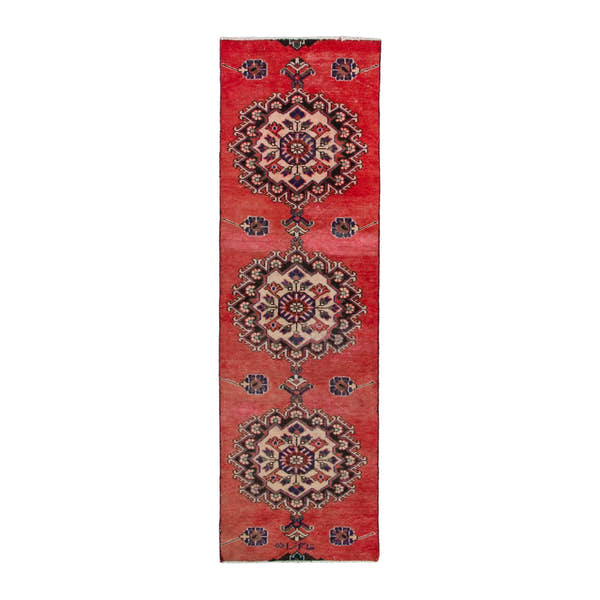
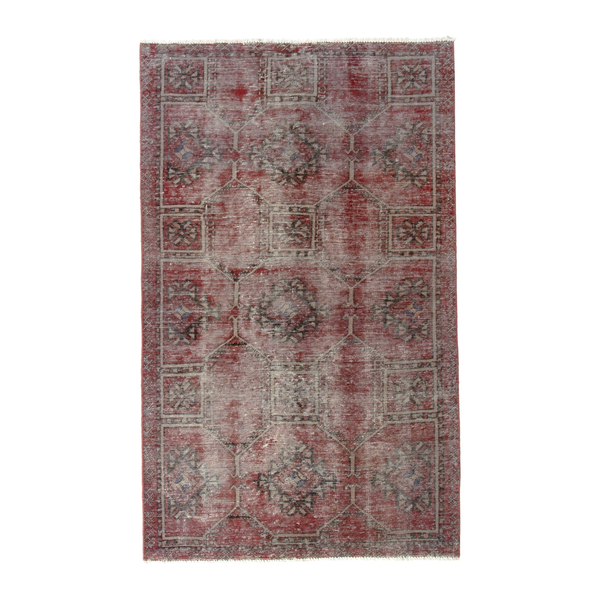
That mix of borrowed patterns is easy to see in the Ferdos rugs we carry. The most common plan is a column of medallions down the field, two, three or five stepped diamonds or hexagons, each with a dark core and small hooked edges. Others repeat rows of octagonal guls, the eight-sided motif of Turkmen weaving, in brown or near-black on a red ground. A few have small boteh, the paisley leaf-drop, scattered over cream, or columns of stylized figures, and one or two carry sprays of flowers in a looser, more town-like hand.
Borders are simple and strong: a band of small rosettes, crosses or a hooked vine between narrow guard stripes. The drawing is geometric and a little irregular, the way a village weaver works from memory rather than from a paper cartoon.
Colors and wear
Red leads. Most of our Ferdos rugs have a deep red, burgundy or faded red field, set against near-black, brown, charcoal and cream, with small touches of blue, orange or gold. A few are cream or gray beige, which gives the dark medallions more room.
These rugs were made for daily use, and many show it. On several the pile has worn low in the center, so the red turns soft and pale and the cotton foundation shows through in places. Each listing describes the wear in plain words and shows the rug in several photos, so you can choose a crisp piece or one with the softened look that only years on a floor can give.

Sizes and prices
Ferdos rugs are mostly small. Most of ours are about 3½ by 6 feet to 4 by 7 feet, sizes that suit an entry, the side of a bed or a spot in front of a chair. There are long runners of about 2½ to 3½ feet by 9 to 11 feet for halls, a handful of tiny mats near 2 by 3 feet, and a few larger pieces up to about 8 by 11 feet for a dining or sitting room.
All are listed at about 50 years old, woven around the 1970s. Prices run from about $210 for the smallest pieces to about $2,400 for the largest, with most between about $300 and $700. Each listing gives the exact size in feet and centimeters.
Living with a Ferdos rug
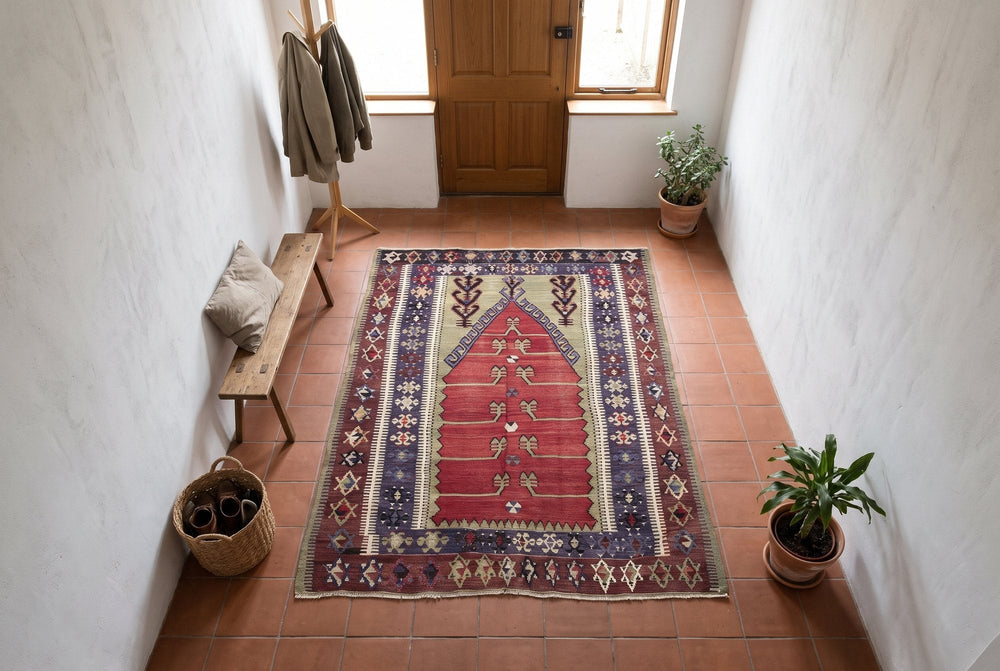
A Ferdos rug is easy to place. The red and near-black palette sits well with warm wood, white walls and leather, and a runner with a column of medallions draws the eye down a hallway. Because many are small, they also layer well over a larger plain rug or a sisal mat.
Care is simple. The Canadian Conservation Institute advises turning rugs from time to time so that they wear evenly.[5] It also warns that light dries out the fibers and fades colors, so keep a rug out of strong direct sun where you can.[5] Vacuum with a plain head and low suction, never a beater bar.[5]
Where to go next
Browse every piece in the Ferdos collection, or all of our Persian rugs. For the finer town rugs of the same province, read our guides to Birjand rugs, Kashmar rugs and Mashhad rugs. The octagonal guls come from Turkmen weaving, which our Torkaman rugs guide explains, and the guide to Persian rugs covers the wider family.


Sources
- The Lands of the Eastern Caliphate. G. Le Strange, Cambridge University Press, via Internet Archive, 1905.
- Oriental Rugs, Antique and Modern. Walter A. Hawley, Project Gutenberg, 1913.
- Material for a History of Islamic Textiles up to the Mongol Conquest. R. B. Serjeant, Ars Islamica vols. 11-12, via Internet Archive, 1946.
- Identification of Bushrouyeh Carpet and Analysis of Structural Characteristics. A. Abdollahzadeh Moqaddam, M. Soltani and M. R. Kheirollahi, University of Kashan, 2022.
- Basic care: Carpets and rugs. Canadian Conservation Institute.