A Pirot weaver never sees the whole kilim she is making. She kneels at the loom, packs down the weft with one tool, a beater called the tupica, and turns the loom from time to time, so she has to carry the design in her head.[3] A Sarkoy kilim is a flat-woven rug in the style of Pirot, a town in southeastern Serbia that Ottoman sources called Sarkoy or Sehirkoy.[1] Sarkoy kilims are woven in wool on an upright loom, with both faces the same, and red is their main color, in several shades.[4] Look for small lizards, birds and scorpions among the geometric shapes.

Where Sarkoy kilims come from

Pirot sits on the old road between Belgrade, Sofia and Istanbul. Historian Machiel Kiel, writing in the encyclopedia of Turkey’s religious affairs foundation, notes that the town was famous for its sheep, its cheese and above all its Sarkoy kilims.[1]
The kilims carry clues to where the craft came from. Kiel points out motifs from western Anatolia, from Usak, in Sarkoy kilims, and suggests they hint at where the town’s first settlers came from.[1] He adds that the terms used in kilim weaving there are Turkish.[1]
The kilims also traveled the other way. A Sarkoy kilim of 154 by 106 centimeters in the collection of Turkey’s General Directorate of Foundations came from the Green Mosque in Bursa.[5]
A living craft
Written reports of kilim weaving in Pirot go back to the 18th century, and 19th-century accounts describe Pirot kilims as fine, densely woven and highly prized.[4] The craft became an industry. According to Serbia’s Intellectual Property Office, Pirot kilims won top awards at the world’s fairs in Lyon in 1894 and Liege in 1905.[3] Kiel records that around 1,800 people in the town were still weaving kilims in the 1960s.[1]
In 2012 kilim weaving in Pirot was entered in Serbia’s national register of intangible cultural heritage.[2]
Sarkoy kilims in Turkey
The name traveled with the people who wove the kilims. A Turkish newspaper report on the craft describes the Sarkoy kilim as a weaving shaped by Ottoman and Islamic influence and kept alive above all by Turks living in Greece and Bulgaria.[6] In the Sultan Murad II Mosque in Macedonia, a study of the kilims found that the Sarkoy style dominates their designs.[7]
In Turkey the tradition has a home in another Sarkoy, a town on the Sea of Marmara in Tekirdag province. One of the weaving teachers there told the paper that her family came from Bulgaria in the population exchange, and that she learned from her grandmother.[6] In the early 2000s, old Sarkoy kilims were brought out of mothers’ and grandmothers’ dowry chests to be copied.[6] Since 2017, with looms given by the Tekirdag municipality, the town’s public education center has taught many women to weave them.[6] They still weave in sheep’s wool.[6]
How a Sarkoy kilim is woven
A Pirot kilim is woven on an upright loom as a flat weave, where colored wefts build the pattern and hide the warp.[2] The warp is white wool from the local pramenka sheep, and a standard kilim of 1.4 by 2 meters takes the fleece of at least nine of them.[3]
The work is slow: the Intellectual Property Office puts it at about 176 hours for 0.8 square meters.[3]
How to recognize one
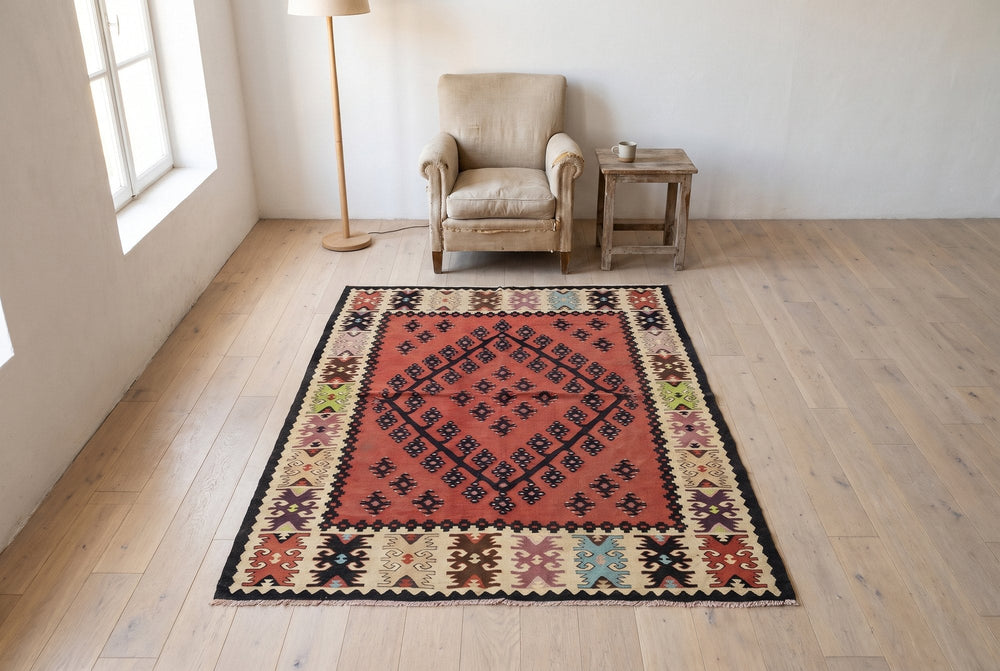
Start with the color. Red dominates, in several shades.[2] Then look at the layout: geometric, plant and animal ornaments set in a central field inside a system of borders.[2]
The small figures are the best clue. Serbia’s heritage register names lizards, birds, scorpions, stag beetles and doves as the most common animal figures, and branched trees, roses and wreaths as the most common plant forms.[2] Scale helps with age: on older kilims the ornaments are smaller and spread more harmoniously, while newer pieces have larger ornaments.[2] Finally, turn it over. A Pirot kilim has two faces of equal quality.[3]

Sizes
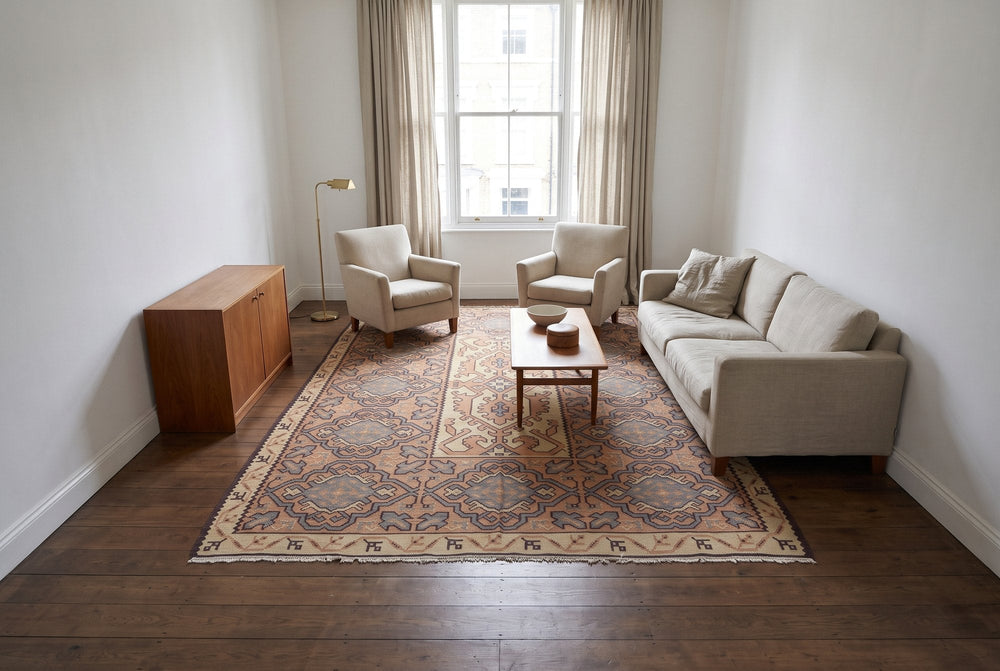
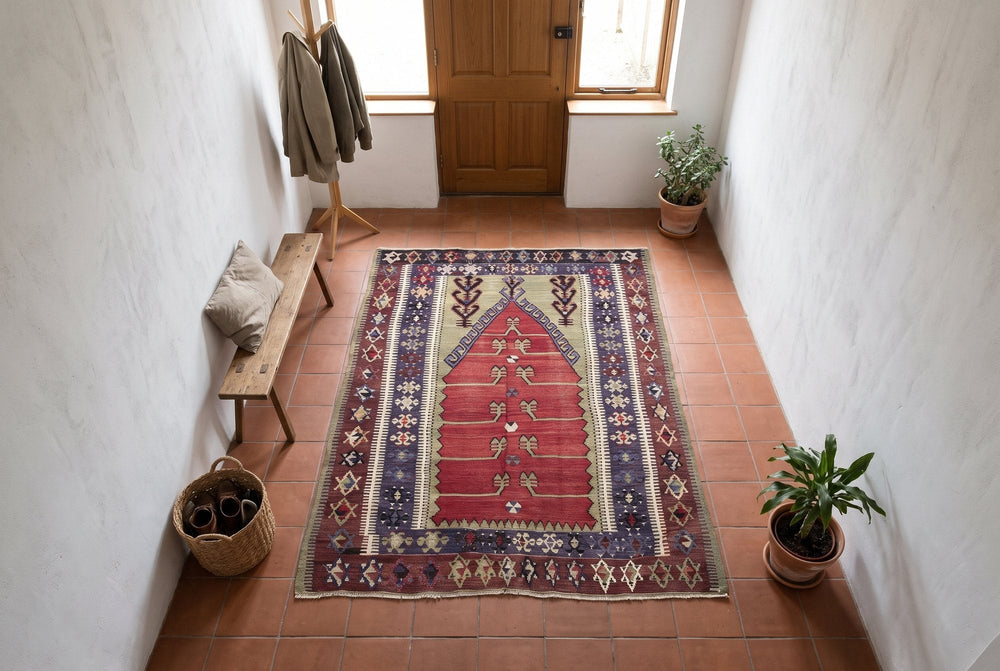
Serbia’s Intellectual Property Office gives the standard Pirot kilim as 1.4 by 2 meters, about 4 feet 7 inches by 6 feet 7 inches.[3] The Sarkoy kilim in the pictures here is close to square, 4 feet 3 inches by 4 feet 11 inches, a size that fits an entry, the end of a bed or a wall. You can see it on its product page.
Living with a Sarkoy kilim
In Pirot these kilims covered floors, walls, beds and benches, and served as tablecloths and curtains.[4] That range still works: a Sarkoy kilim lies thin on a floor, hangs well on a wall and drapes over a bench or the end of a bed. Its reds sit well with white walls and pale wood, and its small figures reward a close look.

Care is simple. Vacuum it without a beater bar, turn it every few months so light and wear reach every side, and use a thin pad on a hard floor so it stays put. Our guide to cleaning a wool rug at home covers spills and stains.
Where to go next
For flat weaves in general, start with our guide to kilim rugs. Birds, trees and scorpions have cousins across Anatolia, and reading a rug: motifs and what they mean explains the common motifs. To see where a town weaving sits next to village and tribal work, read tribal, village and city rugs, and for the Turkish side of our catalog, the guide to Turkish rugs and the Anatolian rugs guide. You can browse all Turkish rugs and Anatolian rugs.
Our Sarkoy kilims are gathered in the Sarkoy collection, and flat weaves from across Turkey are in the kilim collection.


Sources
- Sehirkoy. Machiel Kiel, TDV Islam Ansiklopedisi.
- Rug-making in Pirot. National Register of Intangible Cultural Heritage, Center for the Intangible Cultural Heritage of Serbia.
- Securing Serbia’s cultural heritage: the case of “Kilim of Pirot”. Intellectual Property Office of the Republic of Serbia, 2022.
- Rug-making in Pirot. Regional Center for the Safeguarding of Intangible Cultural Heritage in South-Eastern Europe under the auspices of UNESCO, 2021.
- Vakiflar Genel Mudurlugu Hali-Kilim Koleksiyonu (The Carpet and Kilim Collection of the General Directorate of Foundations). Suzan Bayraktaroglu, Aris, 1997.
- Historic Sarkoy kilims shown at the Public Education Center exhibition. Sabah, 2025.
- An example of Turkish cultural heritage in the Balkans: the Sultan Murad II Mosque in Macedonia. Ahmet Aytac, Mubadele ve Balkan Turk Kulturu Arastirmalari, 2008.